

Electronic signatures are legally valid and enforceable in Spain under Regulation (EU) No 910/2014 (eIDAS) and Law 6/2020. A qualified electronic signature carries the same legal weight as a handwritten one. For the full picture, check the official texts on the BOE, the government’s firmaelectronica.gob.es portal, and the EU Trusted Lists before you sign anything important.
TL;DR:
- Simple signatures suit low risk acknowledgments; advanced signatures fit business and rental agreements, while qualified signatures suit filings, formal acts, and important contracts.
- Tax and social security filings generally require a qualified certificate; local offices may add technical rules, so confirm acceptance with the receiving administration first.
- Only natural persons can hold signature certificates, so a company must use an electronic seal or have a representative sign with their own qualified certificate.
- For future disputes, retain the signed file, metadata, certificate chain, and trusted timestamp together, and verify certificate revocation status when authenticity is challenged.
- A qualified signature from another EU state is recognized in Spain, but non EU signatures lack automatic equivalence, so confirm acceptance with the counterparty.
Table of Contents
- Spain’s Legal Framework: How eIDAS and Law 6/2020 Set the Rules
- Types of Electronic Signatures in Spain: Simple, Advanced, Qualified
- When a Qualified Signature Is Required or Strongly Recommended
- How to Get, Renew and Revoke a Qualified Certificate in Spain
- Validating and Preserving E-Signatures: Trusted Lists, VALIDe and Timestamps
- How EuroCheckin Applies eIDAS-Compliant E-Signatures in Guest Registration
- Cross-Border Contracts Involving Spain: Does the Signature Still Hold?
- Disputes Over Signature Authenticity: What Spanish Courts Look For
- Which Signature Level Fits Your Situation
- EuroCheckin: Compliant Digital Contracts for Spanish Hosts
- FAQ
- Sources
Spain’s Legal Framework: How eIDAS and Law 6/2020 Set the Rules
We start from one principle: an electronic signature cannot be denied legal effect or kept out of court simply because it is not on paper. That rule comes directly from eIDAS, the EU regulation that applies in Spain and across the bloc. It sets the baseline, and it means a judge cannot dismiss an electronic signature on form alone.
Spain built on that baseline with Law 6/2020, published in the BOE, which regulates electronic trust services at the national level. This law covers how qualified trust service providers operate in Spain, how they are supervised, and how qualified certificates are issued and managed. It fills in the practical detail that eIDAS leaves to member states.
Put the two together and you get a clear hierarchy of legal consequences:
- A qualified electronic signature is automatically treated as equivalent to a handwritten signature, with no extra proof needed.
- A simple or advanced electronic signature is admissible in court, but its evidentiary weight depends on the context and how well you can demonstrate who signed and that the document was not altered.
- Public administrations and courts in Spain cannot reject electronic evidence solely because it lacks an ink signature.
If you want the primary legal language rather than a summary, the BOE publishes the full text of Law 6/2020, and firmaelectronica.gob.es offers plain-language explanations aimed at businesses and citizens. Both are worth bookmarking if you handle contracts regularly.
Types of Electronic Signatures in Spain: Simple, Advanced, Qualified
Not every electronic signature carries the same legal force. Spanish law, following eIDAS, recognizes three levels, and knowing which one you are using matters more than most hosts and small business owners realize.
A simple electronic signature is the lightest form: a typed name, a scanned signature image, or a click-to-accept checkbox. It works for low-risk situations such as newsletter sign-ups, internal acknowledgments, or informal confirmations where a dispute is unlikely.
An advanced electronic signature adds real technical assurances. It is uniquely linked to the signer, created using data the signer can control, and capable of detecting any later change to the document. This level fits most everyday business contracts, supplier agreements, and employment paperwork.
A qualified electronic signature sits at the top. It requires a certificate issued by a Qualified Trust Service Provider listed on the EU Trusted Lists, created with a qualified signature creation device that protects the private key. Because of that extra verification layer, Spanish law treats it as automatically equivalent to a handwritten signature, with no further proof of authenticity required.
- Simple: low-stakes acknowledgments, internal forms.
- Advanced: commercial contracts, vendor agreements, rental terms.
- Qualified: tax filings, notarial-equivalent acts, formal dealings with public administration.
Only natural persons can hold signature certificates under the eIDAS and Law 6/2020 framework; companies and other legal entities instead use electronic seals, or a representative signs on the entity’s behalf.
When a Qualified Signature Is Required or Strongly Recommended
Certain procedures in Spain leave no room for a lighter signature. Filing with tax authorities, submitting documents through many public administration portals, and acts that would otherwise require notarization typically call for a qualified electronic signature or its equivalent, a recognized citizen certificate.
Representation adds another layer. Since only natural persons hold signature certificates, a company acting through an employee or legal representative needs that person’s own qualified certificate, or an electronic seal issued to the entity itself. This distinction trips up a lot of small business owners who assume a company can simply “have” a digital signature the way it has a bank account.
- Procedures with the Agencia Tributaria or Seguridad Social generally expect a qualified certificate.
- Court filings and many notarial-adjacent acts favor or require qualified signatures.
- Standard commercial contracts between private parties usually work fine with an advanced signature.
- Local or regional administrations sometimes add their own technical requirements on top of the national baseline.
Because that last point varies by office, confirm acceptance criteria with the specific administration or counterparty before you commit to a signature method, especially for anything with legal or financial consequences.
Pro Tip: When a contract involves a deposit, a lease, or any act you might need to prove in court later, default to a qualified signature rather than guessing which level will hold up.
How to Get, Renew and Revoke a Qualified Certificate in Spain
Getting a qualified certificate is a defined process, and it follows the same basic steps regardless of which provider you choose.
- Find a Qualified Trust Service Provider through the EU Trusted Lists browser, which shows every provider authorized to issue qualified certificates in Spain and across the EU.
- Verify your identity with the provider, typically in person or through an equivalent remote identification method the provider has been authorized to use.
- Receive your certificate and signature creation device, following the eIDAS portal’s guidance on protecting the private key with a qualified device.
- Track your renewal window. Spanish providers such as FNMT typically issue certificates with a set validity period, and firmaelectronica.gob.es recommends renewing before expiration rather than after, since an expired certificate cannot sign validly.
- Revoke immediately if compromised. Report loss, theft, or suspected compromise to your issuing provider without delay so the certificate is added to the revocation list and cannot be misused.
Each provider publishes its own renewal and revocation channels, so check the specific process with whoever issued your certificate rather than assuming a single national procedure applies to all of them.
Validating and Preserving E-Signatures: Trusted Lists, VALIDe and Timestamps
Signing a document is only half the job. You also need a way to prove, months or years later, that the signature was valid when it was made.
Start with the EU Trusted Lists browser to confirm a provider’s qualified status, and use Spain’s VALIDe service to check a specific certificate or signature. Both tools let you or a counterparty verify a signature’s standing without taking anyone’s word for it.
- Keep the signed document, the signature container with its metadata, the certificate chain, and a trusted timestamp together as one package.
- Check the certificate’s revocation status whenever a signature’s authenticity is questioned, since a revoked certificate at the time of signing changes the legal picture entirely.
- Rely on timestamping to fix the exact moment of signing, which matters if a certificate is later revoked or expires.
Long-term preservation formats matter more than people expect. Firmaelectronica.gob.es notes that the national interoperability and security schemes reference specific formats and retention practices precisely because a signature that looked valid at signing can become hard to verify years later without the right archive.
How EuroCheckin Applies eIDAS-Compliant E-Signatures in Guest Registration
For property owners and hotels, rental agreements and house rules are exactly the kind of document that benefits from a properly executed electronic signature. Digital contracts can allow guests to sign rental terms electronically as part of check-in, while guest data moves automatically to SES Hospedajes and can be hosted within EU infrastructure.
Hosts should bring e-signatures into the check-in flow whenever a rental agreement sets rules, deposits, or liability terms, since a signed digital contract gives both sides a record that holds up if a dispute arises later. For hosts managing several properties, we see this step shift from optional to standard practice once volume makes manual paperwork impractical.
Cross-Border Contracts Involving Spain: Does the Signature Still Hold?
A signature valid under eIDAS does not stop being valid at the border. Because eIDAS is an EU regulation, not a national law, a qualified electronic signature created in one member state is recognized throughout the EU, Spain included. A French qualified certificate used to sign a lease with a Spanish property owner carries the same legal standing as one issued by a Spanish provider.
The practical complication shows up with signatories or counterparties outside the EU. eIDAS governs recognition within the EU and EEA; a signature from a non-EU qualified provider may still be accepted in Spain, but it depends on mutual recognition agreements or on the receiving party’s own risk assessment, since it falls outside the automatic qualified-equivalent rule. For contracts with parties outside the EU, an advanced signature backed by solid identity verification and a clear audit trail often serves better than assuming a foreign “qualified” label will be read the same way on arrival.
For hosts dealing with international guests or owners based abroad, the safest approach is straightforward: use a qualified signature for the Spanish party whenever the contract has real legal weight, and confirm with the foreign counterparty how their jurisdiction treats the signature type they plan to use. When in doubt on a cross-border deal, a qualified Spanish certificate paired with a timestamp and a clear retained certificate chain gives you the strongest footing if the agreement is ever challenged.

Disputes Over Signature Authenticity: What Spanish Courts Look For
When a Spanish court is asked to decide whether an electronic signature is genuine, it does not start from suspicion. Under eIDAS, the starting position is that electronic form alone is never grounds for rejection, so the real fight in a dispute is almost always about evidence, not format.
For a simple or advanced signature, the party relying on it typically needs to show who signed, that the signing data was under that person’s control, and that the document was not altered afterward. That is where saved metadata, timestamps, and a complete certificate chain stop being a formality and become the proof that decides the case. A qualified signature skips most of this burden, because the law already presumes it is equivalent to handwritten, shifting the challenge to whoever wants to dispute it.
Local administrations occasionally impose their own additional technical requirements for documents they accept, so a signature that works perfectly for one agency’s internal rules is not automatically guaranteed to satisfy another’s. That variability is exactly why we recommend confirming acceptance with the specific receiving administration before relying on any single signature method for something formal.
Which Signature Level Fits Your Situation
Our own rule of thumb: match the signature to the stakes. Low-risk acknowledgments call for a simple signature. Everyday business agreements, vendor terms, and rental contracts fit an advanced signature. Anything formal, representative, or administrative deserves a qualified signature, and you should always confirm acceptance with the receiving authority first.
When a transaction involves meaningful money, a legal representative, or a public body, choose qualified by default rather than guessing. The small extra step costs less than a dispute later.
— Sofía Herrera
EuroCheckin: Compliant Digital Contracts for Spanish Hosts
Rental agreements signed on paper and filed by hand cost time you do not get back, and a missed SES Hospedajes report risks a fine you did not budget for. We built EuroCheckin so hosts and hotels in Spain handle both at once: digital contracts with e-signatures tied to check-in, automatic guest data submission to SES Hospedajes, multilingual forms for international guests, and data hosted within EU infrastructure throughout.
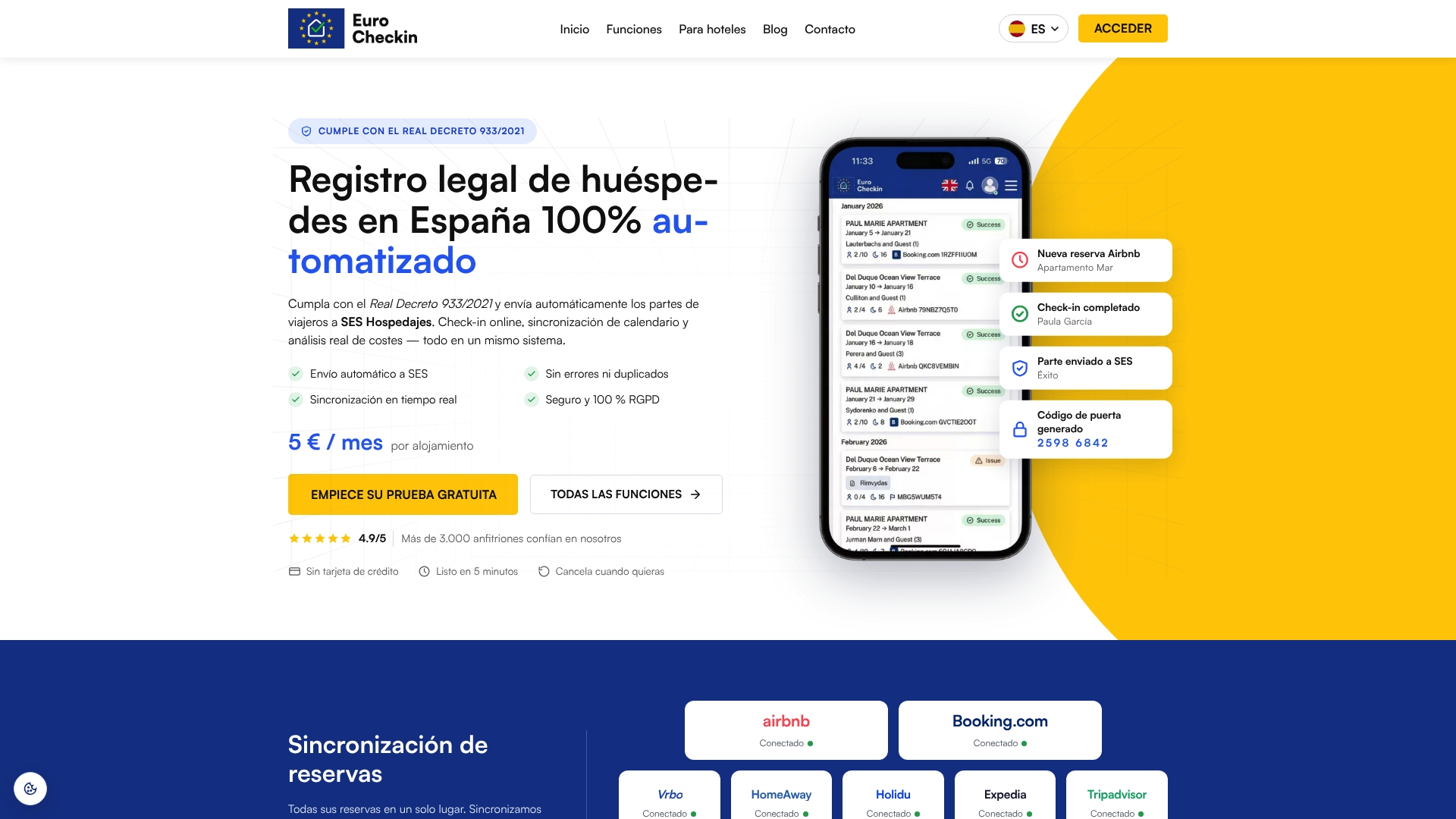
Plans run from €5 per month per accommodation for individual hosts and property managers, or €3 per month per room for hotels, with a free trial to see the workflow before you commit. If you would rather have the registration itself handled for you, our SES Hospedajes registration service starts from €79 one off per property. Start your free trial at Eurocheckin and get your first guest contract signed the same day.
FAQ
What Is a Qualified Digital Signature?
A qualified digital signature is the highest level of electronic signature under eIDAS, created with a certificate from a Qualified Trust Service Provider and a qualified signature creation device. Spanish law treats it as automatically equivalent to a handwritten signature, with no extra proof needed in court.
How Do I Renew My Digital Certificate in Spain?
You renew through the same qualified provider that issued your original certificate, ideally before the expiration date listed on it. Firmaelectronica.gob.es recommends starting renewal ahead of the deadline, since a certificate that has already expired cannot be used to sign validly.
How Do I Get My Digital Signature?
Choose a Qualified Trust Service Provider listed on the EU Trusted Lists, complete the required identity verification, and receive your certificate along with a qualified signature creation device. The eIDAS portal walks through the full procurement process step by step.
Is an Electronic Signature Illegal in Spain?
No. Electronic signatures are explicitly legal in Spain under eIDAS and Law 6/2020, and electronic form alone can never be grounds to deny a signature’s legal effect. The level of protection you get, simple, advanced, or qualified, depends on the method used, not on whether electronic signing itself is permitted.
Sources
- Firmaelectronica
- EU Trusted Lists (TL browser)
- How to procure a qualified certificate (eIDAS portal)