



Most check-in software falls into three pricing shapes: per property, per check-in volume, or per ticket for event use. Headline prices rarely include payment-processing fees, onboarding, or optional modules like OCR or smart-lock integration. Before you sign anything, ask each vendor for a written, itemized quote that shows the total annual cost per accommodation or per event, not just the number on the pricing page.
TL;DR:
- Per-property pricing benefits steady-occupancy portfolios but discounts typically only apply at larger scales, such as 30 units or more.
- Volume or check-in based pricing suits seasonal or irregular operations but results in less predictable costs during peak periods.
- Additional features like OCR, smart-locks, and automated reporting often significantly increase the overall price and should be weighed against time savings.
- Written, itemized quotes are essential to accurately compare total annual costs, including onboarding, transaction fees, and optional modules.
- Support levels and contract terms, including cancellation and minimum property counts, can substantially affect the final cost and flexibility.
Table of Contents
- Pricing models explained: per property, per check-in, per ticket, or flat fee
- What drives price: features, integrations, and compliance work
- Typical price examples and how to normalize the numbers
- How to compare vendors: exact questions to ask and a written-quote checklist
- Billing cadence and discounts: monthly versus annual plans
- Free tiers, trials, and pay-as-you-go options
- Cost impact of customer support and service tiers
- Pricing comparison benchmarks across leading vendors
- Contract terms affecting pricing: length, minimums, and cancellation
- Procurement mistakes and how to avoid them
- Why EuroCheckin can lower your total cost and simplify compliance
- Sources
- FAQ
Pricing models explained: per property, per check-in, per ticket, or flat fee
Vendors structure their pricing around how you operate, so the right model depends on your occupancy pattern and portfolio size.
Per-property pricing charges a flat monthly or annual fee for each accommodation you manage, regardless of how many guests check in. This model suits hotels, aparthotels, and portfolios with steady occupancy, because the cost stays predictable even during high season. Vendors commonly offer per-unit discounts as your portfolio grows: a manager with 30 properties typically pays less per unit than someone with three.
Per-check-in or volume-based pricing charges you for each guest registration processed. This works better for seasonal hosts or properties with irregular occupancy, since you only pay when you actually have guests. The tradeoff is less predictability: a busy summer month can cost far more than a quiet winter one.
Per-ticket pricing, common in event check-in software, charges a small fee per attendee, sometimes a flat amount plus a percentage. This directly affects event margins, since a fee on every ticket sold adds up fast at scale.
Flat enterprise or white-label agreements suit large portfolios or hotel chains that need custom integrations. These are usually negotiated directly rather than listed publicly, and vendors expect longer contract terms in exchange for a lower per-unit rate.
- Per-property pricing fits steady-occupancy portfolios and scales with volume discounts.
- Per-check-in pricing fits seasonal or low-occupancy operators.
- Per-ticket pricing fits events, where transaction fees shape your real margin.
- Flat enterprise deals fit large portfolios that need custom terms.
What drives price: features, integrations, and compliance work
Not every paid feature earns its cost. Some genuinely reduce manual work; others just add a line to your invoice.
Features that commonly raise price include OCR document capture for passports and ID cards, automated reporting to government registries, smart-lock integration for self check-in, payment gateway support for guest upsells, e-signature tools for digital contracts, and multilingual guest communication. Each solves a specific operational problem, so weigh the cost against the hours it actually saves you.
Integration and onboarding costs sit separately from the subscription fee. Syncing with your property management system, custom API work, and staff training are sometimes billed as one-time setup fees and sometimes folded into a recurring rate. Ask which applies before you sign.
Compliance capabilities deserve particular attention. Vendors must document where guest data is stored, who acts as data controller versus processor, and how they support deletion and rectification requests. A Spanish data protection authority decision found that OCR capture and photo retention during check-in are acceptable when limited to the stay period and protected by access controls, but this depends entirely on the vendor documenting those limits in writing.
- OCR, smart-lock integration, and automated reporting typically carry the highest added cost.
- Onboarding and API work may be billed once or spread across your subscription.
- Compliance documentation raises vendor price but lowers your legal exposure.
Pro Tip: Ask for the compliance documentation before the demo, not after you have already picked a favorite.
Typical price examples and how to normalize the numbers
Comparing headline prices across vendors tells you almost nothing until you convert each quote into an annual total per unit.
- Single host, one property: expect a low monthly base fee, plus a possible per-check-in charge if the vendor uses volume pricing.
- Small manager, 5 to 10 units: per-property pricing usually applies here, often with a modest per-unit discount once you cross a small threshold.
- Medium portfolio, 30 or more units: volume discounts become significant, and vendors are more open to negotiating flat or tiered enterprise rates.
- Event organizer: per-ticket fees dominate, so your real cost scales with attendance rather than with a fixed monthly charge.
To normalize any quote, add these five figures into one annual total per accommodation: the base subscription cost, adjusted for its billing period, any per-unit fees, transaction or payment-processing fees, one-time onboarding costs, and optional modules you actually plan to use. Year two drops to $122 once onboarding is paid off. That kind of math is the only fair way to compare two vendors with different pricing shapes.
How to compare vendors: exact questions to ask and a written-quote checklist
A verbal quote or a pricing page screenshot is not enough to make a real decision. Request a written proposal that itemizes every cost component before you compare options.
Ask each vendor to confirm in writing: the base price and billing period, what is included at that price, per-unit or add-on fees, transaction fees on payments, any minimum spends, setup or onboarding fees, contract length, and cancellation terms. HotelTechUpdate notes that published starting prices frequently leave out module costs, billing cadence, and transaction fees, which is exactly why a normalized total-cost sheet matters more than a headline number.
On the compliance side, ask whether the vendor acts as data controller or processor, how long guest data is retained, whether you can export your data on request, how deletion requests are handled, and whether you retain audit rights over their processes. Real Decreto 933/2021 requires accommodation providers to keep a traveler registration record and report certain data through telematic procedures, so confirm the vendor’s reporting workflow actually satisfies that requirement before you rely on it.
- Request an itemized written quote covering every fee category before comparing vendors.
- Confirm data controller versus processor status and deletion or export rights.
- Test calendar sync, reporting workflow, smart-lock compatibility, and language support during the demo.
Pro Tip: Run a live test check-in during the demo instead of trusting a slide deck: it reveals more about reliability than any spec sheet.
Billing cadence and discounts: monthly versus annual plans
Most vendors offer both monthly and annual billing, and the difference between them can meaningfully change your total cost. Monthly billing gives you flexibility if your portfolio size changes often, but it usually comes at a higher per-unit rate than an annual commitment. Annual billing typically unlocks a discount, sometimes framed as a percentage off or as extra months included, in exchange for locking in for twelve months.
Per-seat or per-property scaling adds another layer. Some vendors apply a flat rate per unit no matter how many you manage, while others build in automatic discounts as you cross certain thresholds, such as five, twenty, or fifty properties. If you manage a growing portfolio, ask where those thresholds sit before you sign, since adding one more property might unexpectedly push you into a cheaper tier.
For event organizers, cadence works differently: there is often no monthly subscription at all, only a per-ticket fee that scales with attendance. In that case, the relevant comparison is not billing frequency but the percentage taken per transaction.
Before committing to annual billing, confirm what happens if your portfolio shrinks mid-contract. A discount that looks attractive at signing can turn into a loss if you are locked into a unit count you no longer need.

Free tiers, trials, and pay-as-you-go options
A free trial is the fastest way to test whether a platform’s workflow actually fits how you operate, and most check-in software vendors offer one before asking for payment details. Use the trial period to run a real check-in from start to finish, including calendar sync and any reporting workflow, rather than just clicking through the interface.
Some vendors also offer a limited free tier, usually capped at a small number of properties or check-ins per month. This can work for a single host testing the waters, but it rarely scales to a working property management operation without hitting the cap quickly.
Pay-as-you-go pricing, where you pay only per check-in or per ticket processed, gives you a way to avoid a fixed monthly commitment entirely. Some event platforms charge a small flat fee plus a percentage per ticket instead of a subscription, which shifts your cost structure to match actual usage rather than a fixed capacity.
Whichever option you choose, confirm what happens once the trial ends: some vendors require a credit card upfront and auto-convert to a paid plan, while others ask you to actively choose a tier. That detail alone can save you an unexpected charge.
Cost impact of customer support and service tiers
Support quality varies more between vendors than most pricing pages suggest, and it often correlates directly with the tier you pick. A basic plan might include email support only, with a response window measured in days rather than hours. Higher tiers frequently add live chat, phone support, or a dedicated account manager, which matters most during onboarding or when a compliance reporting issue needs a same-day fix.
For property managers, the practical question is how quickly support responds when a guest is standing at the door and self check-in fails. Ask each vendor what their service level agreement guarantees, not just what channels are available. A vendor that promises 24-hour email response but no phone line may not suit a portfolio with late check-ins across time zones.
Some vendors bundle onboarding assistance into higher-tier plans, while others charge separately regardless of the plan you choose. If training your team is a real cost driver for you, factor the support tier into your total cost calculation rather than treating it as a free extra.
Pricing comparison benchmarks across leading vendors
Comparing vendors side by side only works when you compare like for like, and that means normalizing each quote using the same method described earlier: base subscription, per-unit fees, transaction fees, and onboarding, all converted into one annual figure per accommodation.
Published price comparisons for check-in and property management software exist, though tools like the FeWoSoftware comparison typically note that listed figures are approximate and require direct vendor confirmation. Treat any public comparison as a starting point for questions, not a final answer, since pricing structures change and regional compliance requirements shift what is actually included.
The most useful benchmark you can build is your own: collect three or four written quotes using the same itemized template, then rank them by total annual cost per unit rather than by the number on the homepage. A vendor with a higher base price but no transaction fees can easily beat a cheaper-looking competitor once you add up a full year of guest payments.
Contract terms affecting pricing: length, minimums, and cancellation
The price on a vendor’s website rarely reflects the terms buried in the contract, and those terms can change your effective cost significantly. Minimum contract length is the first thing to check: a twelve-month commitment at a discounted rate can cost you more overall if your needs change and you are stuck paying for unused capacity.
Cancellation terms matter just as much. Some vendors allow month-to-month cancellation with no penalty, while others charge an early termination fee equivalent to several months of service. Ask specifically what happens if you cancel mid-term, and get the answer in writing rather than relying on a sales conversation.
Minimum property or unit counts can also affect your rate. Some vendors set a floor, meaning you pay for a minimum number of accommodations even if your actual portfolio is smaller. If you are testing the waters with a small number of properties, confirm whether that minimum applies to you before you commit to an annual plan.
Procurement mistakes and how to avoid them
The most common mistake is trusting the headline price and forgetting transaction fees, which quietly inflate your real cost over a year. A close second is skipping a live test of calendar sync before signing, and the third is assuming a vendor’s reporting workflow satisfies your legal obligations without checking. Require a test run, insist on a written normalized quote, and verify the data processing agreement before you commit.
— Sofía Herrera
Why EuroCheckin can lower your total cost and simplify compliance
If you manage accommodations and need to report guest data to SES Hospedajes, EuroCheckin folds that requirement directly into the subscription instead of treating it as a separate cost. Plans start from about 5 EUR per month per accommodation, with a dedicated rate for hotels at 3 EUR per month per room, and a free trial lets you test the workflow before paying anything.
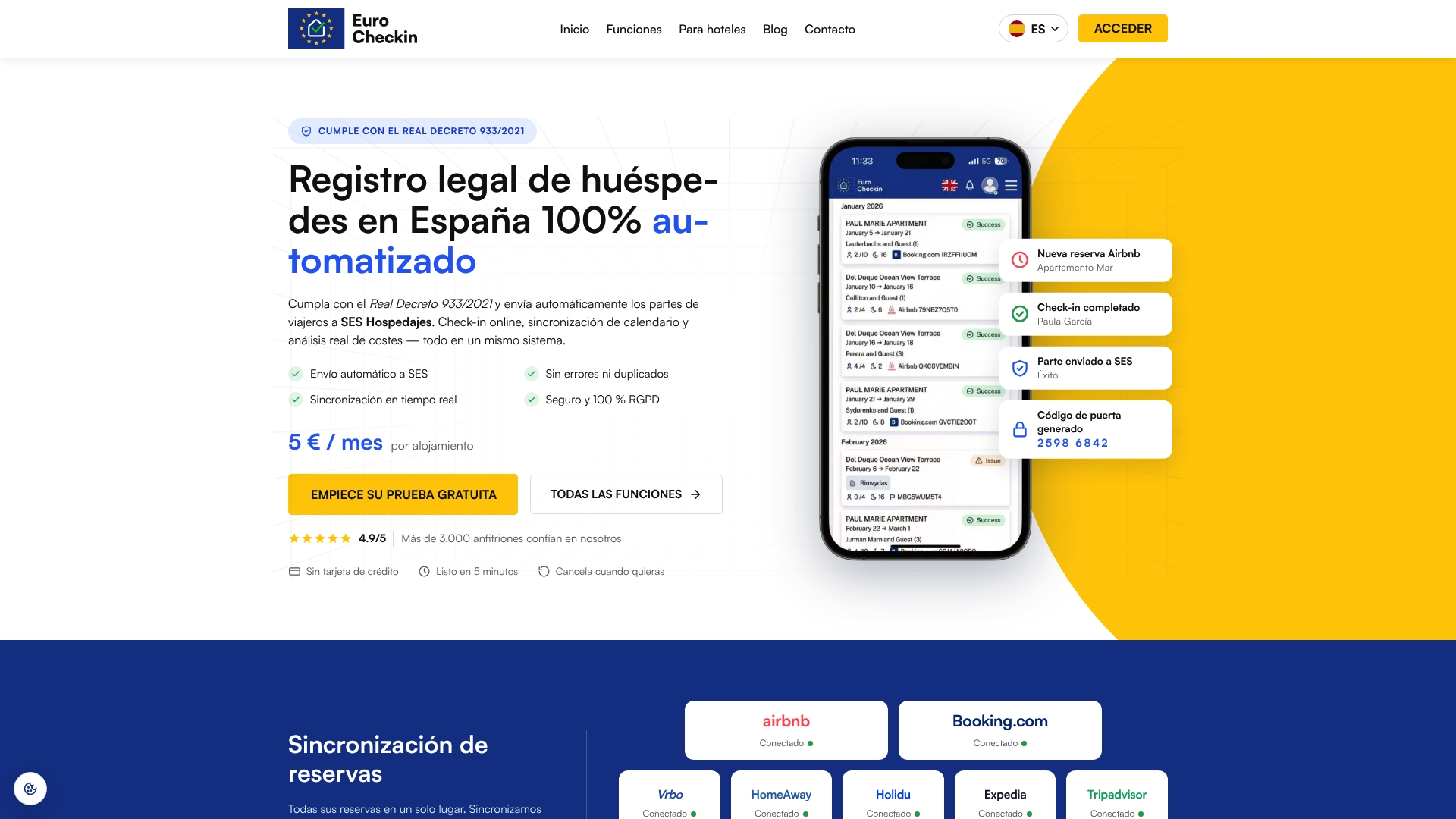
Several features that usually appear as separate line items elsewhere come built into the base plan: automated reporting, calendar sync across major platforms to avoid overbookings, OCR document capture, smart-lock integration, and a built-in payment flow for guest upsells through common digital wallets. Each of these replaces a manual task that otherwise costs you time, which is a real cost even when it does not show up on an invoice.
- Automated SES reporting removes a manual filing step for every guest.
- Calendar sync across major platforms reduces the risk of double bookings.
- Built-in OCR and smart-lock support cut onboarding time for self check-in.
| Cost driver | Without automation | With EuroCheckin |
|---|---|---|
| SES Hospedajes reporting | Manual entry per guest | Automated, included in subscription |
| Calendar sync | Manual updates across platforms | Synced across multiple platforms |
| Guest upsells | Separate payment tool needed | Built-in Apple Pay and Google Pay |
If you need help setting up the registry itself, Registro en SES Hospedajes is available from 79 EUR one-off per accommodation. Start a free trial today to see the full workflow before you commit to a plan.
Sources
FAQ
How much does check-in software typically cost per month?
Pricing varies by model: per-property plans, per-check-in volume pricing, and per-ticket event pricing all produce different totals depending on your operation. EuroCheckin’s per-accommodation plan starts from 5 EUR per month, while its hotel plan runs 3 EUR per month per room.
What hidden fees should I watch for in a check-in software quote?
Transaction or payment-processing fees, onboarding charges, and optional modules like OCR or smart-lock integration are the most commonly omitted costs on pricing pages. Always request a written, itemized quote that separates the base subscription from these add-ons before comparing vendors.
Does check-in software need to comply with Spanish reporting law?
Yes, accommodation providers in Spain must keep a traveler registration record and report data through telematic procedures under Real Decreto 933/2021. Confirm that any vendor you consider actually supports this reporting workflow rather than assuming general check-in features cover it.
Is there a free trial for check-in software before paying?
Most vendors, including EuroCheckin, offer a free trial period so you can test the check-in workflow, calendar sync, and reporting features before committing to a paid plan. Use that period to run a full test check-in rather than just reviewing the interface.
How do I compare pricing across different check-in software vendors?
Convert every vendor’s quote into one annual total per accommodation by adding the base subscription, per-unit fees, transaction fees, and onboarding costs together. Industry commentary from HotelTechUpdate recommends this normalized approach specifically because headline prices often exclude those extra costs.