



Guest data minimization means collecting only the fields a booking or legal registration actually requires, then deleting or anonymizing them once the purpose ends. The clearest action most operators can take today is to stop storing full copies of ID documents and instead verify identity visually or electronically. Everything else, from form design to retention timers, follows from that single rule. We walk through the regulator guidance and the exact steps that put it into practice.
TL;DR:
- Verify IDs visually, through certified digital identity, or by matching booking details to payment; retain an image only for a documented exceptional legal need.
- Separate legally required registration fields from optional marketing or preference data, which need their own lawful basis and usually a clear, unticked consent box.
- Set separate retention periods for registration, accounting, marketing consent, and camera footage; security footage should usually be kept only for a few days.
- Handle guest requests within one month; documented complexity permits up to two extra months, provided you explain the delay during the first month.
Table of Contents
- What data minimization legally requires
- Which guest data fields are required vs optional
- How to verify identity without storing passport or ID scans
- Designing minimal collection flows
- Retention policies: how long to actually keep guest data
- Controller vs processor: what to demand from your vendors
- Operational minimization checklist for staff
- Handling guest data subject requests efficiently
- Technical controls that make minimization enforceable
- What running compliant check-ins day to day has taught us
- EuroCheckin: automating compliant, minimal guest data collection
- FAQ
- Sources
What data minimization legally requires
Data minimization is a straightforward idea with a precise legal definition. Under GDPR Article 5(1)(c), personal data must be adequate, relevant and limited to what is necessary for the purpose it was collected for. Storage limitation, a companion principle in the same article, means you keep that data only as long as the purpose requires it, not indefinitely “just in case.”
Article 25 adds a second layer: data protection by design and by default. This means your booking forms, property management system and check-in flow should be built so that minimal collection is the automatic outcome, not something a well-intentioned staff member has to remember to apply. A form that defaults to collecting a date of birth, a scanned passport and a home address for a two-night stay fails this test before a single guest even checks in.
The EDPB guidelines on Article 25 break minimization into four practical dimensions: the amount of data collected, the extent of processing, the storage period and who can access it. For hospitality, that translates into asking whether each field on your registration form is genuinely needed for the stay, whether every staff member needs to see every guest’s full record, how long you keep booking metadata after checkout and whether access logs exist to show who touched what.

Necessity and proportionality are the test regulators apply in practice. A hotel can justify collecting a name, nationality and document number because national registration rules require it. A hotel struggles to justify photographing a guest’s full ID card, storing a scanned copy on a shared drive and keeping it for years after departure. The AEPD’s own guidance on hospitality registration makes this distinction explicit, and it is the foundation for every operational decision in the sections that follow.
Which guest data fields are required vs optional
Most compliance headaches in hospitality come down to one mistake: treating every field on a legacy form as mandatory. A field-by-field review usually finds that a third of what gets collected has no lawful basis at all.
Required fields generally fall under one of three lawful bases:
- Contract performance: name, contact details, arrival and departure dates, and payment information needed to deliver and bill the stay.
- Legal obligation: the specific identity fields your national registration rules require (document type, document number, nationality, date of birth) for reporting to the relevant authority.
- Legitimate interest: basic fraud prevention data such as a payment method check, applied narrowly and only where you can show the interest outweighs the guest’s privacy expectation.
Optional fields, by contrast, need their own lawful basis, and in most cases that basis is consent. Marketing preferences, dietary notes beyond what’s needed for a booked meal, loyalty program enrollment and room preference history all belong in this category. They should sit behind a clearly labeled, unticked opt-in box, never bundled into the main registration form as if they were required.
A short list of commonly overcollected items worth removing from most hospitality forms:
- Full scanned copies of passports or national ID cards.
- Home addresses for guests who already provided billing details through a payment processor.
- Employer or occupation fields with no connection to the stay.
- Vehicle license plate numbers collected “for security” with no documented retention or access policy.
- Social media handles or follower counts collected for no stated purpose.
Mapping each field to its lawful basis before launch, rather than after a complaint, is the habit that keeps a form defensible. The EDPB decision excerpts on legitimate interest are a useful reference here: they repeatedly find that proportionality fails when operators collect more than the stated purpose needs, photographs being a recurring example.
How to verify identity without storing passport or ID scans
The AEPD’s guidance on guest registration is unambiguous: requesting or retaining a copy of a guest’s DNI or passport breaches data minimization and raises the risk of identity theft if that copy is ever exposed. A more recent AEPD press note reinforces the same point and lists accepted alternatives.
In practice, you have several compliant ways to confirm a guest is who they say they are, without keeping a copy of their document:
- Visual verification at check-in: a staff member checks the physical document against the information already on the registration form, then returns it immediately.
- Certified eID or digital identity schemes: where available, these confirm identity cryptographically without transmitting an image file.
- Two-factor confirmation tied to payment: matching the booking name against the card or account used for payment adds a second verification layer for remote check-ins.
- Secure e-signature on a digital contract: a signed acknowledgment of house rules and booking terms, timestamped and stored as text, serves as a verification record without an image attachment.
If an exceptional case genuinely requires retaining a document image, document the specific legal basis in writing, set an automatic deletion date, and restrict access to the smallest possible group of staff.
Pro Tip: Store the verification method you used, such as “visual check at reception” or “eID confirmed,” rather than the document image itself. That single line satisfies audit requirements without creating a new data liability.
Designing minimal collection flows
The form a guest sees before arrival sets the tone for everything that follows. A short, required-only form with conditional fields that appear only when relevant keeps collection tight without making the booking process feel unfinished.
Practical design patterns that work well in hospitality:
- Show only the legally required identity fields by default, and reveal optional fields (dietary needs, special requests) in a clearly separate, collapsible section.
- Use conditional logic so a field like “vehicle plate” only appears if the guest has indicated they are driving.
- Make every non-essential checkbox opt-in and unticked, with a one-line explanation of what it’s for.
- Offer a fallback contact method (phone, in-person) for guests uncomfortable completing an online form, so minimization doesn’t become a barrier to booking.
On the system side, defaults matter as much as the form itself. Pseudonymizing guest records in internal reporting, restricting staff access to only the fields their role requires, and switching on retention timers at setup rather than leaving them configurable-but-off are the three settings that do the most work with the least ongoing effort.
Reducing friction while minimizing data might sound like a contradiction, but the two usually reinforce each other. A shorter form with clear purpose text (“We need this to confirm your identity for mandatory registration”) completes faster than a long form with no explanation, and it generates fewer abandoned bookings. Progressive profiling, where you ask for optional preferences only after the guest has already booked and engaged with a confirmation email, is another way to gather useful detail without front-loading the registration form.
Pro Tip: Add one sentence of purpose text under each required field. Guests who understand why you’re asking rarely object, and it’s the same documentation you’ll want on hand if a supervisory authority ever asks why a field exists.
Retention policies: how long to actually keep guest data
Storage limitation only works when you’ve assigned each data category a specific retention band tied to its purpose, rather than applying one blanket period to everything you collect. Legal obligations set a floor for some categories; business need sets a ceiling for others.
Reasonable retention bands to build into your systems:
- Security camera footage: a few days, consistent with EDPB guidance on video surveillance, unless a specific incident justifies a longer hold.
- Booking and registration metadata: tied to the legal retention period your national registration rules set, then deleted or anonymized.
- Accounting and invoice records: kept for the period your tax and accounting obligations require, separate from the guest’s personal registration data.
- Marketing consent records: kept only as long as the consent remains active, with an easy withdrawal path that triggers deletion.
Automating these rules inside your property management system removes the single biggest point of human error: the person who means to delete old records but never gets around to it. Deletion logs that record what was removed and when give you a defensible audit trail, and anonymization, stripping identifying fields while keeping aggregate statistics, let you retain useful trend data without retaining personal data. Our guide to retention pitfalls walks through how this plays out over a multi-year retention cycle, and our breakdown of reporting obligations covers how retention interacts with mandatory reporting.
Controller vs processor: what to demand from your vendors
As a hotel or property manager, you are almost always the data controller, the party who decides why and how guest data is processed, even when a property management system, channel manager or OTA is the one physically storing it. That system is typically a processor, acting on your instructions. The distinction matters because you remain accountable for what happens to guest data even after it leaves your own servers.
A practical contract checklist to run through with any vendor touching guest data:
- Confirm the contract gives you control over retention periods, rather than defaulting to the vendor’s own indefinite storage policy.
- Require deletion or anonymization on your instruction, with a stated maximum turnaround time.
- Ask for a current list of subprocessors, including where guest data is hosted geographically.
- Confirm technical and organizational security measures are documented, not just promised verbally.
- Check that the vendor supports data subject access and erasure requests without manual intervention on your part.
Technical features worth requiring outright: configurable retention controls rather than fixed defaults, access logs that show which staff accounts viewed which records, and a deletion API or equivalent mechanism rather than a support ticket as the only way to remove data. An AEPD breach report found that a meaningful share of hospitality-sector incidents trace back to third-party booking systems and weak access controls, which is exactly the gap a solid vendor contract is meant to close.
Red flags worth walking away from: a vendor that cannot tell you where data is hosted, one that keeps records indefinitely by default, or one with no documented process for handling a guest’s erasure request. Our lawful basis guide covers how these vendor obligations interact with the six lawful bases available in hospitality processing.
Operational minimization checklist for staff
Policy only matters if front-of-house staff apply it consistently, at every check-in and every shift change. A short, repeatable checklist beats a long compliance manual nobody reads.
- At reception, never photocopy or photograph a guest’s ID. Confirm visually and return the document immediately.
- Limit any handwritten or system notes to what’s operationally necessary, and avoid recording details with no stated purpose.
- Time-box staff access to guest records so permissions expire automatically after the stay ends, rather than accumulating indefinitely.
- On booking channels and OTAs, request only the fields your registration and billing actually require, and periodically audit what’s syncing into your system.
- Disable automatic storage of unnecessary document copies in channel manager integrations, since many sync more fields than hotels realize.
- For security cameras, keep footage retention short and restrict viewing access to a named, documented list of staff.
Pro Tip: Run a quarterly five-minute audit: pull one guest record at random and check whether every field in it still has a documented purpose. If it doesn’t, remove it from the form.
Handling guest data subject requests efficiently
When a guest asks to see, correct or delete their data, GDPR gives you one month to respond, extendable by two further months for genuinely complex requests, provided you document the reason for the extension and tell the guest within the first month.
A reliable workflow has four steps: authenticate the requester to confirm they are who they claim to be, locate every system holding their data (property management system, channel manager, accounting records, marketing lists), act on the request (provide, correct or delete as appropriate), and document what you did and when. The right to erasure isn’t absolute: if you’re still within a legal retention period for registration or accounting purposes, you can explain that the record will be deleted once that obligation ends, rather than immediately.
This is where minimization pays off operationally, not just legally. A guest record with ten fields across one system takes minutes to locate and act on. A guest record scattered across a booking form, a scanned ID, a marketing list and a spreadsheet of “just in case” notes can take days, and each additional location is another place something can go wrong. Our guide to erasure requests covers the documentation template that keeps this process defensible if a supervisory authority ever asks to see it.
Technical controls that make minimization enforceable
Policy without technical backing tends to drift. The controls below are what turn a minimization policy into something that actually holds.
Pseudonymization, replacing directly identifying fields with a reference code, lets staff work with booking records without seeing full guest details unless they have a specific reason to. Encryption at rest and in transit protects whatever data you do hold, and proper key management, limiting who can decrypt records, keeps that protection meaningful rather than theoretical. Access control lists that restrict each staff role to the fields it genuinely needs close one of the most common gaps auditors find.
Automated deletion and anonymization remove the dependency on someone remembering to act. Minimizing the number of copies and endpoints where guest data lives, one system of record instead of five overlapping spreadsheets, shrinks your attack surface and your audit burden at the same time. Backup policies deserve the same scrutiny as live systems: a deleted record that still exists in a six-month-old backup hasn’t really been deleted.
Some technologies invite more risk than they solve. Biometric check-in and blockchain-based guest records are occasionally pitched as compliance innovations, but both tend to increase the sensitivity or permanence of stored data. Where a simpler, less intrusive alternative achieves the same verification outcome, that’s the one minimization principles point you toward.
What running compliant check-ins day to day has taught us
Working alongside hotels and property managers on registration compliance, one pattern shows up constantly: the biggest risk isn’t malicious misuse of guest data, it’s accumulation by default. Forms inherited from a previous system, fields nobody remembers the reason for, folders of scanned IDs nobody has reviewed in years.
Automation changes that pattern more reliably than policy memos do. When retention rules and reporting are built into the check-in workflow itself, rather than left to a staff member’s discretion, the minimal path becomes the only path. One-click reporting to the relevant authority removes the temptation to keep a local copy “just in case the system is down.” Retention timers that run automatically remove the backlog of old records that tends to accumulate when deletion is a manual task on someone’s to-do list.
The operators who struggle least with audits are consistently the ones who automated this early, not the ones who wrote the most thorough policy document.
— Sofía Herrera
EuroCheckin: automating compliant, minimal guest data collection
Everything in this guide, minimal form fields, no stored ID copies, automated retention, is easier to sustain with a system built around those principles from the start. EuroCheckin automates traveler registration for Spanish properties, sending guest data directly to SES Hospedajes in line with Real Decreto 933/2021 and GDPR, with no manual entry and no duplicate records.
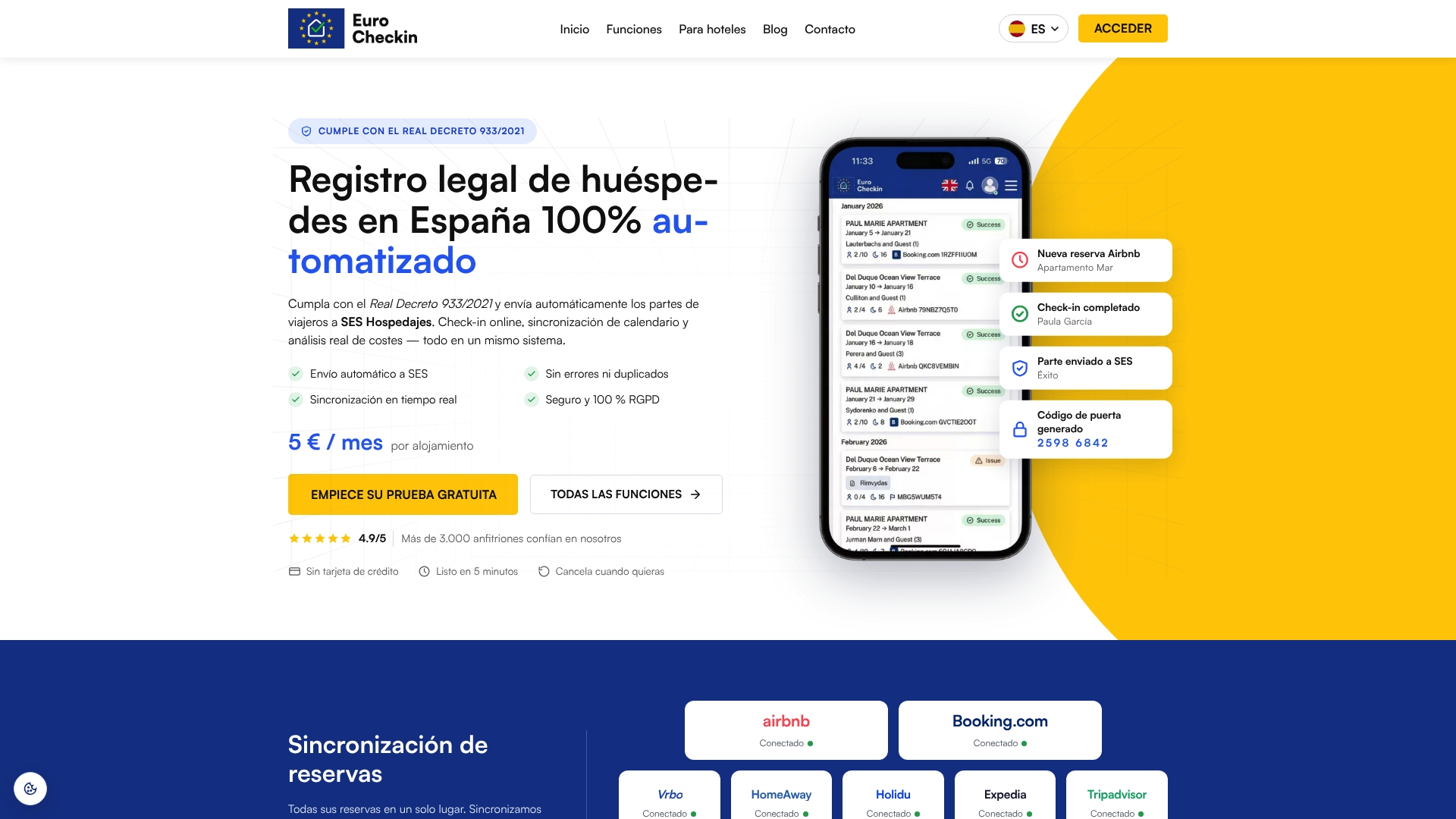
Our online check-in is unlimited and multilingual, with smart links for Airbnb, Booking and Vrbo, and the digital traveler registry is fully compliant, hosted on infrastructure within the European Union. Digital contracts with e-signature, a digital guest guide and integration with smart lock brands complete a self check-in flow that collects only what registration actually requires.
Plans start from around €5 per month per property for EuroCheckin para alojamientos, with a dedicated hotel plan and standalone SES Hospedajes registration support from €79 one-off per property, plus a free trial to see the workflow firsthand.
This article is general information, not a substitute for advice from a qualified lawyer. Consult a qualified legal professional about your own circumstances before acting on anything here.
FAQ
What does data minimization mean in the context of data privacy?
Data minimization means collecting only the personal data that is adequate, relevant and necessary for a specific stated purpose, then deleting it once that purpose ends. Under GDPR Article 5(1)(c), it sits alongside storage limitation, which caps how long you can keep that data.
What are the 5 C’s of hospitality?
Definitions of the “5 C’s” vary across hospitality training sources and aren’t a formal legal or regulatory framework, so no single authoritative version applies here. Common versions reference service qualities such as comfort, communication and consistency, but these aren’t tied to data privacy or registration compliance.
What are the 7 main principles of GDPR?
GDPR’s core principles include lawfulness, fairness and transparency; purpose limitation; data minimization; accuracy; storage limitation; integrity and confidentiality; and accountability. Data minimization, the focus of this guide, specifically requires that collection stay limited to what’s genuinely necessary for the stated purpose.
What is GDPR in simple terms?
GDPR is the European Union’s framework for how personal data must be collected, stored and used, built around principles like necessity, transparency and accountability. For hospitality operators, it means registration data collected for legal reporting must stay separate from optional marketing data, and both must be handled under a clear, documented lawful basis.
How long should hotels keep guest registration data?
Retention periods depend on the specific legal obligation driving collection, such as mandatory registration reporting, and should never default to indefinite storage. Booking metadata, accounting records and security footage each warrant their own retention band, with EDPB guidance on video surveillance recommending footage retention of only a few days in most cases.
Sources
- NOTA DE LA AGENCIA ESPAÑOLA DE PROTECCIÓN DE DATOS CON RELACIÓN A LA SOLICITUD DE COPIAS DE DOCUMENTOS DE IDENTIDAD EN HOSPEDAJES
- Regulation (EU) 2016/679 (GDPR)
- Guidelines 4/2019 on Article 25 Data protection by design and by default (EDPB)