


Hotel brand guidelines are the operational rulebook that turns a brand promise into consistent guest experiences and measurable revenue protection. They are not a logo file. A usable set of guidelines connects visual identity, service scripts, room specs, and compliance rules to a single accountability chain, and ties every one of those pieces to metrics like guest satisfaction score (GSS) and RevPAR correlation. Get this right, and audits get faster, PIP timelines shrink, and owners stop treating brand standards as a cost center.
Before you write a single page, do three things:
- Inventory every existing standard document, however outdated or scattered across departments.
- Pick one property or floor to serve as your prototype space.
- Assign a single governance owner who has authority to approve exceptions.
Pro Tip: Start the inventory with a spreadsheet, not a workshop. You will find contradictions between what corporate says and what the property actually does, and that gap is your real starting point.
Key Takeaways
Hotel brand guidelines succeed only when brand promises get translated into measurable acceptance criteria, verified through regular audits, and tied to KPIs like GSS and RevPAR.
| Point | Details |
|---|---|
| Start with a governance owner | Assign one person the authority to approve exceptions before drafting standards. |
| Pilot before full rollout | Test standards in one or two properties for 60 to 90 days with clear evaluation criteria. |
| Translate promises into checklists | Convert every brand pillar into acceptance criteria, steps, and evidence requirements. |
| Track compliance against revenue | Monitor GSS correlation, RevPAR movement, and compliance pass rate on a fixed cadence. |
| Automate evidence collection | Tools like Eurocheckin generate timestamped registration and contract records that double as audit evidence. |
Table of Contents
- What Are Hotel Brand Guidelines and Who Owns Them?
- Why Do Hotel Brand Standards Protect Revenue?
- What Sections Belong in a Brand Standards Manual?
- How Do You Create and Pilot Hotel Brand Standards?
- How Do You Turn Brand Standards Into Daily SOPs?
- How Should Teams Train on Brand Standards?
- Who Owns Governance and Contract Flexibility?
- How Often Should Brand Standards Be Audited?
- Which Tools Help Operationalize Hotel Brand Standards?
- Common Pitfalls in Enforcing Hotel Brand Standards
- Make Compliance Evidence Part of Your Daily Operations
- Sources
- FAQ
What Are Hotel Brand Guidelines and Who Owns Them?
Hotel brand guidelines are the single source of truth for how a property looks, operates, and communicates, spanning visual identity, service scripts, furniture and fixture specs, connected systems, and legal compliance. Treat them as a living operations document, not a design deliverable.
Ownership typically spreads across four groups:
- The brand team, who set positioning, visual standards, and voice.
- Operations leadership, who translate standards into daily workflows.
- Owners and asset managers, who fund capital upgrades and negotiate flexibility.
- Franchise, legal, and procurement teams, who enforce contract terms and supplier approvals.
Most organizations structure guidelines in tiers: a master Brand Bible covering non-negotiable global standards, regional supplements addressing local codes and market preferences, and property-specific packages that adapt the manual to a building’s actual layout and capital plan.
Why Do Hotel Brand Standards Protect Revenue?
Brand standards are frequently misread as policing when their real function is revenue protection. A consistent guest experience reduces the operational friction that erodes trust, and that trust shows up directly in booking behavior and review scores.
Reviews sway roughly 72% of potential guests, and strong hospitality branding drives measurably more interest, with positive imagery lifting guest interest by more than 130% in some cases. That is not a marketing footnote. It is the business case for why brand consistency belongs on the same planning table as capital budgets and PIP schedules.
Good standards deliver four outcomes worth tracking:
- Consistency across properties, which compounds brand trust over time.
- Owner confidence, since predictable standards reduce disputes during PIP negotiations.
- Direct-booking lift, as guests return to brands that deliver what they expect.
- Lower remediation cost, because fewer surprises during audits mean fewer emergency fixes.
What Sections Belong in a Brand Standards Manual?
A usable manual reads like a set of specifications, not a mood board. Every core section needs a defined deliverable format so property teams can act on it without guessing.
- Brand positioning and pillars: the promise statement and three to five measurable pillars (for example, “efficient arrival” measured by check-in time under two minutes).
- Visual identity system: logo usage, color values, typography, signage placement, with tolerances for exceptions.
- Service standards and scripts: greeting language, escalation paths, and the KPIs tied to each interaction.
- Room and public-area FF&E: material specs, dimensions, acceptance criteria, and replacement cycles.
- F&B concept standards: plating rules, menu architecture, and brand-approved supplier lists.
- Back-of-house and operations: staffing ratios, engineering checklists, housekeeping cycle times.
- Systems and connectivity: PMS, CRS, and loyalty platform requirements and data flows.
- Accessibility and safety: code compliance, ADA-equivalent requirements, and fire and life-safety checks.
- Procurement and supplier rules: approved vendor lists and evidence requirements for substitutions.
- Regional supplements and property packages: local adaptations that do not compromise the core brand promise.
Physical brand applications deserve as much rigor as digital ones. A hospitality branding system needs environmental and materials guidance for menus, uniforms, and wayfinding, since a color that reads correctly on a screen can look completely different under lobby lighting.
A well-written spec looks like this: “Lobby seating fabric: commercial-grade polyester blend, minimum 30,000 double rubs, color per Pantone reference, replacement cycle 5 years or at first visible wear, acceptance verified by procurement photo submission.”

Pro Tip: Write every FF&E spec with four fields: dimension, material, acceptance criteria, and replacement cycle. If a spec is missing one of those four, it will get argued over during the next PIP.
How Do You Create and Pilot Hotel Brand Standards?
Building a manual that survives contact with real properties takes a staged approach, not a single big document drop.
- Research and alignment: audit the competitive set, define guest personas, and confirm market positioning before drafting a single standard.
- Define brand pillars: translate positioning into three to five measurable promises, each with an owner and a metric.
- Prototype and visual references: build mock-ups, commission reference photography, and where budget allows, capture a digital twin of a model room.
- Pilot in one or two properties: set evaluation criteria upfront, run the pilot for 60 to 90 days, and track guest feedback alongside operational cost.
- Iterate and finalize: fold pilot findings back into the manual before wide rollout.
A stakeholder checklist for the pilot phase should include operations, design, procurement, and at least one franchisee or owner representative, since standards that skip owner input tend to face resistance later. Franchise and brand teams increasingly rely on collaborative processes involving owner advisory committees to pressure-test design packages against cost-per-key targets before they get locked in.
Pro Tip: Run your pilot with the same audit checklist you plan to use post-launch. If the checklist does not surface real problems during the pilot, rewrite it before rollout, not after.
How Do You Turn Brand Standards Into Daily SOPs?
The gap between a brand book and a functioning hotel is translation. A brand promise means nothing until it becomes a discrete, observable action a staff member can perform and a manager can verify.
The pattern is consistent: brand promise leads to acceptance criteria, which breaks into checklist steps, which requires evidence of completion. “Efficient arrival” becomes “greet guest within 5 seconds using approved phrase,” which becomes a line item on a front-desk checklist with a supervisor sign-off and, ideally, a photo or system timestamp as proof.
- Write the acceptance criteria in plain, measurable language.
- Break it into steps a new hire could follow without additional training.
- Attach an evidence requirement (photo, checklist tick, system log).
- Assign sign-off responsibility by role.
| SOP Field | Example |
|---|---|
| Role | Front desk agent |
| Frequency | Every arrival |
| Steps | Greet, verify ID, confirm room preference, issue key |
| Acceptance criteria | Completed within 5 minutes of arrival |
| Evidence required | PMS timestamp log |
Store SOPs in a central, version-controlled repository, with mobile checklists pulling the current version automatically so a property never works from an outdated file.
Pro Tip: Never let a room checklist exceed 20 items. Longer checklists get skimmed, not completed.
How Should Teams Train on Brand Standards?
Training fails when it is text-only and delivered once. Role-based modules for front desk, housekeeping, F&B, and engineering should each verify comprehension, not just attendance.
- Use annotated floor plans and photos, not paragraphs, wherever a standard has a spatial component.
- Where budget allows, digital twins outperform static photos for training because they preserve sightlines and spatial relationships a flat image cannot show.
- Set a training cadence: induction for new hires, quarterly refreshers for existing staff, and short briefings any time a standard changes.
- Maintain one internal source for approved assets, such as a brand portal with quick-reference cards, so staff are never guessing which version is current.
Pro Tip: Ask every trainee to photograph one example of the standard they just learned, correctly executed, in their own work area. That single habit catches more gaps than a written quiz.
Who Owns Governance and Contract Flexibility?
Clear decision rights prevent the endless email threads that stall PIP negotiations. A simple governance matrix assigns each decision to one party:
- Brand team: owns visual identity and non-negotiable service pillars.
- Owners: fund capital upgrades and negotiate phased implementation timelines.
- Operators: enforce daily SOPs and report compliance gaps.
- Franchisees: request regional exceptions and manage local supplier relationships.
Brand standards typically split into four practical buckets: guest-facing elements, systems and connectivity, compliance and safety, and legacy or prescriptive rules. Owners often have real room to negotiate on the guest-facing and legacy categories when they tie flexibility to performance KPIs rather than asking for blanket exceptions. Document every negotiated flex point (a phased FF&E schedule, a regional signage exception) directly in the property package, and link it to the specific contract clause it modifies so nobody has to reconstruct the history during the next renewal.
How Often Should Brand Standards Be Audited?
A three-tier audit model keeps standards enforceable without burying properties in inspections: daily department self-checks, periodic internal audits (typically quarterly), and an annual brand or third-party audit.
- Document each deficiency with context, not just a checkbox failure.
- Assign a corrective action with an owner and a deadline.
- Verify completion with before-and-after evidence.
- Close the loop and log the resolution for the next audit cycle.
Digitized checklists and centralized dashboards create a timestamped trail that makes this loop far faster than manual spot-checks, since deficiencies get flagged and routed automatically instead of waiting for the next site visit.
| Metric | Definition | Cadence | Owner |
|---|---|---|---|
| GSS correlation | Guest satisfaction score against compliance rate | Monthly | Brand team |
| RevPAR movement | Revenue per available room versus compliance trend | Quarterly | Revenue management |
| Compliance pass rate | Percentage of standards passed at audit | Per audit cycle | Operations |
| PIP completion timeline | Days from flag to resolution | Ongoing | Asset manager |
Brands pursuing third-party recognition should also map internal standards against external certification criteria such as Forbes or LQA, since those benchmarks often set the ceiling guests expect regardless of your own internal grading.
Which Tools Help Operationalize Hotel Brand Standards?
Five tool categories do most of the heavy lifting: mobile audit apps, learning management systems for training, digital twins for visual reference, PMS/CRS/loyalty integrations, and supplier approval systems.
- Mobile checklist apps push updated SOPs to properties automatically and timestamp evidence photos.
- LMS platforms verify training completion by role, not just attendance.
- Digital twins give remote brand teams a way to verify remediation without a site visit, which cuts real travel cost out of the audit cycle.
- Supplier approval systems tie procurement decisions to a standards register, so a substitution in one region does not silently violate a spec elsewhere.
A platform like EuroCheckin’s digital registration tools illustrates the pattern well: automated guest registration data, synced calendars, and stored digital contracts double as a built-in evidence trail for compliance audits, since every check-in already carries a timestamp and a document attached.
Pro Tip: Before adopting any tool, confirm four things: it integrates with your existing PMS, it captures evidence automatically, it supports role-based permissions, and it stores data in compliance with your market’s privacy rules.
Common Pitfalls in Enforcing Hotel Brand Standards
The most common mistake is treating a brand guideline as a one-time PDF instead of a living operational system. The second is over-prescribing harmless details (exact napkin fold angle) while under-investing in training and verification for the standards that actually move guest satisfaction.
What works consistently: a prototype-to-pilot approach with measurable acceptance criteria, visual references that get updated as often as the property does, and governance with named owners for every decision. I have seen properties spend six figures on a rebrand and then fail their first audit because nobody translated the pillars into a checklist anyone could actually follow. The manual was beautiful. It just never touched a housekeeping cart.
Make Compliance Evidence Part of Your Daily Operations
Audits move faster when the evidence already exists instead of getting assembled the week before an inspector arrives. Eurocheckin is built for exactly that gap in daily hotel operations: automated guest registration, digital contracts, and synced calendars generate a timestamped record every time a guest checks in, without anyone on your team touching a spreadsheet.
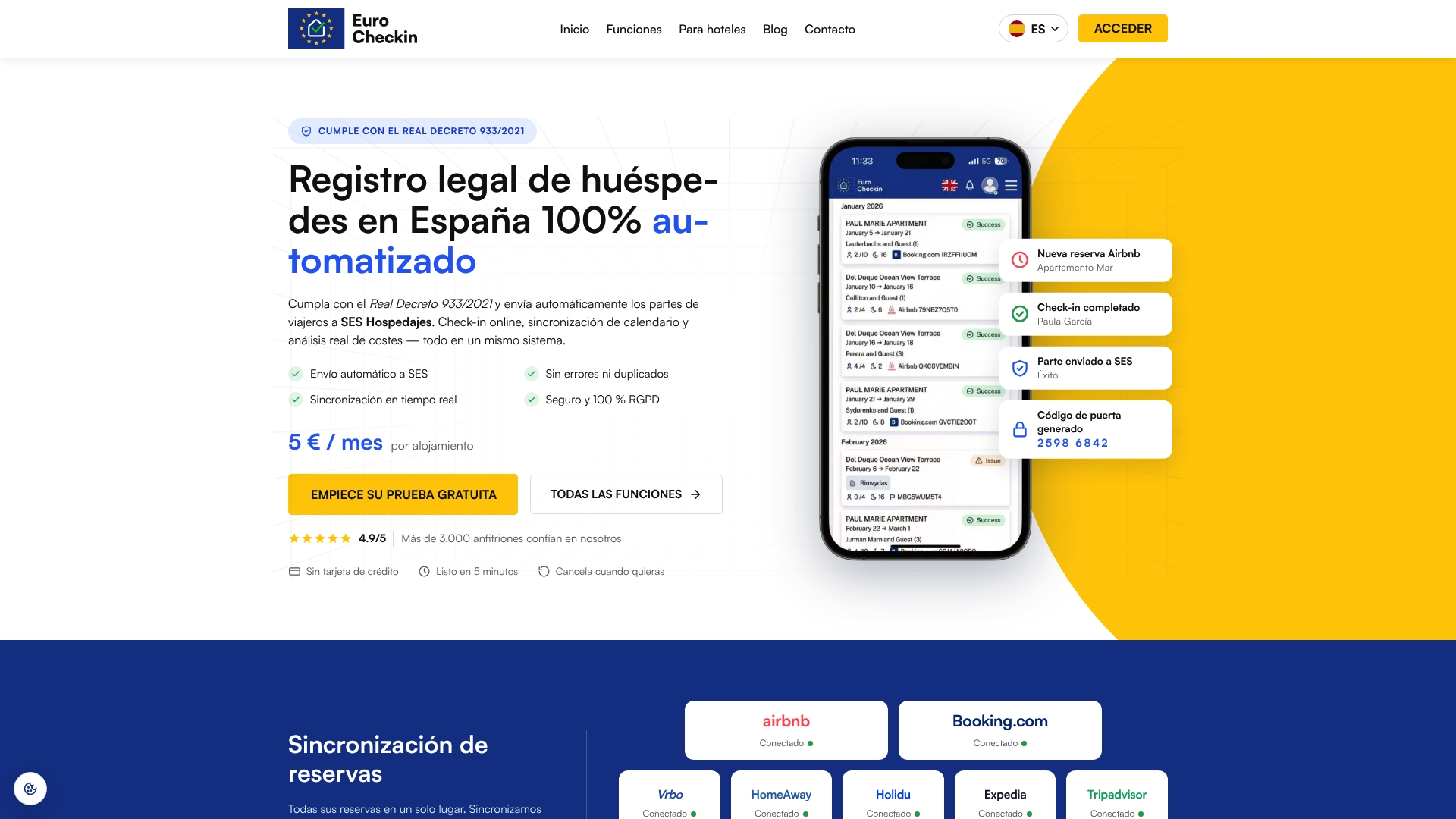
For properties in Spain, this also solves a compliance requirement that sits outside brand standards entirely: automatic reporting of guest data to SES Hospedajes under Real Decreto 933/2021, with data hosted on EU-based infrastructure and no duplicate manual entry. That same record trail, guest ID, contract signature, timestamp, doubles as the evidence package your next brand audit will ask for. If you manage a boutique property or a multi-property portfolio, start by checking your registration and SES Hospedajes reporting workflow to see how much of your audit evidence can already be generated automatically during check-in.
Sources
- Hotel Brand Standards Management: A Practical Guide | Matterport
- Hotel Brand Standards: Where to push for flexibility (Hotels-Strategy)
- Expert guide to hospitality branding | Glion Institute
- Hotel Brand Standards: Guidelines, Rating Systems, and Best Practices | GoAudits
FAQ
What are hotel brand guidelines exactly?
Hotel brand guidelines are the operational rulebook covering visual identity, service standards, FF&E specs, systems, and compliance requirements that a property must follow to deliver a consistent guest experience.
Who should own hotel brand standards inside an organization?
Ownership typically splits across the brand team, operations leadership, owners or asset managers, and franchise or legal teams, with one designated governance owner resolving exceptions.
How often should brand standards be audited?
A three-tier model works best: daily department self-checks, quarterly internal audits, and an annual brand or third-party audit.
Can automation help with hotel brand compliance?
Yes. Platforms like Eurocheckin automate guest registration and generate timestamped digital records that double as audit evidence, reducing the manual work of preparing for inspections.
What is the biggest mistake hotels make with brand guidelines?
Treating the guideline as a static visual document instead of translating it into daily SOPs with measurable acceptance criteria and verification steps.