


Organize hotel expenses into three tiers: operated departments (Rooms, Food & Beverage, Other), undistributed operating expenses, and non-operating or fixed charges. Report payroll separately from every other cost in each department. For Spanish properties, keep this structure for management reporting, then map it to the Plan General de Contabilidad for statutory filings and taxes.
TL;DR:
- Hotels should allocate expenses based on actual usage, such as utility consumption per occupied room or square meter, rather than equal splits.
- Management fees, taxes, and depreciation belong below gross operating profit, reflecting ownership costs rather than daily operational expenses.
- Mapping USALI categories to Spain’s PGC should occur at the start of the fiscal year to avoid errors and reduce reconciliation workload.
- Separating payroll from other costs in each department is essential for benchmarking and maintaining accurate profitability analysis.
- Automating invoice reading and expense classification can help streamline monthly reporting and reduce manual coding errors.
Table of Contents
- What Are the Main Hotel Expense Categories?
- How Do You Break Down Rooms, F&B, and Other Departmental Expenses?
- What Counts as Undistributed Operating Expenses?
- Where Do Management Fees and Fixed Charges Belong?
- How Do You Map USALI Accounts to Spain’s PGC?
- How Should You Allocate Shared Costs Across Departments?
- How Do You Build a Monthly Reporting and Budgeting Routine?
- Can Automation Simplify Hotel Expense Categorization?
- The One Thing Most Hotels Get Backwards
- Sources
- FAQ
What Are the Main Hotel Expense Categories?
The Uniform System of Accounts for the Lodging Industry arranges every dollar a hotel spends into a structure built for one purpose: telling you which parts of your property actually make money. That structure has three tiers, and each one answers a different question.
Operated departments cover the revenue-generating units: Rooms, Food & Beverage, and Other operated departments like spa or parking. Each department reports its own revenue against its own direct costs, producing a departmental profit figure you can compare month to month or property to property.
Undistributed operating expenses sit below that. These are the costs that keep the building running no matter which departments are busy: administration, sales and marketing, maintenance, utilities, and IT. Non-operating and fixed charges come last: management fees, insurance, taxes, depreciation, and reserve funds tied to ownership rather than daily operations.
- Operated departments: revenue-producing units reported on a responsibility basis
- Undistributed operating expenses: property-wide support costs, not tied to one department
- Non-operating/fixed charges: ownership-level costs below Gross Operating Profit
Total Operating Revenue is the sum of departmental revenues. Departmental profit, and eventually Gross Operating Profit, is what remains once you subtract departmental and undistributed costs. That single number is what owners, lenders, and management companies actually watch.
How Do You Break Down Rooms, F&B, and Other Departmental Expenses?
Every operated department carries two kinds of cost: labor and everything else. That split isn’t optional under USALI. Reporting guidelines require expenses to be broken out between labor and other costs so benchmarking data stays comparable across properties.
Rooms department typically includes:
- Payroll for housekeeping, front desk, and reservations staff
- Room supplies, guest amenities, and linen replacement
- Reservation system fees and commissions tied directly to bookings
Food & Beverage typically includes:
- Cost of sales (food and beverage inventory consumed)
- Kitchen and service payroll, broken out by outlet where practical
- Outlet-specific expenses such as china, glassware, and menu printing
Other operated departments (spa, parking, laundry service sold to guests) each carry their own revenue line and direct expenses, exactly like Rooms or F&B. A spa that shares its books with the rooms department loses the visibility that makes departmental reporting worth doing.
Pro Tip: Never post a general manager’s salary or corporate overhead into a departmental payroll line. If the role serves the whole property rather than one department, it belongs in undistributed expenses, not buried in Rooms labor.
What Counts as Undistributed Operating Expenses?
Undistributed expenses support the entire property rather than one revenue center. The standard groupings are Administrative & General, Sales & Marketing, Property Operations & Maintenance, Utilities (often labeled Energy, Water, Waste, or EWW), and Information & Telecommunications Systems.
- Administrative & General: accounting, human resources, legal fees, general management payroll
- Sales & Marketing: advertising, digital marketing spend, loyalty program costs, revenue management staff
- Property Operations & Maintenance: repairs, groundskeeping, engineering payroll
- Energy, Water, Waste (EWW): utility bills and waste management, a category USALI’s 12th edition formalized as its own schedule
- Information & Telecommunications Systems: network infrastructure, software licensing, guest Wi-Fi
The 12th edition also expanded reporting for digital marketing and loyalty program costs, reflecting how much hotel marketing spend has shifted online since the prior edition was written. These costs stay undistributed because attributing a share of the accounting department’s salary to Rooms versus F&B tells you nothing useful. Resist the urge to allocate them into departments just to make departmental margins look cleaner.
Where Do Management Fees and Fixed Charges Belong?
Everything below Gross Operating Profit reflects ownership decisions rather than day-to-day operations. That includes management fees, the FF&E reserve (funds set aside for furniture, fixtures, and equipment replacement), property taxes, insurance, interest expense, and depreciation.
- Management fees: base and incentive fees paid to the operating company
- FF&E reserve: typically a percentage of revenue set aside for capital replacement
- Taxes and insurance: property tax, business insurance, and related coverage
- Interest and depreciation: financing costs and non-cash charges tied to ownership structure
USALI’s Schedule 16 tracks Annual Mandatory Brand and Operator Costs separately from optional pass-through charges, a distinction that matters when you’re comparing what a brand contractually requires against costs a management company chose to pass along. On the P&L, these items appear after Gross Operating Profit, never mixed into departmental or undistributed lines above it.
How Do You Map USALI Accounts to Spain’s PGC?
USALI is a management framework. The Plan General de Contabilidad is the law. Hotels operating in Spain must maintain PGC-compliant books for statutory financial statements and tax filings, regardless of which system they use internally for performance tracking.
Most properties run both. USALI drives daily and monthly management decisions; PGC governs what gets filed with tax authorities at year-end. The two systems work side by side rather than replacing one another.
Mapping generally works like this: USALI departmental revenue maps to PGC’s revenue groups, while departmental and undistributed expenses map into Grupo 6 (Compras y Gastos), which covers purchases, personnel costs, and outside services.
- Reconcile payroll totals between USALI schedules and PGC personnel accounts monthly
- Cross-check depreciation and FF&E reserve entries at year-end, since PGC treats these differently than internal reserve accounting
- Confirm VAT and tax lines never get counted twice across the two systems
Pro Tip: Map your chart of accounts to USALI categories at the start of the fiscal year, not after twelve months of entries pile up. Restating a full year of postings into the correct schedule structure is slow and invites errors nobody catches until the auditor does.
How Should You Allocate Shared Costs Across Departments?
Shared costs should follow usage, not a straight percentage split. Allocating costs proportionally based on actual consumption or activity is the only way departmental profit figures stay meaningful.
- Allocate electricity and water by occupied room nights or square meters per department, not by an even split across all departments.
- Allocate internet and telecom costs by number of full-time equivalent staff or connected devices in each area.
- Allocate laundry costs per occupied room night, since guest linen volume tracks almost exactly with occupancy.
Labor typically represents a large portion of total hotel costs, often being the single largest expense, which is exactly why USALI’s Schedule 15 requires a dedicated Payroll FTE schedule. Comparing labor cost without consistent FTE counts across properties produces numbers that look precise and mean nothing.
The most common misallocation error is splitting shared utilities evenly across departments regardless of actual usage. A close second: posting undistributed costs like marketing directly into a department’s expense line, which breaks comparability against your own prior periods and against industry benchmarks.
How Do You Build a Monthly Reporting and Budgeting Routine?
A workable routine produces the same outputs every month without manual rebuilding. That means departmental P&Ls and a Gross Operating Profit figure generated on a fixed schedule, not reconstructed from scratch each time someone asks for numbers.
- Track Average Daily Rate, RevPAR, occupancy, departmental margins, labor percentage, and GOPPAR (Gross Operating Profit Per Available Room) every month
- Set a variance threshold (many properties use 5 to 10 percent against budget) that triggers a short written explanation, not a full investigation every time
- Reconcile your property management system output against bank statements before closing the books each month
Pro Tip: Invoice OCR tools that read vendor bills automatically cut down the manual data entry that causes most coding errors in departmental expense lines.
Can Automation Simplify Hotel Expense Categorization?
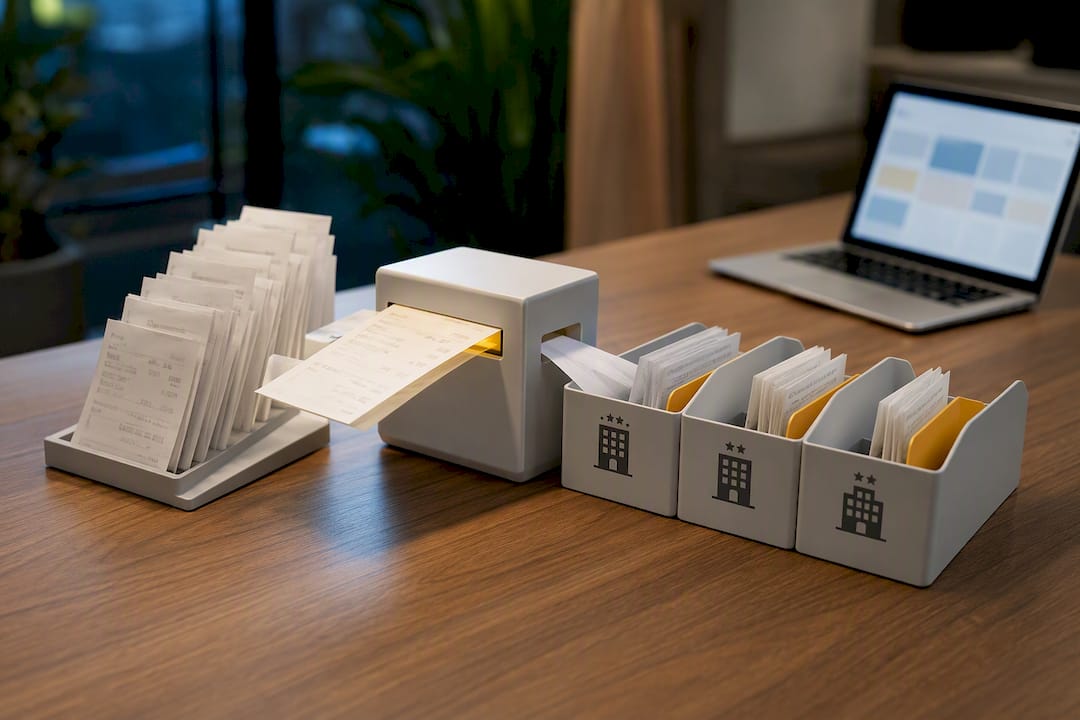
Automation tools that read invoices and sort spend by accommodation cut the manual coding that causes most categorization errors. Automation tools with invoice OCR technology generate per-accommodation expense breakdowns, which speeds up monthly reconciliation for owners running multiple properties. Confirm any tool’s data residency and feature fit against your specific reporting needs before adopting it.
The One Thing Most Hotels Get Backwards
Most properties treat chart-of-accounts mapping as a year-end cleanup task instead of a day-one decision. That’s backwards. Map to USALI categories and separate payroll from other costs before you post a single transaction, not after twelve months of entries need restating.
Run a small pilot on one department before rolling allocation drivers property-wide. Test whether occupied-room-night allocation for utilities actually produces sensible numbers against last year’s data before you apply it everywhere. And assign one person, not a committee, to own the monthly USALI-to-PGC reconciliation. Shared ownership of a recurring task is how checkpoints get skipped.
— Sofía Herrera
Sources
- HFTP — USALI detailed schedules and operating statement guidance (digital extract)
- Blue Cloud CPA — Hotel bookkeeping and USALI: chart of accounts and reporting
- STR/CoStar — P&L data reporting guidelines
FAQ
How Do You Categorize Hotel Expenses?
Group them into operated departments (Rooms, Food & Beverage, Other), undistributed operating expenses (Administrative & General, Sales & Marketing, Property Operations, Utilities, IT), and non-operating/fixed charges (management fees, taxes, insurance, depreciation). Always report payroll separately within each department.
What Are the 7 Main Classifications of Hotels?
Hotel property classifications (budget, midscale, upscale, luxury, resort, boutique, extended-stay) are a separate concept from expense categories and vary by rating system; this article covers expense classification, not property type.
What Are the Types of Expense Categories in Hotel Accounting?
The core types are departmental expenses (Rooms, F&B, Other), undistributed operating expenses (A&G, Sales & Marketing, Property Ops, Utilities, IT), and non-operating/fixed charges (management fees, FF&E reserve, taxes, insurance, interest, depreciation).
Which Costs Should Never Be Allocated Into a Department?
Undistributed operating expenses like marketing and administration should stay below departmental profit rather than being split into departments, since doing so breaks comparability against benchmarks and prior periods.
Is USALI Mandatory for Hotels in Spain?
No. USALI is a voluntary management framework used for internal reporting and benchmarking. The Plan General de Contabilidad is the legally mandatory system for statutory financial statements and tax filings in Spain.