


Prioritize six automations, in this order: calendar sync, guest messaging, compliance-first digital check-in with SES.Hospedajes reporting, smart locks, cleaning scheduling, and payments with upsells. These are the automations that eliminate the most manual hours and the most legal risk, in that order of urgency for hosts operating in Spain.
Hosts running two to ten units typically lose several hours a week to duplicate data entry, missed handoffs, and manual guest registry filings. That time comes back once systems talk to each other instead of requiring you to re-type the same guest details three times.
Here’s the priority stack, from highest to lowest impact:
- Two-way calendar synchronization across every channel you list on
- Automated guest messaging triggered by booking stage
- Digital check-in that files guest data to SES.Hospedajes automatically
- Smart lock integration for keyless, per-booking access codes
- Cleaning and turnover scheduling triggered the moment a guest checks out
- Payments and guest-paid upsells processed without a manual invoice
- Dynamic pricing informed by occupancy and local demand
The compliance piece is not optional. Real Decreto 933/2021 requires telematic reporting of guest data within 24 hours of the reservation or the start of the stay, and records must be kept for three years. Manual registry logging under that deadline is where most small hosts get exposed. A platform like Eurocheckin ties check-in and legal reporting into a single automated step, which is the fastest way to close that gap without adding staff.
Key Takeaways
Compliance-first automation, starting with calendar sync, guest messaging, and SES.Hospedajes reporting, delivers the fastest reduction in manual hours and legal risk for small hosts.
| Point | Details |
|---|---|
| Start with calendar sync | Two-way, real-time sync across channels prevents double bookings before adding any other tool. |
| Automate legal reporting first | SES.Hospedajes filings must reach authorities within 24 hours under Real Decreto 933/2021. |
| Pilot before scaling | Test on one property for 30 days, track hours saved and error rate, then expand. |
| Separate legal data from marketing | Keep the mandatory guest registry distinct from promotional use to stay GDPR compliant. |
| Use EuroCheckin for compliance and check-in | Eurocheckin automates SES.Hospedajes reporting, digital check-in, calendar sync, and smart lock access from about $5 per accommodation monthly. |
Table of Contents
- What Short-Term Rental Automation Actually Fixes
- How Do You Roll Out Automation Without Disruption?
- API Versus iCal: Which Integration Actually Holds Up?
- What Does Spanish Law Require From Automated Systems?
- Which Numbers Prove Automation Is Working?
- How EuroCheckin Covers These Automations
- What Hosts Get Wrong About Automation Priorities
- Start Your EuroCheckin Trial the Right Way
- Sources
- FAQ
What Short-Term Rental Automation Actually Fixes
Short-term rental automation isn’t one tool. It’s a set of connected systems that each remove a specific manual task, and understanding what each one does (and where it breaks) determines whether your setup actually saves time or just adds another dashboard to check.
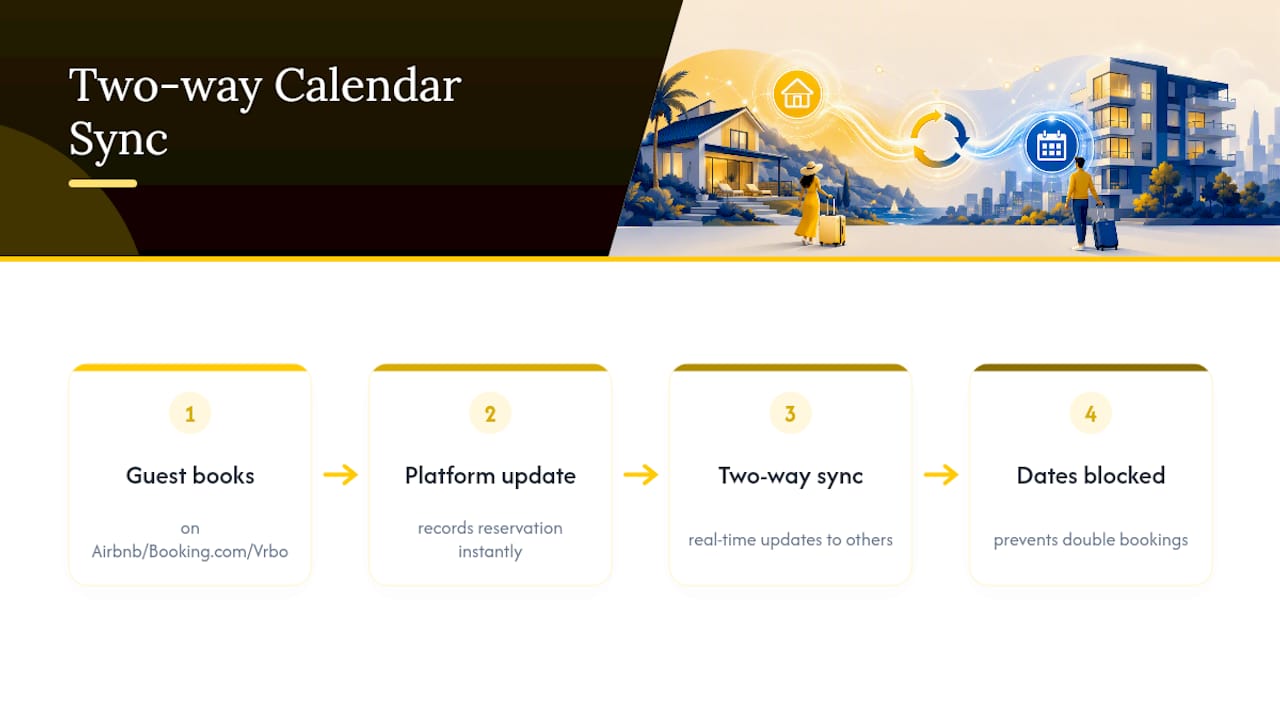
Calendar synchronization and channel management keep your availability accurate across every platform you list on. Two-way sync means a booking on Airbnb instantly blocks that date on Booking.com and Vrbo, and vice versa. The common pitfall is relying on a single-direction sync or a delayed feed, which is exactly how double bookings happen during high-demand weekends. If you list on more than two channels, insist on real-time, two-way sync rather than a periodic refresh.
Automated guest messaging replaces the manual scramble of answering the same five questions for every reservation. Set triggers for booking confirmation, a pre-arrival message with check-in instructions three days out, a welcome message on arrival day, a mid-stay check-in, and a post-checkout thank-you with a review request. Multilingual templates matter more than most hosts assume. A guest who books in French and receives an English-only door code email is far more likely to call you at 11 PM. Hosts who automate this sequence typically report the biggest single time reduction of any automation on this list, because messaging touches nearly every stage of the guest journey.
Digital check-in and guest registration handles two jobs at once: giving guests a smooth arrival experience and satisfying Real Decreto 933/2021’s mandatory data collection. The required fields include full identity document details, nationality, and dates of stay, and that data has to reach SES.Hospedajes within 24 hours. A properly configured system captures this during the guest’s online check-in and transmits it automatically, so you’re never manually re-entering passport numbers at 10 PM before a midnight deadline.

Smart locks and contactless access issue a unique code per booking rather than one master code everyone eventually learns. Look for locks that auto-expire codes at checkout and log entry timestamps. Security-wise, the credential itself should never be reusable across bookings.
Cleaning and maintenance dispatch should fire the moment a guest checks out, not when you remember to text your cleaner. Auto-dispatch rules that include photo proof of a completed clean protect you in disputes and give you a quality record over time.
Payments and upsells work best when guests can pay for extras (early check-in, a parking spot, airport transfer) in the same flow where they check in, using Apple Pay or Google Pay rather than a bank transfer you have to chase. Refunds should route through the same system so you’re not reconciling two separate ledgers.
Revenue management tools adjust nightly rates based on local occupancy trends and event calendars, catching demand spikes a manual pricing review would miss until it’s too late to capture them.
Invoicing and accounting automation rounds out the stack. OCR-based expense tracking tags receipts by property automatically, which turns tax season from a shoebox of paper into a filtered report.
Pro Tip: Don’t automate guest messaging and digital check-in as separate projects. Route both through the same platform so a guest’s language preference, arrival time, and legal registration data all live in one record instead of three.
How Do You Roll Out Automation Without Disruption?
A staged rollout beats a full-portfolio switch every time. Operators who pilot on a single property before scaling report catching integration problems while the stakes are still low.
Follow this sequence over 30 to 90 days:
- Audit your manual tasks first. Write down every recurring task, from calendar updates to registry entries, and estimate the hours each one costs weekly. This becomes your baseline for measuring improvement later.
- Rank tasks by impact versus effort. Guest registry and calendar sync usually sit in the high-impact, low-effort quadrant, which is why they belong first.
- Connect systems in sequence, not all at once. Start with calendar sync, then layer in guest messaging, then digital check-in with legal reporting, then smart locks, then cleaning dispatch, then payments.
- Pilot on one property for 30 days. Track hours saved, booking errors, and check-in complaints before expanding.
- Document data ownership before scaling. Confirm in writing which vendor holds guest data, where it’s hosted, and who’s responsible if a legal report fails to file.
- Roll out to the rest of the portfolio once the pilot property shows a clear drop in manual hours and zero missed compliance filings.
Before you commit, confirm these basics:
- Does the platform support native API connections to your booking channels, not just a delayed feed?
- Can it file guest data to SES.Hospedajes without a manual export step?
- Is guest data hosted within the EU, with documented retention limits?
- Does it issue smart lock codes automatically tied to booking dates?
Getting the online check-in setup right at this stage saves you from re-configuring guest-facing forms later, once guests are already used to the old process.
API Versus iCal: Which Integration Actually Holds Up?
The technical choice behind your automation stack determines whether it’s reliable or a source of constant small failures. Native API integrations and webhook-driven events beat iCal feeds on every dimension that matters for a live rental business.
iCal sync updates on a delay, often 15 minutes to several hours, and it only carries availability blocks, not guest details. That’s fine for basic calendar blocking, but it’s the reason double bookings still happen even when a host believes they’re “synced.” A native API integration, by contrast, pushes changes instantly and can carry guest name, contact details, and stay dates alongside the booking itself.
Webhook events are what make real automation possible. A webhook firing the instant a reservation confirms can simultaneously trigger a welcome message, start the digital check-in flow, and queue the guest registry submission, all without anyone touching a dashboard.
Common failure points to design around:
- Double bookings from delayed iCal feeds during high-turnover weekends
- Missed legal reports when a platform relies on manual export instead of automatic transmission
- Stale lock codes that stay active after a guest has already checked out
- Fragmented guest threads when messaging isn’t centralized, so a question sent through Airbnb never reaches the team monitoring email
The fix is architectural: keep one system as the single source of truth for availability, route every guest conversation through one centralized thread regardless of the booking channel, and use event-driven triggers, not scheduled batch jobs, for cleaning and payment actions. Before trusting any integration, test it with a dummy booking and confirm the data appears correctly on every connected channel within minutes, not hours.
What Does Spanish Law Require From Automated Systems?
Compliance isn’t a feature you bolt onto automation later. It’s the requirement that should shape how you configure guest data flows from day one.
Real Decreto 933/2021 obligates hosts to collect specific traveler data and transmit it telematically through SES.Hospedajes within 24 hours of the reservation or the start of the stay, then retain those records for three years. That’s a tight window if you’re doing it manually, and it’s precisely the deadline automated systems are built to hit without fail.
Legal commentary on the rule notes it significantly expanded the data points hosts and platforms must collect, and raised real questions about proportionality against GDPR principles during the rollout period, according to Garrigues. That tension matters for how you configure your own systems.
Centralizing legal reporting through one system reduces compliance risk far more than stitching together a patchwork of point tools. Treat the guest registry as a non-negotiable core system, not a task delegated to whichever app is easiest that week.
GDPR adds a second layer on top of the reporting obligation. Guidance from Legiscope recommends keeping the mandatory guest registry strictly separate from marketing use of the same data, documenting processor agreements with every OTA you work with, and confirming where that data is actually hosted.
Build these controls into any automation you adopt:
- Explicit retention limits configured to match the three-year requirement, not indefinite storage
- Clear purpose separation so registry data never feeds into a marketing list without separate consent
- Signed processor agreements with each platform or vendor touching guest data
- Audit logs showing when data was collected, transmitted, and eventually deleted
Which Numbers Prove Automation Is Working?
Automation only earns its subscription cost if you can point to a number that moved. Track five KPIs: hours saved per week, booking error rate, cleaning turnaround time, occupancy lift, and direct-booking rate.
A small portfolio running two to five units without automation typically spends several hours weekly just on manual messaging and calendar checks. That figure is the one that drops first and fastest once messaging and calendar sync go live, which makes it the easiest KPI to show a skeptical co-owner or property manager within the first month.
A simple breakeven calculation works like this: if a subscription costs roughly $5 to $10 per accommodation monthly and automation saves even two hours a week, most hosts recover that cost many times over just in labor, before counting fewer double bookings or missed legal filings. Booking error rate and cleaning turnaround time follow next, usually visible within the first 30-day pilot.
How EuroCheckin Covers These Automations
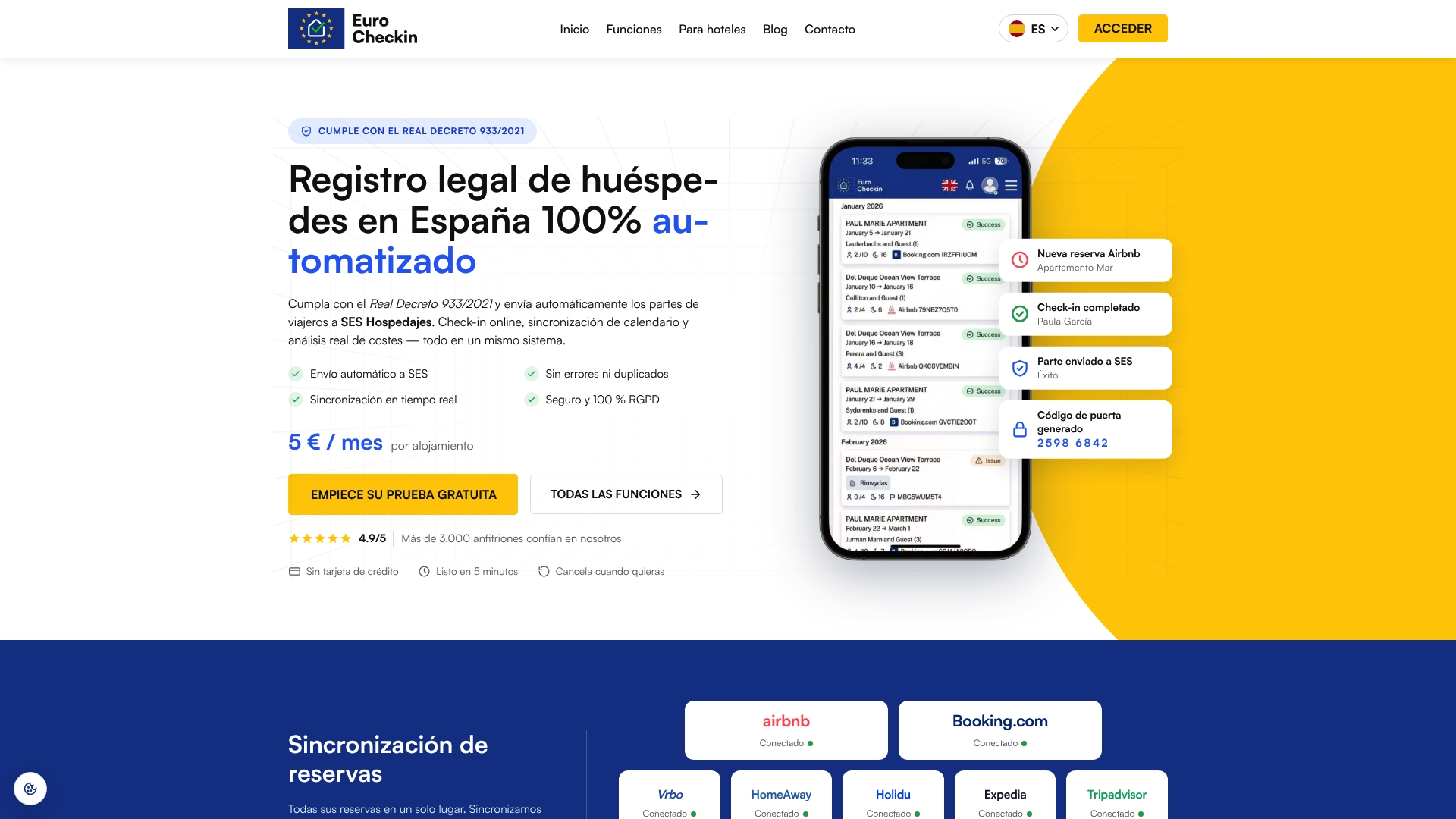
Eurocheckin was built around the exact stack described above, with legal compliance as the foundation rather than an add-on. It automatically transmits guest data to SES.Hospedajes in line with Real Decreto 933/2021 and GDPR, without manual entry or duplicate filings.
The platform covers:
- Multilingual, unlimited online check-in with smart links for Airbnb, Booking, and Vrbo
- Two-way calendar sync across more than 12 platforms to prevent overbookings
- Integration with TTLock, Nuki, and Yale smart locks for autonomous self check-in
- Digital contracts with electronic signature and house rules
- Invoice OCR for automated per-property expense tracking
- Guest-paid upsells processed through Apple Pay and Google Pay
Hosts using this setup report fewer manual registry entries, faster guest arrivals, and a compliant guest log that doesn’t require checking three separate systems.
Pro Tip: Run your first month tracking just two numbers: hours spent on manual check-in tasks and the count of SES.Hospedajes filings completed on time. Those two alone will tell you whether the platform is earning its subscription.
What Hosts Get Wrong About Automation Priorities
Most advice on rental automation treats every tool as equally urgent, which leads hosts to chase pricing algorithms and review-boosting apps before they’ve solved the boring, mandatory stuff. That’s backward.
The conventional wisdom oversells dynamic pricing as the automation with the biggest return. In practice, pricing tools optimize a business that’s already running cleanly. If your calendar sync is unreliable or your guest registry filings are inconsistent, better pricing just means more guests arriving into a shakier operation. Fix the plumbing before you fix the thermostat.
What gets underestimated is how much operational risk sits in the guest registration step. It’s not glamorous, and it doesn’t show up in a “top automation tools” listicle the way smart locks or AI pricing do. But a missed SES.Hospedajes filing carries real legal exposure, while a suboptimal nightly rate just costs you a few dollars of margin.
If you manage more than one unit, start with compliance and communication, not revenue tools. Everything else compounds on top of that foundation, not the other way around.
— Sofía Herrera
Start Your EuroCheckin Trial the Right Way
Eurocheckin charges a subscription of around $5 monthly per accommodation, with a free trial to test the full stack before you commit. That pricing shape means a five-unit host pays roughly what one missed compliance fine would cost, spread across a year instead of absorbed in a single penalty.
The smartest way to start is the same pilot approach covered earlier: activate the trial on one property, connect your calendar channels first, then turn on digital check-in and SES.Hospedajes reporting before adding smart locks and cleaning dispatch. Success after 30 days looks like zero missed legal filings, a measurable drop in manual messaging hours, and guests checking in without calling you for help.
If you’re currently juggling a spreadsheet for guest registry entries and a separate app for messaging, this is the point where consolidating pays off fastest. Start the trial and automate your guest registration today to see exactly how much manual work disappears in the first week alone.
Sources
- Cuenta atrás para el registro de viajeros: las claves y los retos de privacidad de la norma — Garrigues (Blog Turismo)
- RGPD hoteles y turismo España 2026: parte de viajeros, reservas y OTAs — Legiscope
This article is general information, not a substitute for advice from a qualified lawyer. Consult a qualified legal professional about your own circumstances before acting on anything here.
FAQ
What is the best short-term rental software?
The best choice depends on whether you need pure channel management or a compliance-first platform. For hosts operating in Spain, a system like Eurocheckin that combines calendar sync, digital check-in, and automatic SES.Hospedajes reporting covers both operational and legal needs in one subscription.
What does the 80/20 rule mean for Airbnb?
In rental management, it generally refers to the idea that roughly 20% of your tasks (guest messaging and registration) consume 80% of your manual time, which is why automating those two areas first delivers the biggest return.
What is the 90 day rule for short-term lets?
This rule varies by jurisdiction and typically caps how many nights per year a property can be rented short-term without additional licensing, most commonly cited in UK cities like London. It doesn’t apply uniformly across Spain, where short-term rental rules are set at the regional and municipal level instead.
What are the new short-term rental rules in Spain?
Spain’s Real Decreto 933/2021 requires hosts to report guest data telematically to SES.Hospedajes within 24 hours of reservation and retain those records for three years. Regional governments layer additional licensing and registration requirements on top of this national reporting obligation.