



There is no single nationwide tourist tax in Spain. A small number of regions, mainly Catalonia and the Balearic Islands, charge it, and your accommodation host or manager is legally responsible for collecting and remitting it. Ley 2/2026 raised Catalonia’s tariffs and clarified municipal surcharges, starting April 1, 2026, while exemptions and age cutoffs vary by region.
TL;DR:
- Tourist tax applies only in Catalonia and the Balearic Islands, with rates ranging from €1 to €4 per person per night, plus municipal surcharges.
- Catalonia’s 2026 law increased base tariffs and allows municipalities to add up to €8 per person per night, creating regional variation.
- The Balearic Islands’ ecotasa includes a 10% VAT, and rates vary by accommodation category and season, with exemptions for children under 16.
- Hosts are responsible for itemizing and remitting the tax, with common exemptions for minors, medical stays, subsidized programs, and day cruise visitors.
- No tourist tax exists in most regions of Spain, including Madrid and Costa del Sol, so travelers only pay if staying in Catalonia or the Balearics.
Table of Contents
- Where Tourist Tax in Spain Applies in 2026
- Catalonia’s 2026 Tax Changes: What Ley 2/2026 Actually Does
- Balearic Ecotasa Rates: What Mallorca, Ibiza, and Menorca Charge
- Who Actually Pays the Tourist Tax and Who’s Exempt
- How to Collect, Invoice, and File the Tax as a Host
- Penalties, Audits, and What Triggers Regulatory Scrutiny
- Why Compliance Should Be Operational, Not an Afterthought
- Let Eurocheckin Handle the Filing Details for You
- Sources
- FAQ
Where Tourist Tax in Spain Applies in 2026
If you’re booking a stay in Madrid or along the Costa del Sol, you won’t see a tourist tax line on your invoice. Those regions haven’t adopted one. Catalonia and the Balearic Islands are the two active regimes that matter for anyone tracking Spain visitor tax rates in 2026, and the amounts differ enough that budgeting by region, not by country, is the only approach that works.
Here’s the regional breakdown travelers and hosts need:
- Catalonia (including Barcelona): Base tariffs run roughly €1 to €4 per person per night depending on accommodation category, with Barcelona allowed a municipal recargo of up to €8 and other municipalities able to add up to €4 starting October 1, 2026.
- Balearic Islands (Mallorca, Menorca, Ibiza, Formentera): The Impuesto del Turismo Sostenible (ITS), commonly called the ecotasa, runs €1 to €4 per person per night depending on category, plus 10% VAT on the tax itself.
- Rest of Spain (Costa del Sol, Madrid, Valencia, and most other regions): No tourist tax currently applies.
Both active regions apply seasonality, charging more during peak summer months, and both exempt young children. Industry trackers peg the broader Spain travel tax range at roughly €1 to €7 per person per night once municipal surcharges are factored in, which lines up with what Catalonia’s 2026 changes now allow.
Catalonia’s 2026 Tax Changes: What Ley 2/2026 Actually Does
Catalonia’s Impuesto sobre las Estancias en Establecimientos Turísticos (IEET) got a real overhaul this year. Ley 2/2026, published in the BOE on March 6, 2026 and in force since April 1, 2026, raised base tariffs and rewired how municipalities can add their own surcharge on top of the regional rate.
The Agència Tributària de Catalunya (ATC) confirmed the increases and set new limits: Barcelona can apply a municipal recargo of up to €8 per person per night, while every other Catalan municipality gained the ability to levy a recargo of up to €4, effective October 1, 2026. That’s a structural shift. The regional government sets the floor, but city halls now have real leverage to add their own charge, so a stay in Barcelona and a stay in Tarragona can carry very different final bills, even under the same base law.
Calculation follows a strict rule: the tax applies per person per night, but Catalonia caps the taxable period at a maximum of seven units of stay per person at a single establishment. Stay eight nights, and you are only taxed for seven.
Hosts must:
- Itemize the tax as a separate line on every invoice, never folded into the room rate.
- File autoliquidaciones (self-assessments) through ATC’s electronic system on the required schedule.
- Retain documentation proving any claimed exemption, since undocumented exemptions get treated as taxable stays during a review.
Pro Tip: Keep a running log of nightly occupancy by guest and by property. If ATC ever questions a filing, having synchronized booking-channel records ready saves you from a drawn-out back-and-forth.
Balearic Ecotasa Rates: What Mallorca, Ibiza, and Menorca Charge
The Balearic Islands run their own system, the Impuesto del Turismo Sostenible, better known as the ecotasa. ATIB sets banded tariffs by accommodation category, and for 2026 those bands run from €1 to €4 per person per night, with luxury hotels and high-end vacation rentals sitting at the top of the range and budget hostels near the bottom.
A quirk that catches a lot of travelers off guard: the tax itself carries 10% VAT, so the amount on your final invoice is the banded rate plus that VAT layer. For a family booking a 4 star hotel in Majorca during high season, that typically means a per-person, per-night charge in the upper part of the band once VAT is added.
Key rules for owners and travelers:
- High season (roughly May through October) carries the full rate; low season rates drop, and stays beyond a set number of nights qualify for a long-stay discount.
- Children under 16 are exempt.
- Owners must register in the ATIB census under Model 017 and file periodically, typically through Model 700 quarterly declarations or annual summary models, all submitted telematically with a digital certificate or Cl@ve.
Who Actually Pays the Tourist Tax and Who’s Exempt
The guest is the taxpayer in every case, but the host or manager is the substitute obligated to collect the charge at check-in or on the invoice and remit it to the tax authority. That distinction matters for liability: if the tax goes uncollected, the regulator comes after the accommodation provider, not the traveler who already left.
Common exemptions apply in both Catalonia and the Balearics:
- Children under age 16 are exempt in the Balearics; Catalonia applies a similar age-based carve-out.
- Stays for medical treatment at a hospital or health facility are generally exempt, though documentation is required.
- Subsidized social stays, such as those funded through EU or public social tourism programs, are typically exempt.
- Cruise passengers on day visits without an overnight stay in a taxable establishment fall outside the tax entirely.
How to Collect, Invoice, and File the Tax as a Host
Getting collection right starts at booking, not at checkout. Presenting the charge early, whether through a line item in your booking engine or a clear note in your pre-arrival communication, avoids disputes at check-in.
Practical steps for accommodation managers:
- Add the tax as its own invoice line, separate from the nightly rate, for every reservation across every channel.
- File through ATC’s electronic system for Catalonia properties, or through ATIB’s telematic portal using Model 700, 710, or 790 depending on your Balearic filing regime.
- Reconcile occupancy data across Airbnb, Booking, and direct bookings before each filing period, since mismatched numbers are the fastest way to trigger a review.
- Retain invoices and occupancy records for the statutory retention period in case of an audit.
Pro Tip: If you manage more than one property, sync your calendar and check-in data through your property management software before filing. Manually reconciling spreadsheets across a dozen listings is where most filing errors start. A tool built for automating traveler registration can pull this data automatically instead.
Penalties, Audits, and What Triggers Regulatory Scrutiny
Tax authorities in both regions don’t need a full paper trail to act. Under Catalonia’s framework, ATC can apply an indirect estimation method to calculate what you owe if your autoliquidaciones are incomplete or your occupancy data doesn’t add up, and that estimate is rarely generous to the host.
Watch for these common triggers:
- Missing or late autoliquidaciones for one or more filing periods.
- Occupancy figures on your filing that don’t match your booking platform records.
- Exemptions claimed without supporting documentation on file.
- Invoices that bundle the tax into the room rate instead of itemizing it.
The fix is largely preventive: itemize every invoice, keep documentation for every exemption, and reconcile your booking channels before you file. Understanding the penalties for non-compliance with guest registration rules helps put the stakes in perspective, since tourist tax audits often surface alongside broader guest-registration compliance checks.
Why Compliance Should Be Operational, Not an Afterthought
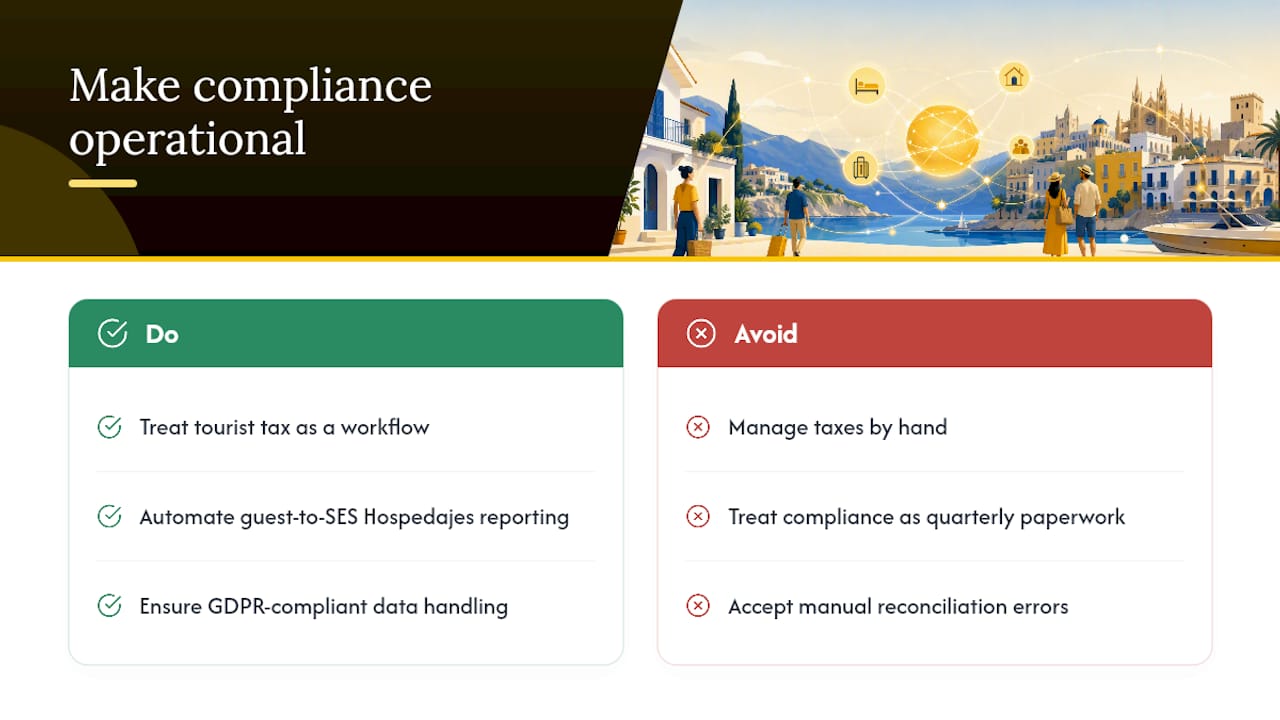
Managing tourist tax across multiple properties by hand is where most hosts lose money, not through fraud, but through small reconciliation errors that snowball into estimation penalties. Treating this as a workflow problem, not a once-a-quarter paperwork chore, is what actually protects your margin.
Automation that ties guest registration to SES Hospedajes reporting under Real Decreto 933/2021, with GDPR-compliant data handling, closes the gap between what you collect and what you file.
— Sofía Herrera
Let Eurocheckin Handle the Filing Details for You
Chasing occupancy numbers across Airbnb, Booking, and direct reservations, then reconciling them against a quarterly ecotasa filing, eats hours that a property manager doesn’t have. Eurocheckin closes that gap by automating traveler registration straight to SES Hospedajes while keeping every invoice itemized correctly, so the tourist tax line never gets buried in the room rate.
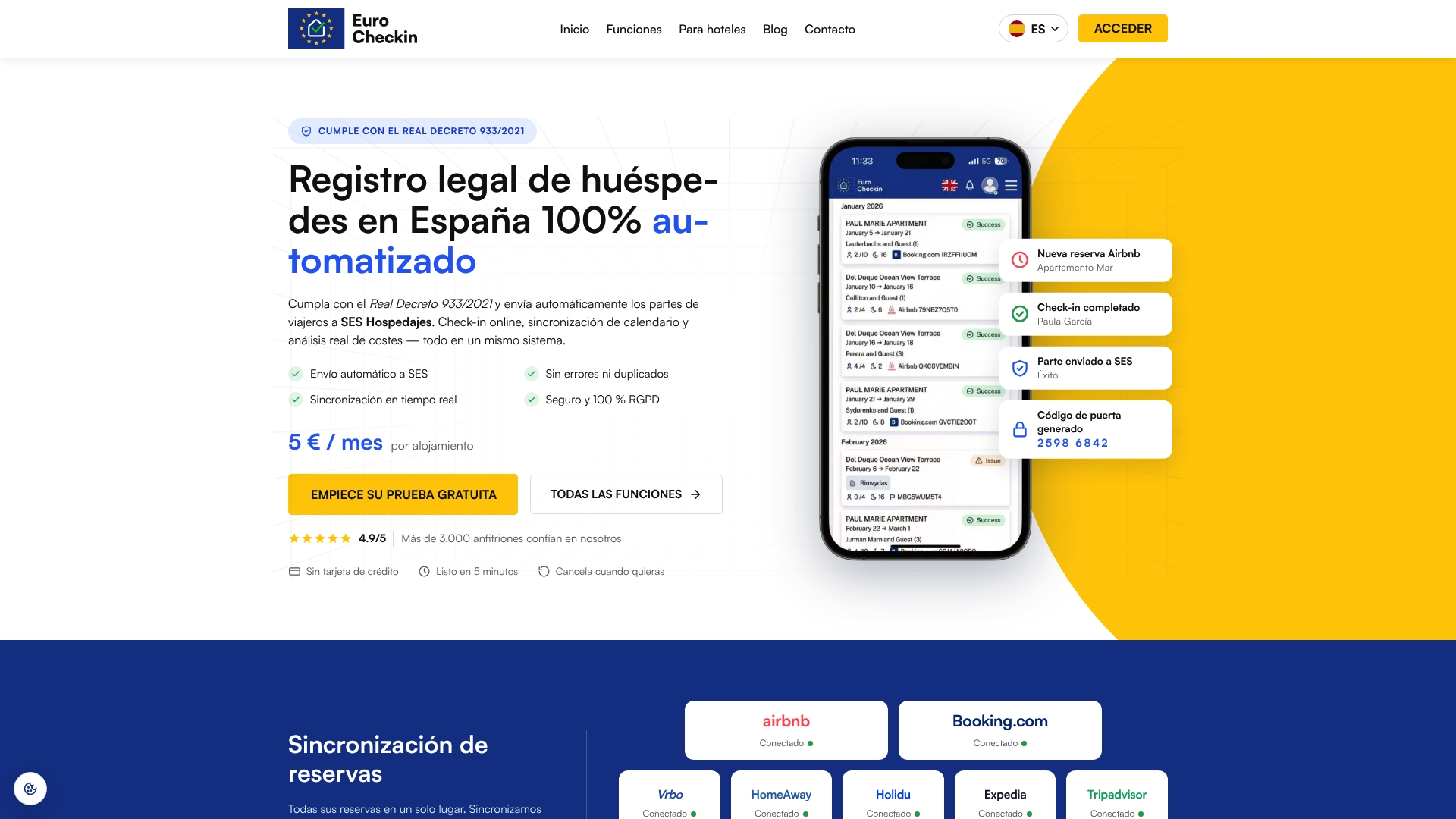
The platform syncs calendars across Airbnb, Booking, Vrbo, and more than a dozen other channels, which means your occupancy data stays consistent across every booking source, exactly the kind of record that protects you if ATC or ATIB ever asks questions. Digital contracts with e-signatures, multilingual online check-in, and smart-lock integrations with Nuki, TTLock, and Yale round out a self check-in flow that runs without you present. Explore Eurocheckin’s role in digital guest registration, and start a free trial to see how much manual filing work disappears from your week.
FAQ
Do I have to pay tourist tax in Spain?
Only if you’re staying in a region that charges it, currently Catalonia (including Barcelona) or the Balearic Islands (Mallorca, Ibiza, Menorca, Formentera). Most other regions, including Madrid and the Costa del Sol, don’t apply one.
Will there be a tourist tax in Spain in 2026?
Yes, the tax already applies in Catalonia and the Balearics, and Ley 2/2026 raised Catalonia’s rates and expanded municipal recargo powers effective April 1, 2026, with additional municipal surcharges allowed from October 1, 2026.
How much is tourist tax in a 4 star hotel in Majorca?
Balearic ITS bands run €1 to €4 per person per night depending on category, plus 10% VAT on the tax itself, so a 4 star hotel typically falls in the upper part of that range during high season.
Is there a tourist tax in Costa del Sol?
No. Andalusia, which includes the Costa del Sol, has not adopted a tourist tax as of 2026, unlike Catalonia and the Balearic Islands.