



Managing Airbnb and Booking reservations manually is one of the most costly mistakes a vacation rental owner can make. Updating calendars by hand, adjusting prices on each platform separately, and checking messages in multiple inboxes consumes hours every day. The result is almost always the same: overbooking, out-of-sync rates, and dissatisfied guests. The good news is that integrating these platforms with the right technology can save up to 80% of the time spent on management, freeing you up to focus on what really matters: providing an excellent experience and complying with regulations.
Table of contents
- What does integrating Airbnb and Booking entail?
- Maximize occupancy and revenue with a multichannel strategy
- Efficient management and risk reduction: real cases and challenges
- Regulatory compliance: how integration facilitates legality
- What expert owners and managers actually do
- Solutions for integration and regulatory compliance in Spain
- Frequently asked questions about Airbnb and Booking integration
Key Points
Spot
Details
Efficient synchronization
Integrating platforms reduces errors and saves up to 80% of time in reservation management.
Revenue maximization
The multichannel strategy increases occupancy and profitability by reaching different audiences and using dynamic pricing.
Regulatory compliance
The integration automates passenger reporting and helps avoid fines of up to €60,000.
Professional strategy
Successful managers combine automation, multichannel, and daily monitoring to operate effectively and comply with the law.
What does integrating Airbnb and Booking entail?
Now that we understand the need to manage multiple channels simultaneously, let’s explore how integrating these systems works. Integrating Airbnb and Booking means connecting both platforms through a centralized system that automatically synchronizes calendars, prices, and availability. The key element of this integration is the channel manager , a tool that acts as a bridge between your property and all the OTAs (Online Travel Agencies, such as Airbnb, Booking, and Vrbo) where your listing is published. There are two main types of systems you should know about:
- PMS (Property Management System): This is the central management system for your property. It controls reservations, billing, guest communication, and internal operations. Think of it as the brain of your business.
- Channel manager: It connects to the PMS and distributes information to all platforms in real time. When someone books on Booking.com, the channel manager automatically blocks those dates on Airbnb and any other active channels.
- API vs iCal: These are two connection methods. The API (Application Programming Interface) synchronizes data instantly. iCal updates calendars with delays of up to several hours, which increases the risk of errors.
The channel manager concept is fundamental to understanding why real-time synchronization prevents duplicate bookings and saves up to 80% of management time. Without this synchronization, every manual change on a platform is an opportunity for error. The main advantages of proper integration are:
- Almost total elimination of the risk of overbooking
- Automatic price and availability updates across all channels
- Reduction of administrative time and human errors
- Better guest experience thanks to always up-to-date information
Pro tip: Monitor the integration daily, especially during the first few months. Technical glitches can happen without warning, and catching them early prevents bigger problems with your guests and the platforms.
Maximize occupancy and revenue with a multichannel strategy
Knowing the technical basics, it is vital to understand the economic impact of managing several portals simultaneously. Not all travelers look for accommodation in the same place. Booking attracts a different user profile than Airbnb, and being present on both platforms multiplies your visibility to different audiences. Data from the Spanish market confirms this: Booking generates 54.3% of bookings for vacation rentals in Spain, while Airbnb accounts for 26.7%. Ignoring either one means missing out on a significant portion of the market. Furthermore, professional managers who integrate multiple channels and implement dynamic pricing achieve significantly better results. Guesty reports a 16-17% increase in revenue for accommodations with properly integrated listings. 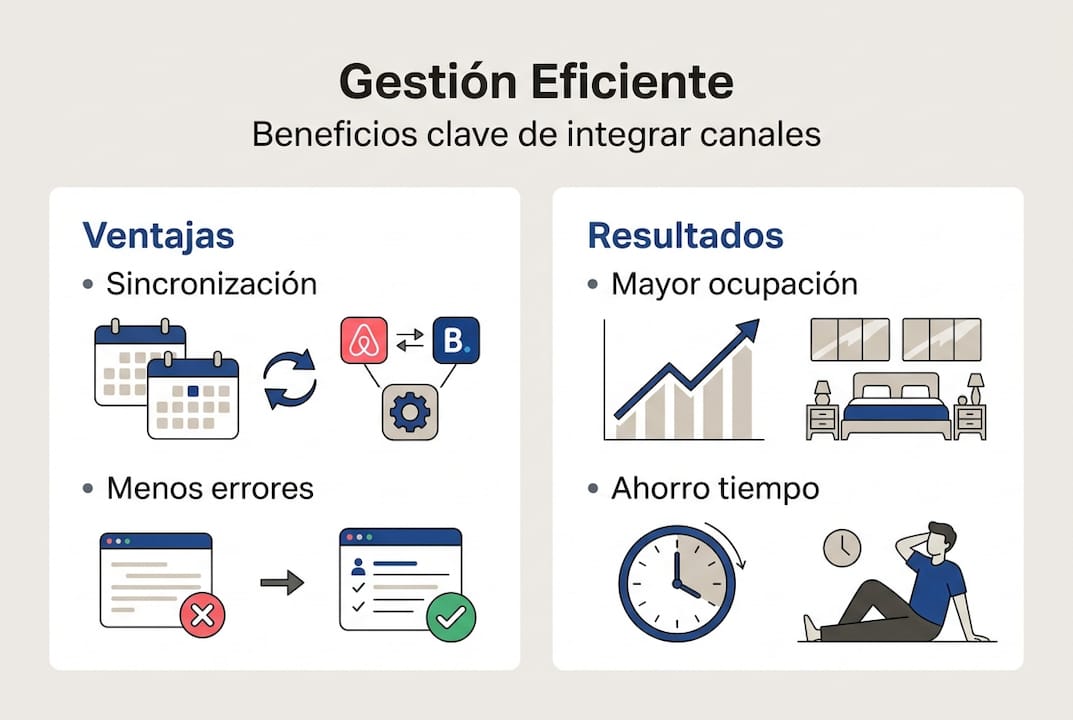
Comparison of platforms in Spain
Platform
VUT reservation quota
Main user profile
Booking
54.3%
Business traveler and general tourism
Airbnb
26.7%
Experiential and family tourism
Other OTAs
19%
Specific segments and niches
To maximize revenue with a multichannel strategy, follow these steps:
- Select your channel manager with a direct API connection to Airbnb and Booking, not just iCal.
- Configure dynamic pricing that automatically adjusts based on demand, season, and local events.
- Maintain price parity across platforms to avoid penalties from OTAs.
- Review the performance of each channel monthly and adjust your strategy based on the data.
- Check out a real-world integration case to understand how other owners in Spain have successfully implemented this strategy.
Pro tip: Use your channel manager to maintain price parity across platforms. Booking and Airbnb may penalize or reduce the visibility of your listing if they detect lower prices on other channels or your direct website without justification.
Efficient management and risk reduction: real cases and challenges
Profitability depends on both strategy and effective management of risks and technical problems.  Even with an active channel manager, errors can happen. Knowing about them in advance allows you to prevent them. The average national occupancy rate in Spain is 59.37% with an ADR of €195.87 (ADR is the average daily rate). In markets like Barcelona, occupancy rises to 75% with an ADR of €248. These margins mean that every booking lost due to an integration error has a real and measurable cost.
Profitability data by market
Market
Average occupancy
ADR (average nightly rate)
National media
59.37%
€195.87
Barcelona
75%
€248
Madrid
~65%
~€210
The most frequent problems in platform integration are:
- Duplicate reservations: These occur when synchronization takes too long, especially with iCal connections.
- Loss of rate parity: If you manually change prices on one platform without updating the others.
- Room typology desynchronization: When room categories are not correctly mapped between the PMS and the OTAs.
- Errors in minimum stay restrictions: Which can generate unprofitable gaps in the calendar.
To mitigate these risks, the most robust channel manager recommendations agree that you should prioritize the API over iCal for real-time synchronization. The practical difference is enormous: while iCal can take hours to update, the API does it in seconds.
“Constant monitoring and choosing the right connection method are the two factors that most impact the reliability of your multichannel integration.”
To avoid overbooking and maintain real synchronization between platforms, establish a weekly review protocol for your control panel and activate the error alerts offered by your channel manager.
Regulatory compliance: how integration facilitates legality
Just as important as efficient management is ensuring legality; let’s see how technological integration solves this key aspect. From July 2025, tourist accommodations in Spain are required to report traveler data to the Digital Single Window for Rentals, according to Royal Decree 1312/2024. This regulation complements Royal Decree 933/2021 and establishes strict requirements for identification and data communication. Fines for non-compliance can reach €60,000, and platforms are required to remove listings for accommodations that do not comply with the regulation. Modern channel managers and PMS systems integrate specific functionalities for this compliance. According to the SES.Hospedajes regulations , the systems must automatically report traveler data to the Single Window. Steps to automate regulatory compliance with your integration:
- Verify that your PMS or channel manager is certified to send data to SES.Hospedajes.
- Configure online check-in to collect identity documentation from each guest before their arrival.
- Activate the automatic sending of traveler reports to the relevant authorities.
- Review the traveler registration guide to ensure you meet all the required fields.
- Consult the updated regulatory compliance to learn about the changes applicable in 2026.
The risks of non-compliance are concrete:
- Administrative fines of up to €60,000 for serious offenses
- Forced removal of ads on OTA platforms
- Civil liability for incidents with unidentified guests
- Loss of tourist license in autonomous communities with strict controls
Key fact: From July 2025, simply registering guests on paper will no longer be sufficient. The system must send data digitally and in real time to the authorities, making integrated technology essential.
What expert owners and managers actually do
After reviewing the legal and technical dimensions, it is worth asking what the most successful managers do differently. The difference between an amateur property owner and a professional manager isn’t the number of properties they manage. It’s how they make operational decisions. Professional managers don’t rely on a single OTA. They distribute their inventory across multiple channels, maintain direct bookings through their own website, and automate every repetitive process they can. This isn’t just efficiency; it’s resilience in the face of algorithm changes, rising commissions, or new regulations. Managers who use multichannel automation achieve greater efficiency and regulatory compliance without additional manual effort. While the amateur owner updates calendars manually and sends out paper guest registration forms, the professional has everything automated and can manage ten properties in the same amount of time the other spends on one. Mandatory registration on Airbnb is a clear example: many hosts are still unaware of this requirement or believe the platform handles it automatically. Expert managers already have systems in place that do it automatically. Pro tip: Integrate a direct booking channel from day one. Reducing your reliance on OTAs by 10 or 15% can result in significant annual savings on commissions, which you can reinvest in technology or improving the guest experience.
Solutions for integration and regulatory compliance in Spain
For those who want to take action, there are tools that facilitate all these processes. Euro Checkin is specifically designed for owners and managers of tourist accommodations in Spain who need to automate guest registration, comply with current regulations, and synchronize their calendars between platforms without technical complications. 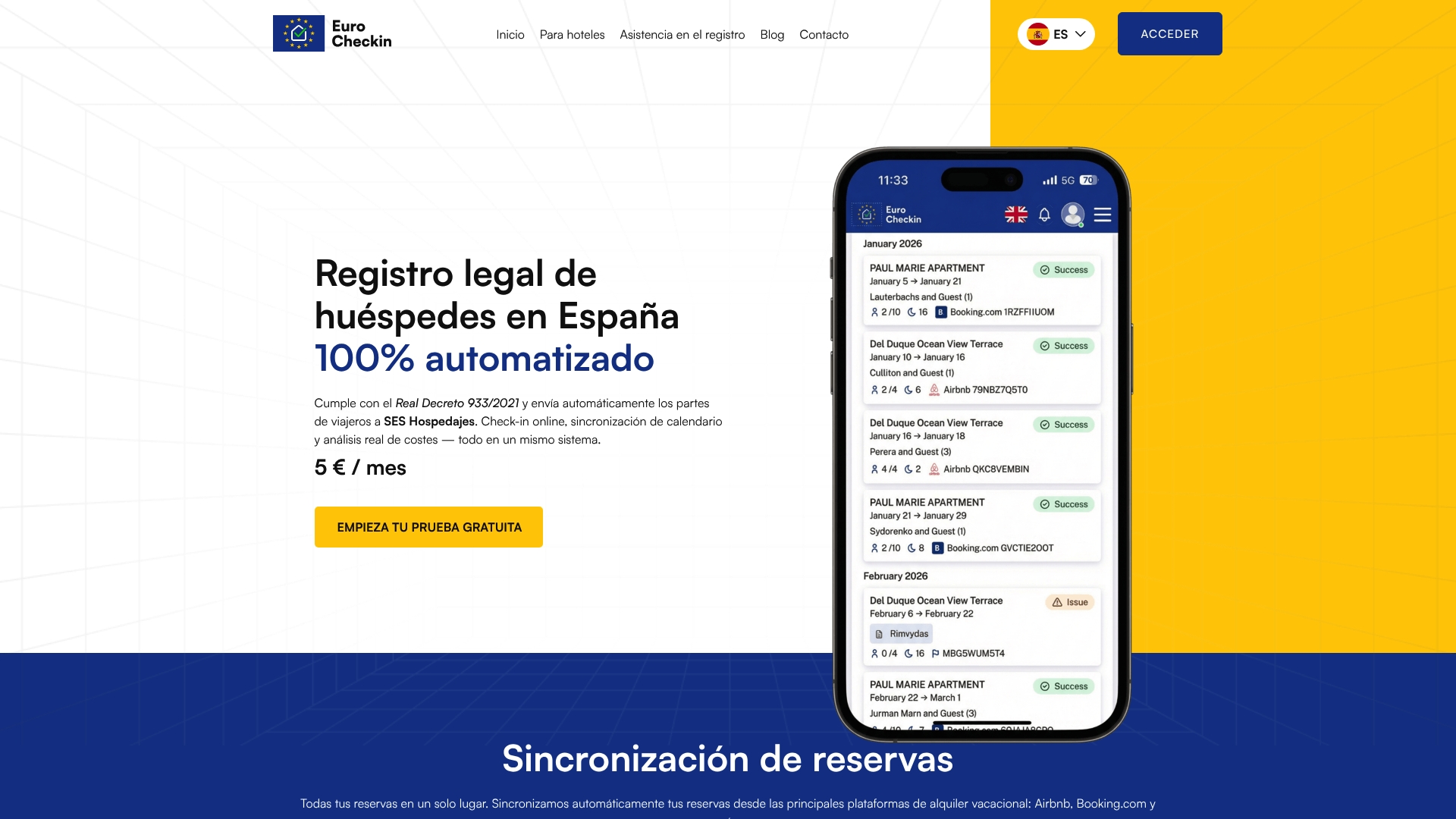 With Euro Checkin, you can automatically manage guest registration , complying with Royal Decree 933/2021 and Royal Decree 1312/2024 without manual intervention. The platform also fulfills the obligation to register guests on Airbnb and other OTAs, and offers real-time synchronization between Booking.com and Airbnb to keep your calendars always up-to-date. All on a single platform, with data stored within the European Union and support for legal requirements.
Frequently asked questions about Airbnb and Booking integration
What are the advantages of integrating Airbnb and Booking into a single system?
Integration saves time, minimizes errors, and increases efficiency by reaching diverse audiences. Integrating through channel managers can save up to 80% of the time spent on administrative tasks.
What does regulatory compliance for tourist accommodation in Spain entail?
You must register each traveler, verify their identity, and report the data to the Single Window in accordance with the regulations in force since 2025. Channel managers automatically report traveler data in compliance with Royal Decree 1312/2024, and the fine for non-compliance can reach €60,000.
What common problems occur when integrating multiple platforms?
The most frequent issues are duplicate bookings, loss of rate parity, and calendar desynchronization. Using the API instead of iCal is recommended, as this ensures real-time synchronization without delays.
How does integration improve positioning on OTA platforms?
Keeping your calendars and prices up to date improves your listing’s ranking and visibility, increasing bookings. Guesty reports a 16-17% increase in revenue for properly integrated listings.