



Use a PCI-compliant payment gateway or an integrated PMS with online check-in that supports staged billing and mandatory upsells. That combination reliably collects deposits, tourist taxes, and extras while keeping you aligned with PSD2 and Strong Customer Authentication (SCA). Your first move: pick a processor that offers tokenization and staged captures, then connect it to your check-in flow so fees get charged automatically instead of chased down manually.
TL;DR:
- Using staged billing with tokenization and a PCI-compliant processor enables automatic and secure collection of deposits, taxes, and extras.
- Combining direct host collection with OTA or channel payments balances control over timing and administrative effort depending on booking sources.
- Implementing mandatory, property-specific upsells for tourist tax and extra fees ensures full payment and compliance, reducing disputes and hidden charges.
- Proper authorization timing, documentation, and chargeback management are crucial to minimize liability and resolve disputes effectively.
- Integrating payment workflows with your PMS and check-in system automates fee collection, improves data accuracy, and enhances guest experience.
Table of Contents
- Best Ways to Collect Guest Fees Online
- How Do You Set Up Secure, PSD2-Compliant Payment Flows?
- How Do You Collect Tourist Tax and Extra Fees Online?
- Deposits, Authorization Holds, and Reducing Chargebacks
- Connecting Payments to Your PMS and Check-In Flow
- Handling Refunds, Cancellations, and Chargeback Disputes
- Do You Need Multi-Currency Support for International Guests?
- GDPR and Payment Data: What You’re Responsible For
- Balancing Guest Experience and Revenue Protection
- Automate Fee Collection Without Adding Admin Work
- Sources
- FAQ
Best Ways to Collect Guest Fees Online
You have four realistic options, and most successful operators combine two or three of them depending on booking source.
Host collect via gateway or PMS gives you full control over timing and payouts. You decide when the deposit gets charged, when the balance comes due, and how refunds get processed. The tradeoff is responsibility: you need PCI compliance and tokenization set up correctly, since you are the one holding the card relationship.
OTA or channel collect, including virtual credit cards, shifts that burden elsewhere. Platforms like Airbnb or Booking.com handle the guest transaction and pay you out on their schedule. You get less administrative work but also less say over disbursement timing, which matters if you are managing cash flow across a dozen properties.
Payment links and guest portals work best for direct bookings and anything outside the standard rate: late checkout, extra cleaning, a pet fee added after arrival. You send a link, the guest pays in seconds, and you get a clean digital receipt.
- Host collect: full control, requires PCI setup and staged captures
- OTA/channel collect: low effort, limited timing control
- Virtual credit cards: strong reconciliation, common for corporate and OTA-sourced stays
- Payment links: flexible for upsells and custom charges
- Bank transfer/SEPA: suited to large corporate bookings, but reconciliation stays manual
Bank transfers still show up for corporate group bookings and long stays, but they demand manual reconciliation that does not scale past a handful of reservations a month.
How Do You Set Up Secure, PSD2-Compliant Payment Flows?
Most European card payments over roughly €30 now require Strong Customer Authentication under PSD2, and 3DS2 is the mechanism that satisfies it. Skip this step and you will see rising decline rates as banks reject unauthenticated transactions, especially on the balance payment you try to capture close to arrival.
Pro Tip: Run a test booking through your own payment link before launch. If the 3DS2 challenge screen never appears, your processor is not enforcing SCA correctly, and that gap will surface as declined balance payments later.
Set this up in order:
- Choose a PCI-compliant processor that tokenizes card data at capture, so you never store raw card numbers or CVV codes on your own servers.
- Configure staged captures: authorize at booking, capture the deposit immediately, and schedule the balance capture for a set number of days before arrival.
- Enable Merchant Initiated Transactions for the balance and any post-stay charges, since the guest is not present to re-authenticate at that point.
- Keep authentication logs, receipts, and 3DS2 confirmation records tied to each booking for at least as long as your card network’s dispute window runs.
RoomRaccoon’s explainer on PSD2 compliance makes a strong case for centralizing this inside a PMS rather than running payments and check-in as separate systems. A security checklist for direct-booking sites adds the basics that still trip people up: HTTPS everywhere, visible cancellation terms, and a processor that publishes its own PCI DSS attestation.
How Do You Collect Tourist Tax and Extra Fees Online?
Tourist tax and mandatory fees need their own line item, separate from the nightly rate, or guests will dispute them as a hidden charge. The cleanest fix is a mandatory upsell built into online check-in: the guest cannot finish checking in without acknowledging and paying the tax.
- Calculate per booking, per night, per person, or with conditional rules (minimum-stay exemptions, age-based reductions for children)
- Make the tax step mandatory for direct bookings and OTA-sourced stays alike, since guests rarely read fine print in a booking confirmation email
- Customize enforcement by property or channel: some cities require the tax collected at check-in regardless of how the guest booked
- Generate and store a timestamped receipt for every tax payment, since local authorities may ask for remittance records
ChargeAutomation’s documentation on mandatory upsell configuration shows a workable pattern: attach the tax as a required step in the check-in workflow rather than an optional add-on buried in a welcome message. Optional fees get ignored. Mandatory ones get paid.
Deposits, Authorization Holds, and Reducing Chargebacks
Authorization holds and captured deposits solve different problems. A hold reserves funds without moving money, useful for damage protection you hope never to use. A captured deposit actually transfers funds and works better when you need guaranteed revenue at booking.

Card networks generally limit how long an uncaptured authorization hold can stay open, often around seven days, so time your hold placement close to check-in rather than at booking if you are using this method for security deposits.
A workable staged schedule looks like this:
- Deposit captured at booking (25 to 50 percent of total)
- Balance captured 3 to 7 days before arrival
- Security hold placed at check-in, released within 24 to 72 hours after checkout
- Automated refund triggers for cancellations inside your stated policy window
Pro Tip: Set a dollar threshold below which refunds process automatically, and require manager approval above it. This cuts response time on routine cancellations without opening the door to unchecked refund abuse.
Documentation wins disputes. Guesty’s guidance on chargeback prevention is blunt about it: hosts who lose chargebacks are usually the ones without a signed rental agreement, ID verification, or timestamped guest messages on file before the dispute lands.
Connecting Payments to Your PMS and Check-In Flow
Running payments separately from check-in creates duplicate work and missed fees. When the two systems talk to each other, a completed check-in can automatically trigger a payment link for outstanding balances, and a new booking can automatically schedule the deposit capture without anyone touching a spreadsheet.
- Look for token storage so saved cards can be charged later without re-entering details
- Require event triggers: booking created, check-in completed, balance due
- Confirm multilingual guest-facing pages, since a confusing checkout page in the wrong language kills upsell conversion
- Check for calendar sync across platforms and, where relevant, automated SES Hospedajes reporting alongside payment data
Properties that automate this sequence see higher tax and upsell collection simply because the payment request appears at the exact moment the guest is already engaged with the check-in process, not three days later in an easily ignored email.
Handling Refunds, Cancellations, and Chargeback Disputes
Refund policy needs to live in three places: the booking confirmation, the payment request, and the signed rental agreement. Guests who cannot find your cancellation terms in at least one of those spots will dispute a charge instead of requesting a refund through you directly, and a dispute costs you a processing fee even when you win it.
Automate what you can. Full refunds for cancellations inside a stated window should process without a human touching them. Partial refunds and anything involving property damage need a manual review step, ideally with a dollar threshold that routes larger amounts to a manager before the refund goes out.
When a chargeback does land, your evidence package determines the outcome more than your policy wording does. Card networks want to see the signed agreement, proof the guest agreed to the charge (a 3DS2 authentication log helps here), and any communication showing the guest was informed of the fee before it posted. Guesty’s chargeback guidance notes that hosts without this paperwork lose disputes far more often, regardless of how reasonable their original policy was.
Build a simple internal rule: no check-in completes without a signed agreement on file, and no refund above your threshold processes without a second set of eyes. That single rule catches most of the disputes that otherwise turn into a chargeback three weeks later.
Do You Need Multi-Currency Support for International Guests?
If a meaningful share of your bookings come from outside your home currency zone, yes. A guest who books in US dollars but gets charged in euros without warning will dispute the conversion, even when your processor’s exchange rate was fair.
The fix is showing the currency clearly before the guest pays, not after. Let the guest choose to pay in their home currency or yours, and display the conversion rate at the point of payment rather than burying it in a post-charge receipt. Processors built for multi-party payout logic generally handle this conversion transparently and settle to your account in your base currency, which keeps your accounting simple even when guest payments arrive in a dozen different currencies.
Watch for two practical issues: dynamic currency conversion fees that some processors add without clearly disclosing them, and exchange rate lag between authorization and capture on staged payments. A deposit authorized in one currency and captured weeks later at a different rate can create a small mismatch that confuses guests if your receipts don’t explain it. Keep your payment confirmation language consistent about which currency the guest is actually being charged in, and avoid switching currencies mid-booking between the deposit and balance payment.
GDPR and Payment Data: What You’re Responsible For
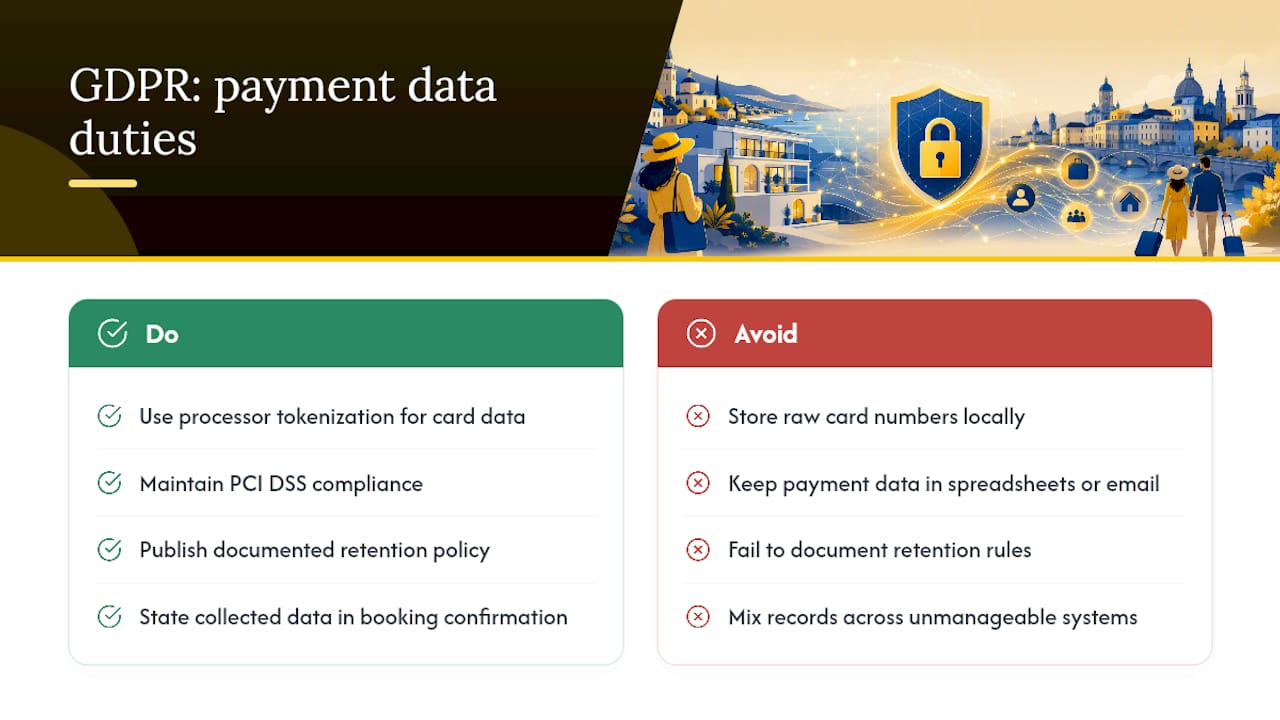
Storing guest payment details without proper safeguards violates GDPR even if the guest never disputes a charge. The obligation applies the moment you collect a name, card token, or booking record tied to an identifiable person, which covers nearly every payment transaction you process.
Tokenization solves most of this problem structurally. When your processor tokenizes card data, you never hold the raw card number, which means a data breach on your end exposes far less liability since there’s nothing usable to steal. Pair that with PCI DSS compliance and you have covered the two biggest technical requirements regulators actually check for.
The parts operators miss are procedural, not technical. You need a documented retention policy that says how long guest payment and identity records stay on file before deletion, a clear statement in your booking confirmation about what data you collect and why, and a process for honoring a guest’s request to have their data removed once legal retention requirements expire. A guide to tourist data security covers the practical side of this for property managers handling both payment and identity information under one system. Keep payment records and guest identity records in systems that support export and deletion on request, since a scattered mess of spreadsheets and email attachments makes compliance nearly impossible to demonstrate if a regulator ever asks.
Balancing Guest Experience and Revenue Protection
The friction question comes down to this: charging the full amount at booking is simpler to administer, but staged capture protects you better against no-shows and chargebacks. I lean toward staged billing for anything beyond a short direct booking, because the operational cost of setting it up once is lower than the recurring cost of disputing chargebacks one at a time.
Small operators should prioritize automation over sophistication. A payment link, a clearly stated policy, and check-in software that enforces mandatory fees will outperform a complex system nobody maintains. General-purpose processors work fine at low volume, but once you are managing seasonal spikes across multiple properties, a travel-specialist gateway that understands staged billing tends to save you from merchant account freezes down the road.
— Sofía Herrera
Automate Fee Collection Without Adding Admin Work
Eurocheckin is the alternative to juggling separate check-in forms and payment tools for properties that need both compliance and revenue collection handled in one place. Instead of chasing tourist tax payments manually or bolting a payment link onto an unrelated check-in system, you can run mandatory upsells directly inside a multilingual online check-in flow, with guests paying instantly via common digital wallets in seconds.
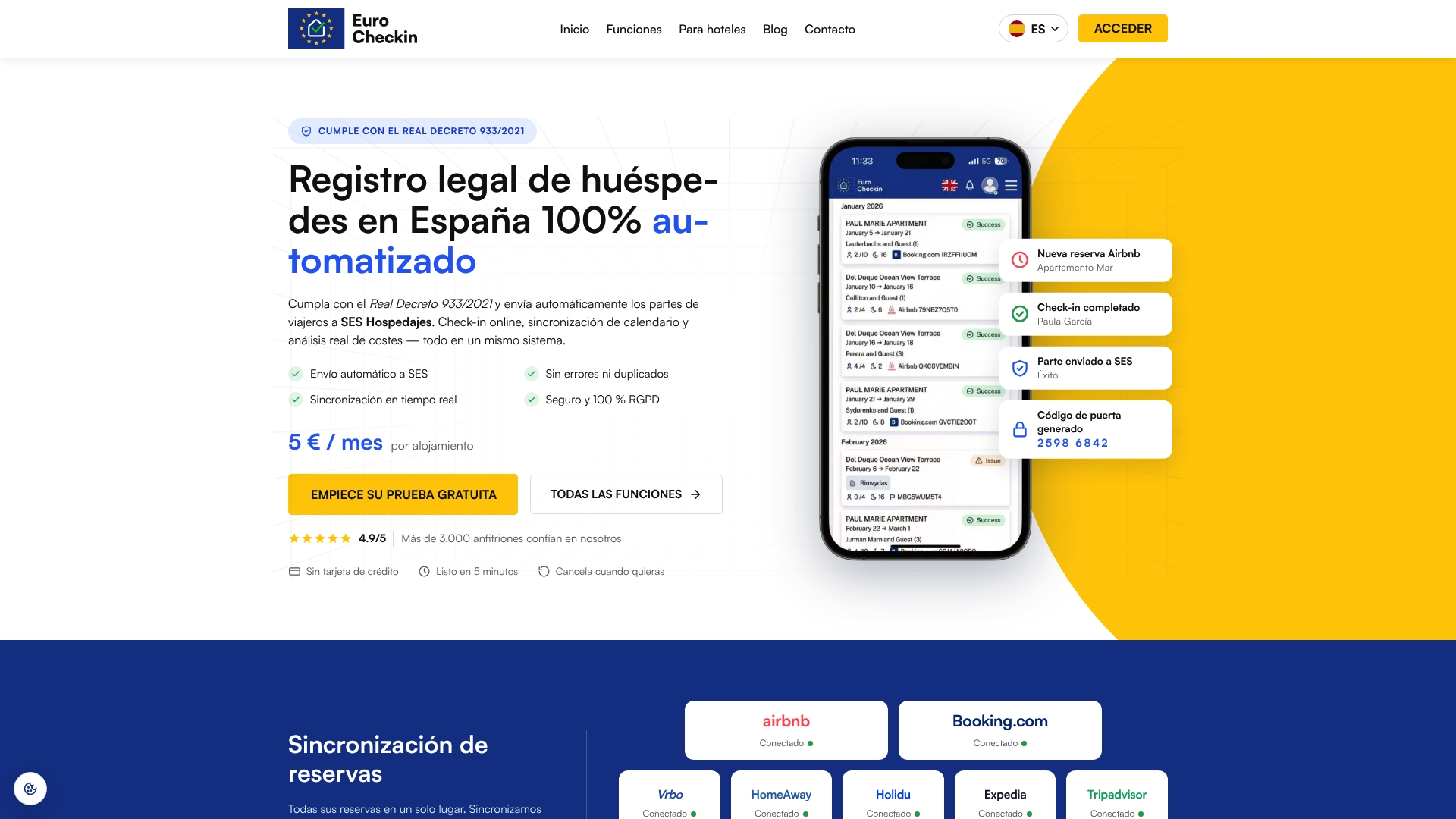
The platform also handles the compliance side that payment collection alone does not touch: automated reporting to SES Hospedajes under applicable regulations, digital contracts with e-signatures, and smart lock integration with leading brands for self check-in that never requires you on site. Hosts can create and launch a new paid add on quickly without any IT work, turning fee collection into a revenue channel instead of a chasing exercise.
Plans start at 5 EUR per month per property for vacation rentals, or 3 EUR per month per room for hotels, with a free trial available. Start the trial on the Eurocheckin homepage and connect your first property’s check-in and payment flow today.
Sources
FAQ
How Can I Collect Guest Payments Online?
Set up a PCI-compliant payment gateway or an integrated PMS with tokenization, then use staged billing to capture a deposit at booking and the balance closer to arrival. Add payment links for extras and upsells so guests can pay for add-ons without a separate checkout process.
How Do I Collect a Payment From a Guest Who Already Checked In?
Send a payment link tied to the specific charge, whether that’s a late fee, damage cost, or extra service, and require card details only through a PCI-compliant form. For a recurring pattern of post-stay charges, a Merchant Initiated Transaction on a saved token avoids asking the guest to re-enter payment details.
What Is an Extra Guest Fee?
An extra guest fee is a charge added when the number of occupants exceeds the number included in the base nightly rate, common in vacation rentals with per-person pricing tiers. It should appear as a separate line item during booking or check-in, calculated per person, per night, or as a flat additional charge depending on your pricing structure.
How Can I Collect Payments on My Own Booking Website?
Use HTTPS throughout, connect a PCI-compliant processor, and display your cancellation and payment policy clearly before checkout. A check-in platform that supports payment links and mandatory upsells lets you collect deposits and extras without building a custom payment system from scratch.
Does Eurocheckin Handle Guest Fee Collection?
Eurocheckin supports mandatory upsells during online check-in, letting guests pay for extras and add-on services instantly through Apple Pay or Google Pay. Pricing runs from 5 EUR per month per property for vacation rentals or 3 EUR per month per room for hotels, with a free trial available.