



Use a regulation-aware, PMS-connected online check-in form that automates the “parte de viajeros” submission to SES Hospedajes and keeps optional marketing data completely separate from mandatory legal fields. That single decision solves most of what trips up owners: compliance, guest friction, and staff time lost to manual entry.
Your next step is concrete: enable an online check-in form on one property, run a single test booking through it, and confirm the data reaches SES Hospedajes correctly before rolling it out everywhere.
- Legal anchor: Real Decreto 933/2021 requires accommodation providers to collect specific traveler data and transmit it electronically, often within 24 hours of arrival.
- GDPR caution: biometric identification methods count as a special data category and generally require an alternative, non-biometric path for guests who decline.
Key Takeaways
A compliant online check-in form works only when it separates mandatory SES Hospedajes reporting fields from optional marketing consent while automating both the legal submission and the guest experience.
| Point | Details |
|---|---|
| Lead with mandatory fields | Collect name, ID number, nationality, DOB, and address first; marketing questions come in a separate block. |
| Automate SES Hospedajes reporting | Connect your form directly to the SES Hospedajes channel and test transmission before full rollout. |
| Avoid biometrics by default | Offer document upload and visual checks as standard; treat facial recognition as an opt-in extra requiring a DPIA. |
| Test before scaling | Run an internal booking, a mobile guest test, and a no-internet fallback before enabling on every property. |
| Choose an integrated platform | Eurocheckin combines SES Hospedajes automation, PMS/OTA sync, e-signatures, and smart lock access in one subscription. |
This article is general information, not a substitute for advice from a qualified lawyer. Consult a qualified legal professional about your own circumstances before acting on anything here.
Table of Contents
- Why Use an Online Check-In Form
- What Does the Guest Experience Look Like Step by Step?
- What Fields Must You Collect for Legal Compliance?
- How Should You Handle ID Verification and Biometrics?
- How Do You Set Up and Launch the Form?
- What Should You Look for in a Check-In Provider?
- What Does Pricing and ROI Look Like?
- Get a Compliant Check-In Form Running Without an IT Team
- Sources
- FAQ
Why Use an Online Check-In Form
The time savings are the first thing owners notice. A guest who fills out their details on a phone before arrival means your reception staff isn’t retyping a passport number at 11 p.m. while three other guests wait in line. Integrated check-in flows reduce manual re-entry and the transcription errors that come with it, particularly on document numbers, which are the fields most often mistyped by hand.
Beyond staff time, the business case is just as strong:
- Fewer booking mismatches because guest data syncs directly from the reservation.
- Cleaner data for SES Hospedajes, which lowers the risk of rejected submissions.
- A natural moment to offer paid extras (early check-in, parking, breakfast) that guests actually see before they arrive.
- Better first impressions, which tend to show up later in review scores.
Pro Tip: Send the check-in link the same message your OTA confirmation arrives in. Guests who complete forms while booking excitement is still fresh finish them at a much higher rate than those who get a separate email three days later.
The form also becomes the trigger point for smart locks. Once mandatory fields and a signed contract are in, an autonomous arrival with a digital key is possible without anyone standing at the door.
What Does the Guest Experience Look Like Step by Step?
A well-built digital check-in form follows a predictable path from link to arrival:
- You send the check-in link by email, SMS, or an automated OTA message, ideally 48 to 72 hours before arrival.
- The guest opens it on their phone (most completions happen on mobile, not desktop).
- They fill in mandatory legal fields first: full name, ID type, ID number, nationality, date of birth.
- They upload a photo of their ID or passport, if your setup requires document verification.
- They e-sign the rental contract and house rules.
- They pay any deposit or optional add-on, often through Apple Pay or Google Pay.
- They receive confirmation plus arrival instructions, whether that’s a lockbox code, a smart lock PIN, or a front-desk pickup time.
Guests without internet access or limited comfort with forms still need a path in. Keep a simple paper fallback at reception and have staff complete the digital form on the guest’s behalf during check-in.
Pro Tip: Use progressive disclosure. Show only the mandatory legal fields on the first screen, and reveal optional questions (arrival time, preferences) after. Guests abandon long forms fast when every field appears at once.
What Fields Must You Collect for Legal Compliance?
This is where most forms go wrong. Confusing legally mandatory data with optional marketing questions creates both a compliance gap and a consent problem.
Under Real Decreto 933/2021, the traveler register must include:
- Full name and gender
- Document type (DNI, passport, or TIE) plus ID number and support number
- Nationality and date of birth
- Residence address and contact details (phone, email)
Providers must retain these records for three years and transmit them electronically, often within 24 hours of the guest’s arrival. Miss the field list or the deadline, and you’re exposed to enforcement action, which is worth reading up on separately if you want the specific fine ranges for non-registration.
Optional fields, by contrast, belong in a distinct block: marketing opt-in, room preferences, special requests, dietary notes. Legal guidance is direct on this point: bundling mandatory registration with marketing consent on the same checkbox is a common and avoidable mistake. Present separate information clauses, store consent evidence separately from the register itself, and never make marketing opt-in a condition for completing check-in.
How Should You Handle ID Verification and Biometrics?
Most properties don’t need facial recognition to verify a guest. A photo upload cross-checked against the reservation name, combined with a quick visual glance at arrival, covers the vast majority of cases without touching sensitive data categories.
Where owners get into trouble is biometric shortcuts. Facial recognition or fingerprint check-in falls under a special category of data in GDPR article 9, and Spain’s data protection authority interprets this strictly. Expect to justify why biometrics are necessary, offer a working non-biometric alternative, and in many cases run a Data Protection Impact Assessment before deployment.
- Default to document upload plus manual visual check, not biometric scanning.
- If you use mobile keys, limit that identifier’s use strictly to the length of the stay.
- Document your legal basis before you ever ask a guest to scan their face.
Pro Tip: Offer biometric login only as an opt-in extra, never the default. Guests who understand the benefit (skip-the-line entry) tend to accept it; guests who feel it was forced on them complain, and complaints attract regulatory attention.
How Do You Set Up and Launch the Form?
Configuration is mechanical once you know the order of operations. Work through it in this sequence:
- Enable online check-in in your platform and select mandatory legal fields first.
- Add optional fields in a visually separate block, with its own consent language.
- Configure document upload and e-signature for contracts and house rules.
- Set data retention rules and restrict access to registration records to staff who genuinely need it.
- Connect your PMS and OTA calendars so guest data flows in automatically instead of being retyped.
- Enable payment processing (Apple Pay, Google Pay) for deposits and upsells.
- Confirm your SES Hospedajes transmission is active and correctly mapped to the required fields.
Testing matters as much as configuration. Run an internal test booking first, then a real guest-facing test on a phone, not just a desktop browser. Verify the SES Hospedajes submission actually goes through, simulate a guest with no internet access to confirm your fallback works, and test the smart lock or key handoff end to end.
Pro Tip: After launch, track completion rate weekly for the first month. A sudden drop usually means a field got too long or a payment step is confusing, not that guests suddenly stopped cooperating.
What Should You Look for in a Check-In Provider?
Not every platform that calls itself “digital check-in” actually handles the legal side. Prioritize these criteria over interface polish:
- Compliance support: built-in SES Hospedajes reporting, preconfigured legal fields, and audit logs you can produce if authorities ask.
- Data security: encryption at rest and in transit, role-based access controls, and clear retention settings.
- Integrations: two-way PMS and OTA calendar sync, payment gateways, e-signature, and smart lock compatibility (TTLock, Nuki, Yale are common standards).
- Operational fit: multilingual guest-facing links, automated reminder messages, and a support team that answers when a transmission fails at 9 p.m.
- Commercial model: subscription per accommodation tends to suit portfolios with steady occupancy, while per-check-in pricing can suit very seasonal or low-volume properties.
Owners running a handful of vacation rentals usually prefer a flat monthly rate they can budget around. Larger hotel groups sometimes negotiate volume pricing instead, but the underlying compliance features should be identical regardless of size.
What Does Pricing and ROI Look Like?
Most check-in software follows one of two pricing shapes: a monthly subscription per managed accommodation, or a per-check-in fee that scales with volume. Entry-level SaaS plans for this category often start in the single-digit euros per month per unit, with cost rising based on the number of properties, SMS volume, and add-ons like biometric verification or smart lock integration.
A quick way to think about payback: if manual check-in takes 10 minutes of staff time and a form cuts that to 2 minutes, an 8-minute saving across 20 monthly arrivals adds up fast at any reasonable hourly reception wage. Add in even a modest uptake on paid upsells, and the subscription typically pays for itself well before the free trial period ends.
- Low, predictable monthly pricing per accommodation is the norm, not the exception.
- A free trial period reduces the risk of committing before you’ve tested transmission and guest completion rates.
A Note From the Field
The most common setup mistake isn’t legal, it’s structural: owners jam marketing questions into the same form as the mandatory register and end up with messy consent records. Start with one property, separate the two data flows from day one, and the rest of the rollout goes smoothly.
Compliance and a smooth guest experience aren’t in tension once the form is built correctly. Run a real SES Hospedajes transmission test before you flip the switch on additional properties.
Get a Compliant Check-In Form Running Without an IT Team
Eurocheckin is the practical answer for owners who want the legal side handled automatically, not bolted on as an afterthought. It reports guest data to SES Hospedajes in line with Real Decreto 933/2021, keeps mandatory fields separate from optional marketing consent, and syncs calendars across Airbnb, Booking, Vrbo, and more than a dozen other platforms so nothing gets double-booked.
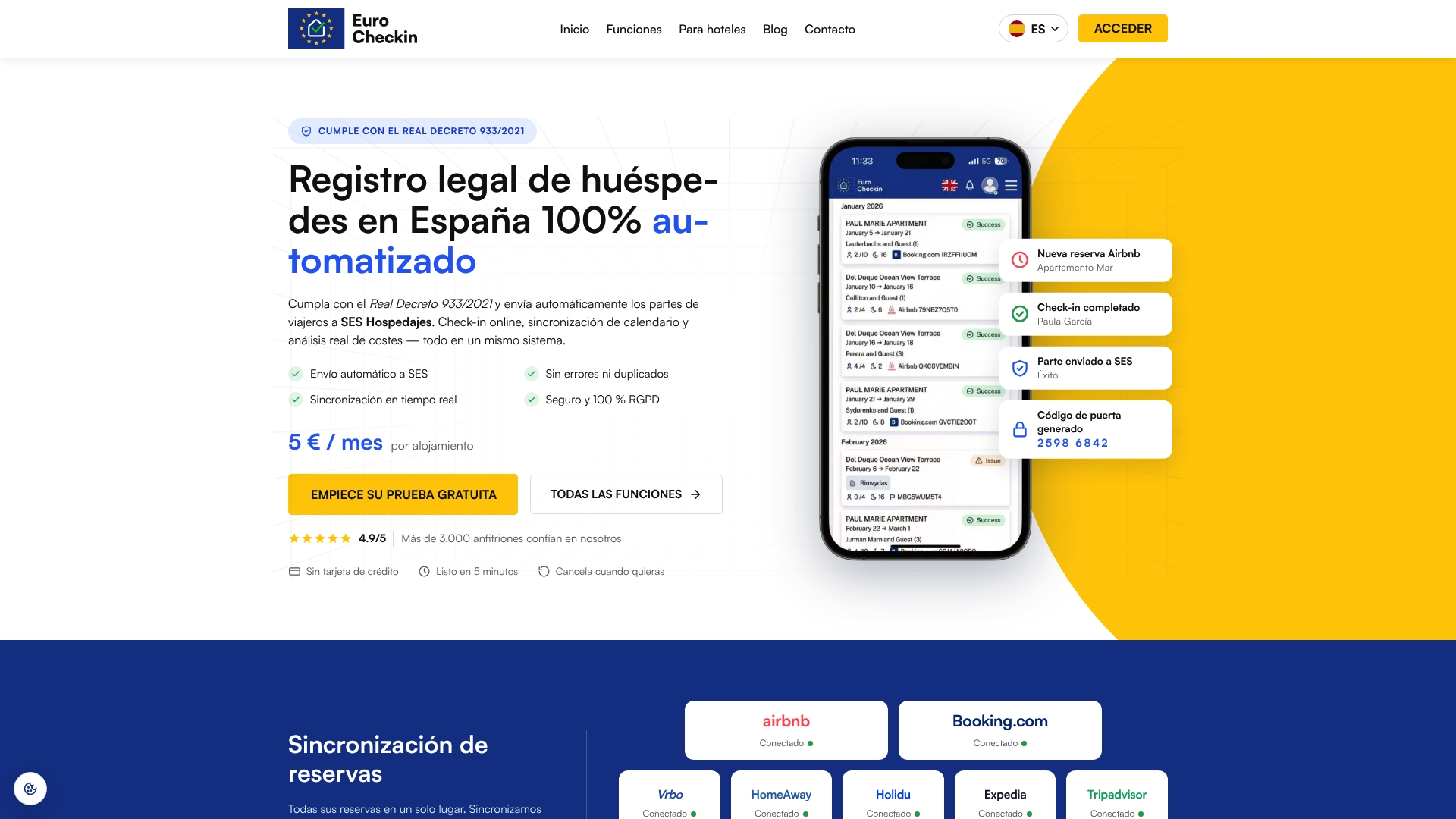
The platform adds digital contracts with e-signatures, multilingual check-in links, and self check-in through TTLock, Nuki, and Yale smart locks, plus Apple Pay and Google Pay support for deposits and upsells. It fits owners and managers in Spain who need compliant automation without hiring an IT team. Plans start around $5/month per accommodation, and a free trial lets you test one property before committing further. Start with the vacation rental check-in setup to see how quickly a single listing goes live.
Sources
- BOE-A-2021-17461 Real Decreto 933/2021 — BOE
- SES Hospedajes — Ministerio del Interior (Spain)
- Data protection in hotels — LetsLaw
- Data protection guidance for Spain — Linklaters
FAQ
What Is an Online Check-In Form?
It’s a digital form guests complete before arrival that captures the legally required traveler data and transmits it to authorities like SES Hospedajes, replacing paper registration.
Is Online Check-In Legally Required in Spain?
Collecting and transmitting specific traveler data is mandatory under Real Decreto 933/2021, though the form itself can be paper or digital; digital simply makes the 24-hour transmission deadline easier to meet.
Can I Use Facial Recognition for Check-In?
You can, but biometric data is a special category under GDPR that generally requires explicit consent, a working non-biometric alternative, and often a Data Protection Impact Assessment.
How Long Must I Keep Guest Registration Data?
Traveler register records must be retained for three years under Real Decreto 933/2021, separate from any marketing data you collect with distinct consent.
Does Eurocheckin Handle SES Hospedajes Reporting Automatically?
Yes, Eurocheckin sends guest data to SES Hospedajes automatically in compliance with Real Decreto 933/2021 and GDPR, removing the manual submission step entirely.