


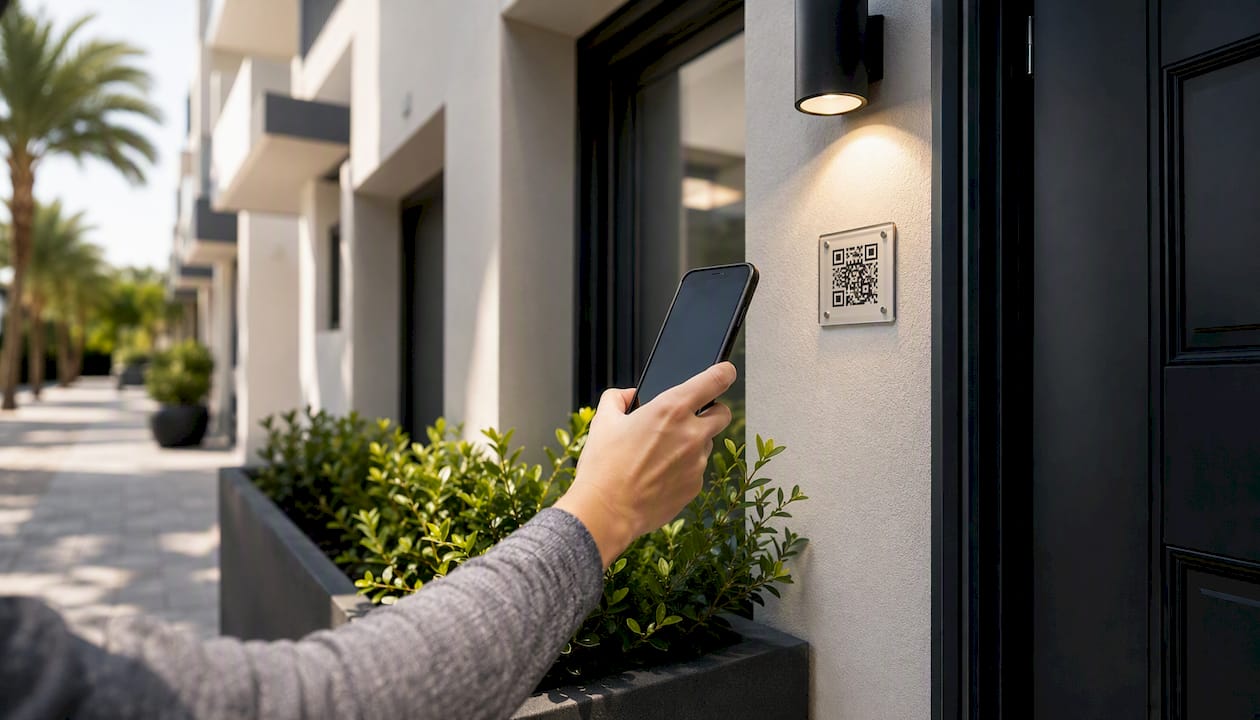
A QR code check-in can satisfy RD 933/2021 registration and SES.HOSPEDAJES reporting, but only when the form captures every required field, the register lives on EU-hosted infrastructure, and submission to the authorities runs automatically. That’s the whole verdict. The details determine whether you’re compliant or exposed.
Before you activate any QR-based system, check three things first:
- Is your establishment already registered on SES.HOSPEDAJES with the correct activity type?
- Does your check-in form collect every field listed in Annexes I and II, not just a name and passport number?
- What is your data retention policy, and does it match the three-year window RD 933/2021 require?
RD 933/2021 sets a three-year retention requirement and mandates transmission through SES.HOSPEDAJES, often within 24 hours of a reservation or the start of service. A QR code check-in that skips either of those two mechanics isn’t a compliance tool. It’s just a faster way to collect names.
Key Takeaways
A compliant QR code check-in requires capturing every Annex I and II field, hosting records in the EU, and automating SES.HOSPEDAJES transmission within the required window.
| Point | Details |
|---|---|
| Register before you build | Confirm your SES.HOSPEDAJES registration and activity type before configuring any check-in form. |
| Map the full data set | Collect every field in Annexes I and II, not a shortened version of a passport scan. |
| Respect the 24-hour rule | Transmit reservation and service-start data to SES.HOSPEDAJES within the required window. |
| Retain records for three years | Store completed guest registers for three years from the end of the stay, per RD 933/2021. |
| Consider EuroCheckin for turnkey setup | EuroCheckin automates SES.HOSPEDAJES submission, hosts data in the EU, and starts near €5 per month per accommodation with a free trial. |
Table of Contents
- How Does a QR Code Check-In Workflow Actually Function?
- What Does RD 933/2021 Actually Require From Hosts?
- How Do You Set Up QR Check-In Across Your Properties?
- How Do You Keep Guest Data Secure With QR Check-In?
- What Does QR Check-In Cost and How Long Does Setup Take?
- Why Does EuroCheckin Fit Compliance-First Operators?
- Try QR Check-In With Compliance Built In
- Where to Verify These Rules Directly
- Sources
- FAQ
How Does a QR Code Check-In Workflow Actually Function?
A compliant workflow follows a fixed sequence, and skipping a step anywhere in that chain creates a compliance gap, not just a user experience hiccup.
Here’s the typical path from scan to submission:
- QR generation: a unique code is created per booking or per property, often tied to the reservation reference from your channel manager.
- Guest scans and lands on a multilingual form: no app download, just a browser-based page in the guest’s language.
- Identity capture: OCR reads a passport or ID card, or the guest types details manually if OCR fails or isn’t available.
- Electronic signature: required for guests aged 14 and older, capturing consent and confirming the data entered.
- Digital register storage: the completed record is stored on EU-hosted servers, not on a local spreadsheet.
- SES.HOSPEDAJES transmission: submitted automatically, or queued for transmission if there’s a temporary connectivity issue.
Channel sync sits quietly behind this whole process. When your calendar connects to Airbnb, Booking, and Vrbo, the system knows which guest is checking in and prevents duplicate registrations for the same reservation. Smart-lock integrations plug in right after the signature step, releasing a digital key or access code only once the register entry is complete.
The minimum data set matters more than most hosts realize. Annexes I and II require name, document type and number, nationality, date of birth, contact details, and in many cases transaction data, plus exact check-in and check-out timestamps.
Pro Tip: Run a dummy booking through your full workflow before going live. Use the SES.HOSPEDAJES sandbox or a dry-run transmission to confirm your field mappings match what the platform expects. A mismatched date format or a missing nationality code is the most common reason first submissions get rejected.
What Does RD 933/2021 Actually Require From Hosts?
RD 933/2021 is the regulation driving every technical decision behind a QR code check-in, and it’s worth understanding the core mechanics rather than treating it as background noise.
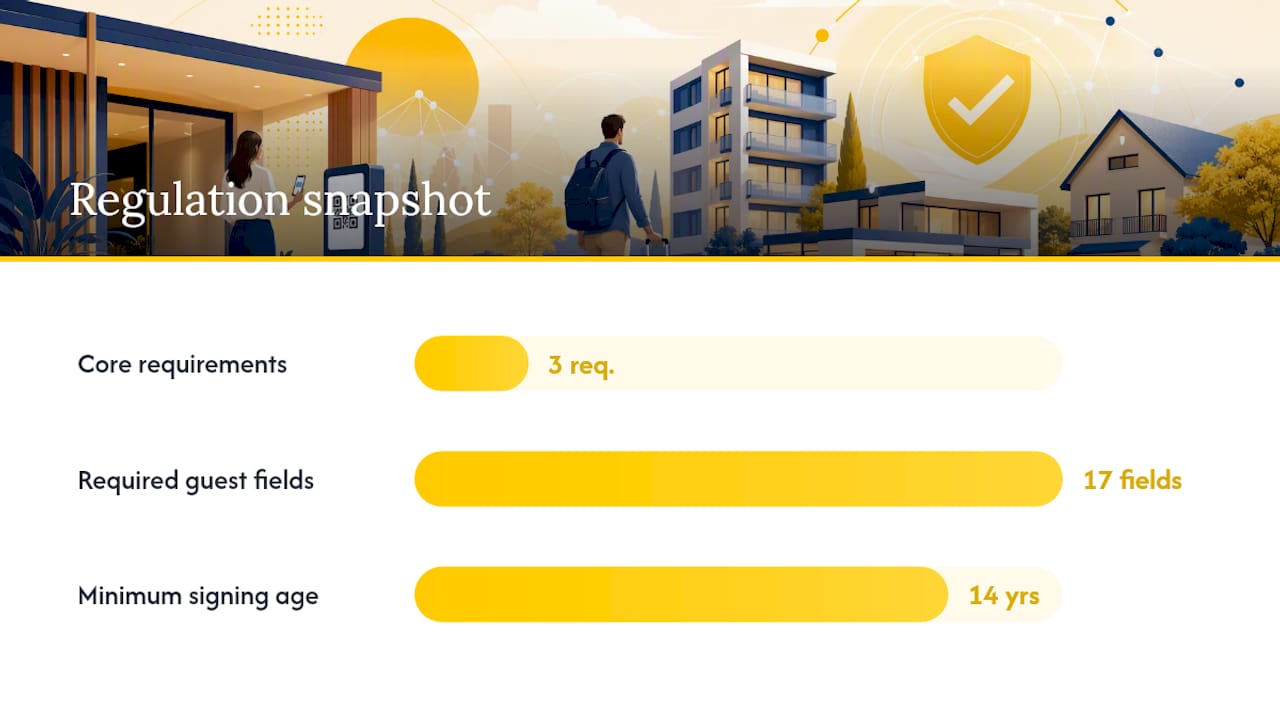
The rule requires three things, in plain terms:
- A computerized register containing the guest data fields listed in Annexes I and II of the decree.
- Telematic transmission of that data through SES.HOSPEDAJES, with a 24-hour window for reservations and the start of service in most cases.
- Three-year retention of every record, counted from the end of the guest’s stay.
Practitioner summaries describe the expanded scope as covering roughly 17 data points per guest, a wider net than the passport-and-signature process many smaller operators used before the decree took effect.
That means you need to register your property with the Ministry of Interior, map every required field into your check-in form, and make sure every guest aged 14 or older signs the record. Sloppy data entry isn’t a minor issue here. The register must be exact and auditable, and Garrigues’ legal analysis notes that operators remain responsible for the accuracy of what they submit, even when a third-party platform handles the transmission itself.
Here’s where things get uncomfortable for a lot of hosts. Garrigues also flags a real tension between how much data RD 933/2021 asks you to collect and the data minimization principle at the heart of GDPR. The practical mitigation isn’t to wait for perfect clarity from regulators. It’s to document your legal basis (compliance with a legal obligation), limit collection strictly to what Annexes I and II require, host everything inside the EU, issue clear privacy notices at the start of the form, and complete a documented Data Protection Impact Assessment where your risk profile calls for one.
Pro Tip: Keep an internal log recording exactly when each guest record was transmitted to SES.HOSPEDAJES. If an inspector ever asks whether you met the 24-hour window, a dated transmission log settles the question in seconds instead of forcing you to dig through old emails.
How Do You Set Up QR Check-In Across Your Properties?
Rolling out QR code check-in is a sequencing problem more than a technical one. Get the order wrong and you’ll spend weeks fixing avoidable mistakes.
Follow this order:
- Register your property on SES.HOSPEDAJES and confirm the correct activity type for your establishment.
- Gather your company and establishment identifiers, the ones Annex I requires for the property record itself.
- Map every booking channel you use, so reservations from Airbnb, Booking, and Vrbo all route into the same check-in workflow.
- Configure your multilingual QR form to collect every Annex I and Annex II field, not a shortened version.
- Enable e-signature for guests aged 14 and up.
- Confirm EU hosting and encryption are active before you process a single real guest record.
- Connect calendar sync and smart locks if you’re offering autonomous access.
Once the technical pieces are in place, testing matters as much as setup. Run several sample bookings through the entire chain, and check the actual SES.HOSPEDAJES payload your system generates, not just whether the form submitted successfully.
A few operational items round this out:
- Train staff on what to do when a guest can’t complete the digital form (older travelers, connectivity issues, damaged documents).
- Build a fallback: a paper form scanned and uploaded within the same 24-hour window as digital submissions.
- Set up an audit log process so every transmission has a timestamp and a status you can pull up on demand.
- Prepare a short support flow for non-tech-savvy guests, ideally a phone number or in-person option listed right on the QR landing page.
How Do You Keep Guest Data Secure With QR Check-In?
Security and privacy aren’t separate concerns from compliance here. They’re the same requirement viewed from a different angle.
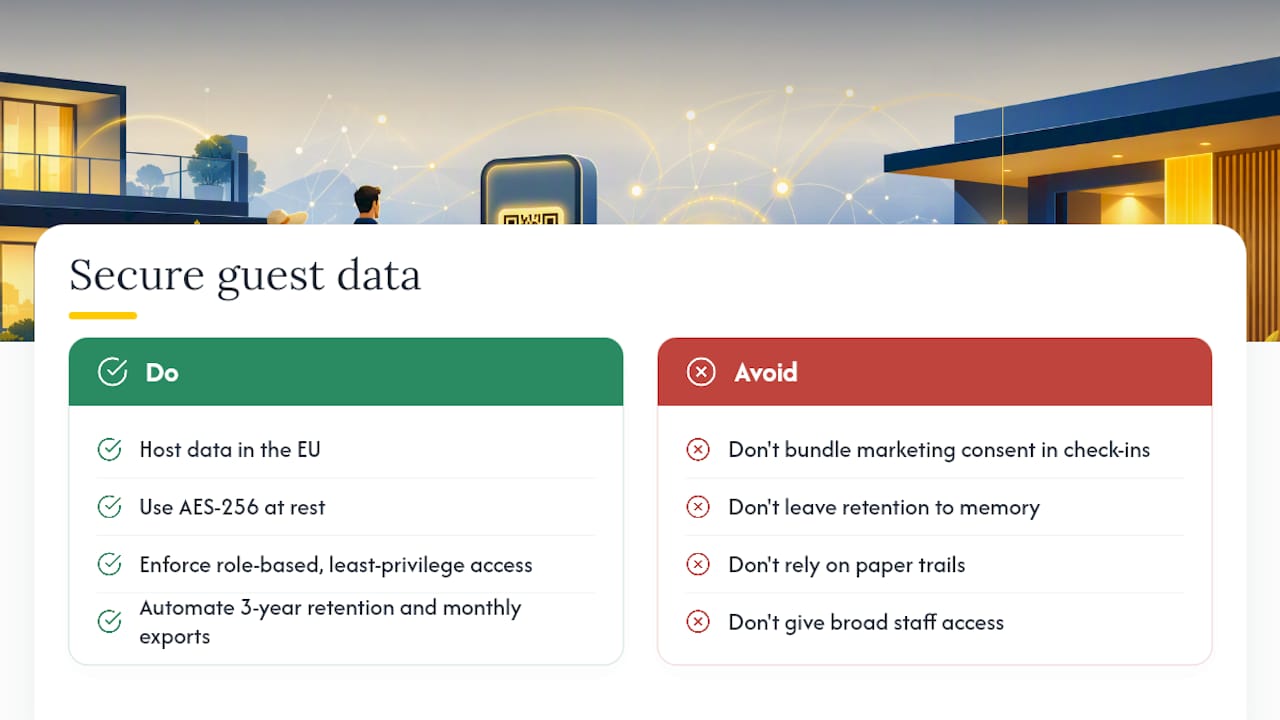
On the technical side, look for EU hosting, AES-256 encryption at rest, TLS encryption in transit, role-based access controls, and multi-factor authentication for any admin account that can view or export guest records.
Operationally, three-year retention only works if it’s enforced automatically rather than left to memory. Regular access audits, logged activity, and a least-privilege policy (staff only see what their role requires) close most of the gaps that cause data breaches in smaller hospitality operations.
On the privacy side, your check-in form should open with a clear notice explaining what data you’re collecting and why. Collect only the fields Annexes I and II actually require, state your legal basis plainly (compliance with RD 933/2021), and avoid the temptation to bundle in extra marketing consent forms at the same touchpoint. Perez Parras’ legal review recommends EU-hosted platforms with exportable audit logs specifically so operators can prove timely submission without relying on paper trails.
Pro Tip: Set your system to generate a monthly exportable audit report automatically. When an inspection happens, you want a document ready in one click, not a scramble through six months of individual transmission records.
What Does QR Check-In Cost and How Long Does Setup Take?
Setup timelines vary by property count, but typically registering with SES.HOSPEDAJES and completing the paperwork take a few days, configuring forms and integrations for a single property can take from some days to a couple of weeks, and a multi-property rollout with staff training and channel mapping usually takes several weeks before full operational handoff.
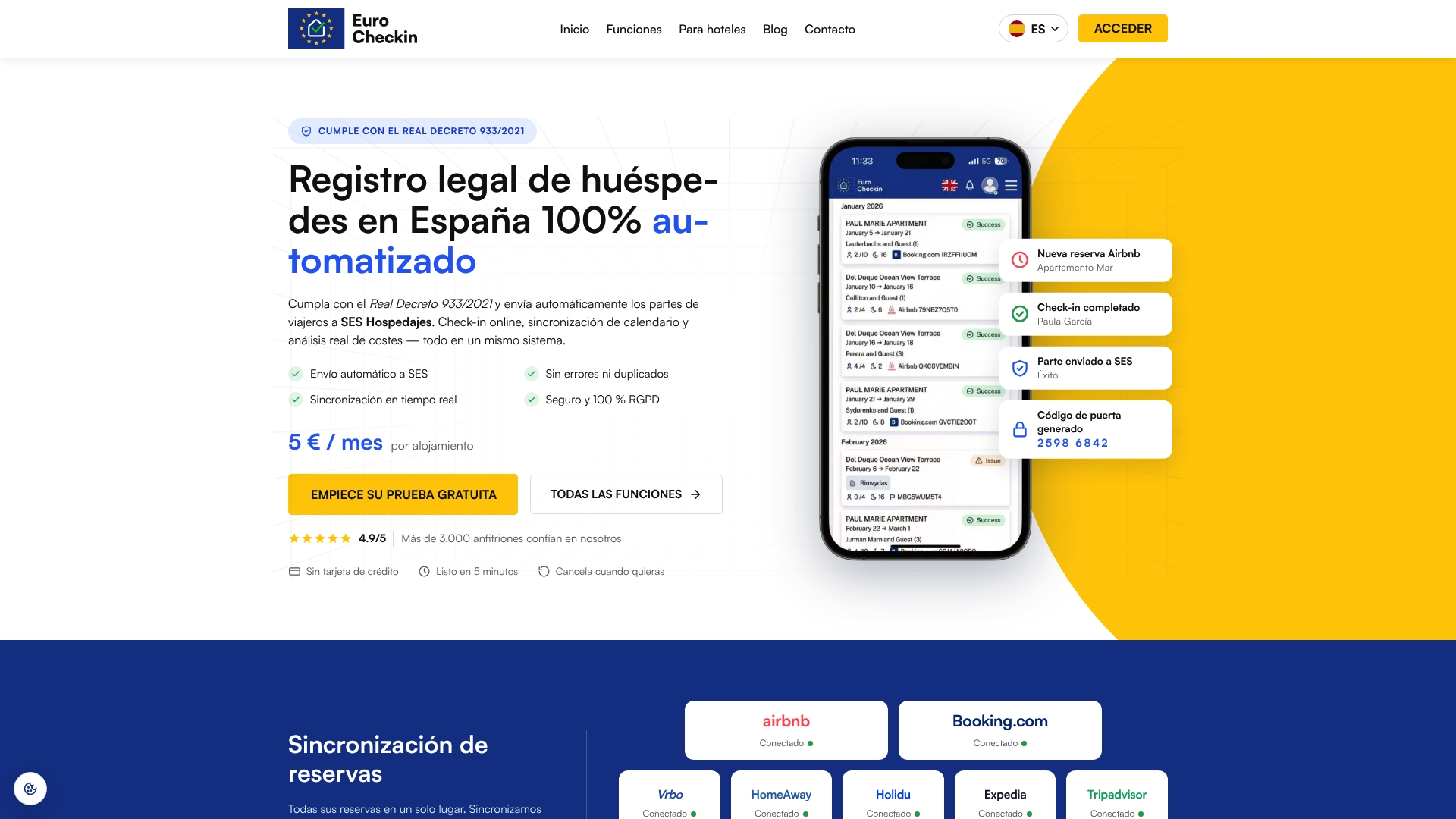
Cost shape follows a predictable structure across the market: a per-accommodation subscription, some implementation hours (whether handled internally or by a consultant), and optional hardware costs if you’re adding smart locks. EuroCheckin advertises pricing starting around €5 per month per accommodation, with a free trial period to test the setup before committing.
The operational payoff shows up fast: hours saved on manual register entry, fewer transcription errors in what you submit to SES.HOSPEDAJES, and a lower chance of the penalties that come with late or inaccurate reporting.
Why Does EuroCheckin Fit Compliance-First Operators?
EuroCheckin was built around the exact chain this guide describes: capture, sign, store, transmit. It’s a practical fit for operators who want the compliance mechanics handled without babysitting a spreadsheet.
Here’s what the platform covers:
- Automated SES.HOSPEDAJES submission, so records transmit without manual entry.
- EU-based hosting, meeting the data residency expectations most compliance reviews look for.
- Multilingual online check-in, unlimited and guest-facing, with no app required.
- E-signature capture for guests aged 14 and older.
- Calendar sync across Airbnb, Booking, Vrbo, and more than 12 other platforms, preventing overbookings and duplicate entries.
- Smart-lock integrations with Nuki, TTLock, and Yale for fully autonomous self check-in.
- Digital contracts with e-signature plus house rules, and optional upsells guests pay through Apple Pay or Google Pay.
The platform stores guest records for the three years RD 933/2021 requires and handles the telematic transmission the decree mandates, without a manual export step. Pricing starts near €5 per month per accommodation, with a free trial available for operators who want to pilot the system before switching a full portfolio over.
An operations note on running QR check-in at scale
Most launch problems trace back to one thing: a booking channel that wasn’t mapped correctly, so a reservation never triggers the check-in link. Fix the channel mapping first, then watch for missing fields on older ID documents. Properties that get this right typically see shorter check-in queues and cleaner SES.HOSPEDAJES reports within the first month.
Try QR Check-In With Compliance Built In
Eurocheckin is the direct route to a working QR code check-in without spending weeks reading regulatory PDFs first. The trial includes a sample property setup, a live SES.HOSPEDAJES test so you can see your actual data payload before you’re relying on it, and support for smart-lock integrations if you’re offering self check-in.
If you manage a vacation rental, a boutique hotel, or a hostel, the fastest way to find your compliance gaps is to run one real booking through the check-in online setup and see what breaks. It’s a lot cheaper to catch a missing field during a trial than during an inspection. Start with the SES.HOSPEDAJES feature page or, if you’re managing a hotel specifically, the hotel registration workflow built for that use case. Either path gets you to a working, compliant setup in days, not months.
Where to Verify These Rules Directly
For the legal text itself and further context, consult these sources:
- Real Decreto 933/2021 (BOE consolidated PDF) for the exact Annex I and II requirements.
- Ministerio del Interior — Hospedajes y alquiler de vehículos for SES.HOSPEDAJES registration.
- Garrigues’ legal analysis for GDPR-related discussion.
- EuroCheckin’s compliance page for implementation help.
This article is general information, not a substitute for advice from a qualified lawyer. Consult a qualified legal professional about your own circumstances before acting on anything here.
Sources
- Real Decreto 933/2021 (BOE consolidated PDF)
- Ministerio del Interior — Hospedajes y alquiler de vehículos
- Garrigues — Registro de viajeros: las claves de la norma
- SpanishSolicitors — Guest registration duties in rentals
FAQ
Does a QR code check-in replace the paper traveler register?
Yes, provided it captures all fields in Annexes I and II, stores them for three years, and transmits them through SES.HOSPEDAJES within the required window.
Is electronic signature mandatory for QR check-in?
Yes, for guests aged 14 and older. The signature confirms the data entered and is part of the required register under RD 933/2021.
What happens if my QR check-in system misses the 24-hour transmission window?
You risk non-compliance with RD 933/2021’s telematic transmission requirement, since establishments remain responsible for the accuracy and timing of submitted data.
Can EuroCheckin handle multi-property portfolios?
Yes, EuroCheckin syncs calendars across Airbnb, Booking, Vrbo, and more than 12 other platforms, letting managers run SES.HOSPEDAJES compliance across several properties from one account.
Do I still need a fallback for guests who can’t use a QR code?
Yes, a scanned paper form uploaded within the same 24-hour window keeps you compliant for guests without smartphones or digital literacy.