



Yes, SES.HOSPEDAJES accepts automated submissions, and for most property managers, API integration is the recommended route. Manual entry or CSV uploads can work for one or two units, but once you manage multiple properties or handle frequent check-ins, an API connection through a GDPR-compliant provider becomes the only practical way to stay compliant. Either way, you need to register as an obligated subject first and secure access through certificado digital or Cl@ve before you send a single record.
TL;DR:
- API integration is highly recommended once managing multiple properties or frequent check-ins, as manual entry becomes impractical and error-prone at scale.
- Registration requires a minimum of several days to obtain necessary credentials like a digital certificate or Cl@ve, so onboarding should begin early before first guest arrivals.
- Submissions must be made within 24 hours of guest arrival, with the system needing to retain detailed records and acknowledgment codes for at least three years for compliance and verification.
- Proper field mapping to the annexed data structure and validating with test reservations are essential to prevent rejection issues during live submissions.
- Automating guest data submission through platforms like EuroCheckin simplifies compliance, reduces errors, and ensures timely reporting within regulatory deadlines.
Table of Contents
- What Is SES.HOSPEDAJES and Why Does It Matter for Property Managers?
- What Are the Legal Deadlines Under Real Decreto 933/2021?
- How Do You Register and Get Access Credentials?
- Manual Form, CSV Upload, or API: Which Method Fits Your Operation?
- How Does the SES.HOSPEDAJES API Work Technically?
- How Do You Build a Reliable Automation Workflow?
- When Does API Automation Pay Off?
- How Do You Troubleshoot Failed Submissions?
- Recommended First Steps From EuroCheckin
- Automate SES.HOSPEDAJES Reporting Without the Manual Work
- Sources
- FAQ
What Is SES.HOSPEDAJES and Why Does It Matter for Property Managers?
SES.HOSPEDAJES is the official system the Ministerio del Interior uses to collect guest registration data from every accommodation provider operating in Spain. It runs on the Ministry’s Sede Electrónica, meaning every registration, submission, and credential you use ties back to a government-run infrastructure, not a private intermediary. There is no alternative channel: if you rent out rooms, apartments, or beds to travelers, this is where the data goes.
The obligation covers a wider range of businesses than many owners assume:
- Hotels, hostels, and guesthouses of any size
- Vacation rentals classified as VUT (Vivienda de Uso Touristic) or VFT
- Rural tourism accommodations and campsites
- Certain vehicle rental businesses under related reporting rules
Skipping this isn’t a paperwork gap you can quietly fix later. Noncompliance exposes you to sanctions under Spanish administrative law, and inspectors have the authority to request your traveler logs on demand. Automated reporting removes the guesswork: once your system sends data correctly, you have a timestamped record proving you met the deadline, which matters far more than most owners realize until an inspection actually happens.
What Are the Legal Deadlines Under Real Decreto 933/2021?
Real Decreto 933/2021 is the law that turned traveler registration from a loose hotel-industry custom into a strict digital obligation. It defines who must report, what data they must collect, and how long they must keep it.
Two numbers matter more than anything else in the text:
- 24 hours — communications to SES.HOSPEDAJES must generally happen within this window of a guest’s arrival, per the timing rules in Real Decreto 933/2021.
- Three years — the minimum period you must retain the underlying guest records after submission.
Pro Tip: Set your reporting workflow to run at check-in, not the night before departure. Waiting until the last minute is how most missed 24-hour windows happen.
The annexes to RD 933/2021 spell out exactly which guest fields you’re required to collect: full identity document details, nationality, dates of stay, and the establishment’s own registration code, among others. There’s no room for improvisation here since the annex structure is what your CSV or API payload has to match field by field.
Because you’re handling identity documents and, in effect, personal data tied to law enforcement reporting, GDPR obligations run in parallel with RD 933/2021, not instead of it. You need a documented legal basis for processing, secure storage, and a retention policy that satisfies both the three-year rule and GDPR’s data-minimization principle at once. That dual compliance layer is exactly where a lot of small operators trip up: they build a spreadsheet that reports fine but stores guest passport scans indefinitely with no deletion policy, which is its own GDPR liability.
How Do You Register and Get Access Credentials?
Before you send any data, you need to exist in the system as an authorized sender. That happens through the Sede Electrónica’s Hospedajes y alquiler de vehículos portal, and it’s a sequential process, not something you can shortcut.
- Register as an obligated subject. Submit your establishment’s details through the provider registration flow on the Sede.
- Choose your authentication method. You’ll need either a certificado digital issued by the FNMT or a Cl@ve registration, both of which confirm your identity to the Ministry electronically.
- Set up signing tools if required. Some flows call for cl@ve-Firma or the autofirm@ application to complete document submissions digitally.
- Request your web service credentials. Once verified, you receive the usuario web service and contraseña you’ll use for CSV, XML, or API submissions.
- Gather establishment codes and ownership documentation before you start, since the registration form will ask for them upfront.
Pro Tip: Getting a certificado digital or completing Cl@ve registration can take several business days. Sede Electrónica’s own guidance reflects this, so start credentialing at least a week before you plan to go live, not the day before your first guest arrives.
Keep a simple checklist on hand: your NIF or NIE, the establishment’s SES.HOSPEDAJES code once assigned, proof of legal representation if you’re registering on behalf of a company, and the contact details tied to your Cl@ve or certificado digital account.
Manual Form, CSV Upload, or API: Which Method Fits Your Operation?
SES.HOSPEDAJES gives you three ways to submit guest data, and the right choice depends almost entirely on how many check-ins you process.
- Manual web form — you log into the portal and type each guest’s details by hand. This works only if you manage a single small property with occasional bookings; beyond a handful of guests a week, it becomes a genuine time sink.
- CSV/XML bulk upload — you prepare a structured file matching the required annex fields and upload it in batches. This suits managers with a handful of properties who can tolerate submitting data once or twice a day rather than in real time.
- API/web service — your property management system or a dedicated compliance platform sends guest data automatically as reservations come in. According to market guidance on SES.HOSPEDAJES implementation, this is the method vendors recommend once you’re managing multiple units or handling frequent turnover.
The web service option isn’t just about saving time. It removes the human error that creeps into manual CSV formatting, and it lets your system react immediately when a guest’s check-in details change, rather than waiting for the next batch upload.
How Does the SES.HOSPEDAJES API Work Technically?
The provider registration and technical entry points for API access live on Sede, which lists the official endpoints tied to provider.ses.mir.es and hospedajes.ses.mir.es. Before building or configuring an integration, confirm you’re pointed at these government-hosted addresses rather than a third-party mirror.
Authentication follows patterns familiar to anyone who has worked with government web services in Spain. You’ll typically use one of these approaches:
| Authentication method | How it works | Best suited for |
|---|---|---|
| Web service user and password | Credentials issued after registration, used directly in API calls | PMS platforms and compliance software with direct integrations |
| Certificado digital | FNMT-issued certificate validates identity at the transport layer | Single-property owners handling their own submissions |
| Cl@ve-based access | Ministry-linked identity verification, sometimes paired with cl@ve-Firma | Owners who prefer government-issued digital identity over a certificate file |
Data fields in your XML or CSV payload have to mirror the structure defined in the RD 933/2021 annexes. Vendor integration documentation, including examples published by iSystems for its Guest hotel software, shows the pattern clearly: guest identity document type and number, nationality, arrival and departure dates, and the establishment code all need to map to specific tags before submission.
A typical field mapping includes:
- Establishment identifier and reporting date
- Guest identity document type (passport, DNI, NIE) and number
- Nationality and date of birth
- Arrival date and expected departure date
- Number of accompanying minors, where applicable
Pro Tip: Test your field mapping against a sample of five or six real reservations before connecting your live system. Mismatched date formats and truncated document numbers are the most common causes of rejected batches in early integrations.
How Do You Build a Reliable Automation Workflow?
A working SES.HOSPEDAJES automation pipeline follows a predictable sequence, whether you build it yourself or rely on a platform that already handles it.
- Capture guest data before arrival. Send a digital check-in link that collects identity documents and consent language explaining how the data will be used and reported.
- Validate with OCR. Scan passport or DNI images automatically to pull structured fields and catch obvious errors, like a mismatched name or an expired document, before submission.
- Normalize and map the data. Convert captured fields into the exact structure SES.HOSPEDAJES expects, matching the RD 933/2021 annex layout.
- Send via the API and queue retries. Submit the record, and if the connection fails or the Ministry’s system is briefly unavailable, retry automatically rather than losing the submission.
- Read the acknowledgment and store the communication code. Every successful submission returns a code confirming receipt. Log it against the reservation.
- Run integration tests in a sandbox environment first, checking that a handful of test records return valid acknowledgments before you flip the switch to production.
Pro Tip: Keep every communication code tied to its reservation in a searchable log, not just a raw export. When an inspector asks about a specific guest from eight months ago, you want that answer in seconds, not after digging through old files.
A sandboxed test process with careful field mapping to the RD annexes measurably cuts down on rejected submissions once you go live, which is exactly the kind of problem you want to catch before it involves a real guest and a real deadline.
When Does API Automation Pay Off?
Integration costs in the Spanish market for SES.HOSPEDAJES connectivity typically run somewhere between €5 and €30 per accommodation per month, depending on the platform and what else it bundles in.
- One property, occasional bookings — manual entry or the web form is often enough.
- Two to three properties — CSV batch uploads can still work if you’re disciplined about daily submission.
- Three or more properties, or frequent turnover — market consensus points toward API automation being worth the monthly cost, since it turns hours of manual data entry into minutes of oversight.
Expect the full path from registration to a live integration to take one to three weeks: several days for certificado digital or Cl@ve approval, then a shorter window for testing and go-live once credentials are active.
How Do You Troubleshoot Failed Submissions?
When a submission fails, the first place to look is the acknowledgment log tied to that reservation. Every response from SES.HOSPEDAJES carries a code, and a rejection code almost always points to a specific field problem rather than a system-wide outage.
- Document number mismatches — usually caused by OCR misreads or manual typos; recheck against the original scan.
- Date format errors — the most frequent cause of rejected batches, especially when a CSV export defaults to the wrong regional date format.
- Missing establishment code — happens when a new property hasn’t finished the registration flow before someone tries to send data for it.
- Duplicate submissions — often the result of retry logic firing twice without checking whether the first attempt already succeeded.
Retain every log, whether successful or rejected, for the full three-year window RD 933/2021 requires, and store it in a way that satisfies GDPR’s own security and access-control expectations. A rejected submission you can’t produce later during an inspection is functionally the same as never having submitted at all.
Recommended First Steps From EuroCheckin

Register as an obligated subject first, then secure your certificado digital or Cl@ve, then decide how you’ll capture guest data. In that order, not reversed. The most common mistake we see is property managers building a beautiful check-in form before they’ve even confirmed their establishment code, which means everything downstream has to be rebuilt.
The gap between “compliant on paper” and “compliant under inspection” almost always comes down to whether your logs are searchable. A CSV you can technically produce is not the same as an audit trail you can produce in thirty seconds.
— Sofía Herrera
Automate SES.HOSPEDAJES Reporting Without the Manual Work
Every workflow described here, from OCR capture to field mapping to storing communication codes, is exactly what EuroCheckin runs automatically for Spanish hosts and managers. Instead of building your own API connection from scratch, you get a platform that already sends guest data to SES.HOSPEDAJES the moment a check-in is completed, with no manual CSV formatting and no risk of missing the 24-hour window.
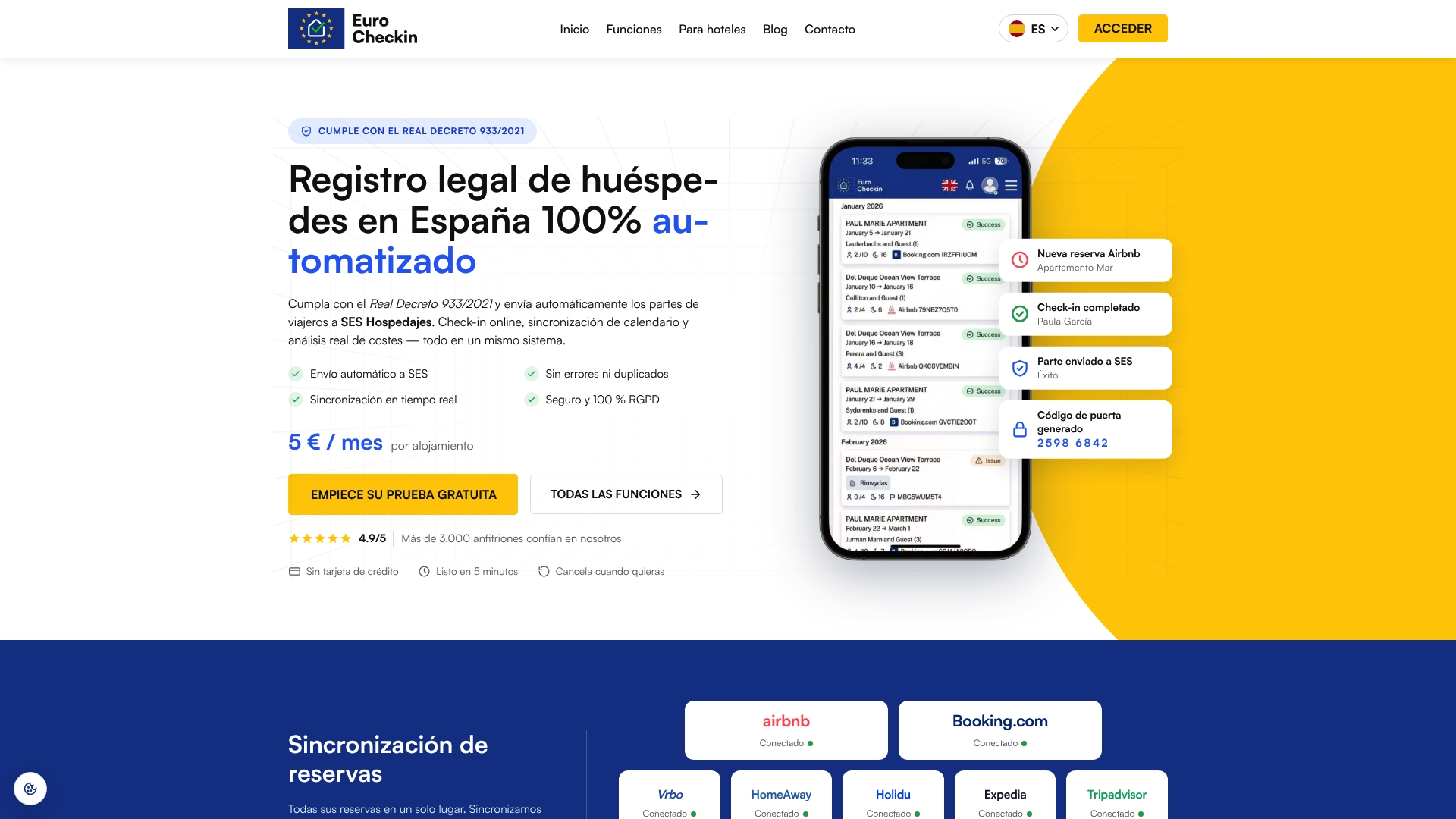
Here’s what that looks like in practice: guests complete a multilingual check-in form linked directly to their Airbnb, Booking, or Vrbo reservation, your invoices get scanned and categorized through built-in OCR, and your calendars stay synced across a dozen-plus platforms so nothing double-books while you’re focused on compliance. Data lives on infrastructure hosted within the European Union, which keeps your GDPR retention obligations and your RD 933/2021 reporting obligations satisfied under one system instead of two.
If you’re currently juggling manual entry or a CSV routine that’s starting to strain under more properties, explore EuroCheckin’s SES.HOSPEDAJES automation features and start a free trial to see your first automated submission go through.
Sources
- Ministerio del Interior — Hospedajes y alquiler de vehículos
- Real Decreto 933/2021 (BOE)
- Sede Electrónica — Hospedajes y alquiler de vehículos
FAQ
Is API Integration Mandatory for SES.HOSPEDAJES?
No, API integration isn’t legally required. Manual and CSV submissions remain valid options, though API automation becomes the practical necessity once you manage multiple properties or frequent check-ins.
How Long Does SES.HOSPEDAJES Registration Take?
Getting your certificado digital or completing Cl@ve registration typically takes several business days, so start the process at least a week before you need to submit your first report.
What Happens if I Miss the 24-Hour Reporting Window?
Missing the deadline set in Real Decreto 933/2021 exposes you to administrative sanctions, which is why automated, real-time submission through a platform like EuroCheckin reduces that risk significantly.
Can One Property Management System Handle Multiple Properties on SES.HOSPEDAJES?
Yes, a single API integration or compliant platform can report data for multiple establishments simultaneously, as long as each property has its own registered establishment code.
Do I Still Need to Keep Records if I Use the API?
Yes, RD 933/2021 requires three years of data retention regardless of submission method, so your API workflow needs to store logs and communication codes alongside the actual transmission.