



Yes, you can automate guest check-in while meeting your legal requirements, and for most properties, you should. Automation cuts registration time, reduces data-entry errors, and lets you enable contactless access alongside automatic reporting to authorities. Platforms built for this are designed to keep compliance and speed working together instead of against each other.
TL;DR:
- Automated check-in systems must accurately merge bookings from multiple channels and ensure proper submission to SES.HOSPEDAJES to avoid compliance risks.
- Verifying guest identity without storing full document images aligns with Spanish data protection rules, reducing legal exposure.
- Piloting the system across different booking types helps identify errors, such as timezone mismatches or duplicate fields, before full deployment.
- Ensuring data is securely transferred with encryption and role-based access minimizes security breaches and complies with GDPR requirements.
- Using an integrated platform like EuroCheckin simplifies SES.HOSPEDAJES reporting, calendar synchronization, and contactless access, providing a cost-effective solution for small operators.
Table of Contents
- How automated guest check-in works: the step-by-step workflow
- What Spanish law and data-protection rules require
- Essential features to demand from any automated check-in solution
- Implementation checklist: plan, pilot, test, and deploy automated check-in
- Technology and data-security best practices for automated workflows
- Publisher perspective: what teams actually gain and the realistic trade-offs
- How EuroCheckin maps to the compliance-first checklist
- Sources
- FAQ
How automated guest check-in works: the step-by-step workflow
Every automated check-in system follows roughly the same sequence, whether you run a single apartment or a small hotel chain. Understanding each stage helps you spot where compliance and guest experience actually meet.
- Reservation trigger: a new booking generates a unique guest link, sent by email, SMS, or through the booking channel itself.
- Guest data entry: the guest fills out required fields, accepts your house rules, and signs electronically.
- Verification (optional but recommended): OCR scanning, two-factor confirmation, or a payment authorization step confirms identity without demanding a full document copy.
- Data storage and submission: the system stores the record securely and files it with SES.HOSPEDAJES when required.
- Access delivery: a digital key, smart-lock code, or door instructions get sent automatically once everything checks out.
- Upsell and communication: confirmation messages, arrival instructions, and optional paid extras can ride along the same flow.
Each step should feed the next without manual re-entry. If your guest link asks for the same information twice, or your smart lock doesn’t know a booking exists until someone manually pushes a code, the automation isn’t finished yet: it’s partial, and partial automation tends to create more support tickets than it saves.
What Spanish law and data-protection rules require
Before you automate anything, you need to know what the law actually asks for. Real Decreto 933/2021 sets out the specific guest data hosts must record, requires that records be kept for three years, and mandates telematic submission to SES.HOSPEDAJES on the timelines the decree specifies, with some communications due within 24 hours.
The data categories generally required include:
- Full identification details of each guest (name, document type and number, nationality).
- Dates of arrival and departure.
- Property or establishment identification linked to the booking.
- Signature or acceptance confirming the guest provided the information themselves.
SES.HOSPEDAJES is the official telematic portal for these submissions, run through the Ministry of the Interior’s registration system. Filing late or filing incorrectly formatted records defeats the purpose of automating in the first place.
Data protection adds another layer. The Spanish Data Protection Agency has stated that requesting copies of a guest’s DNI or passport is not generally permitted, pushing operators toward data minimization and alternative verification methods instead of storing document images.

Industry groups back the shift to automation for a practical reason. HOTREC has stated that RD 933/2021 increases the administrative burden on hospitality businesses and that dedicated digital tools are needed to avoid compliance risk and fines, especially for small operators without dedicated admin staff.
The practical takeaway: your automated workflow needs to produce exportable, auditable records that match the official format, not a spreadsheet you hope translates cleanly later.
Essential features to demand from any automated check-in solution
Not every check-in tool on the market handles compliance the same way. Before you commit to one, confirm it covers these points.
- Channel synchronization: bookings from Airbnb, Booking.com, Vrbo, and your PMS should merge into a single guest record, not scattered duplicates.
- SES.HOSPEDAJES integration: either native submission or a secure export mapped precisely to the official fields.
- Secure e-signature and minimal forms: capture only what’s legally required, in the guest’s own language.
- GDPR-aware verification: identity checks that don’t default to storing document scans, plus clear answers on where your data lives.
- Smart-lock and payment integration: scheduled access codes and the ability to sell extras without a separate system.
Pro Tip: Ask any vendor to show you a sample SES.HOSPEDAJES export before you sign anything. If they can’t produce one on the spot, treat that as a warning sign.
Look for vendors who host data within the European Union, since that detail matters both for GDPR obligations and for your own peace of mind if a guest ever asks where their information sits.
Implementation checklist: plan, pilot, test, and deploy automated check-in
Rolling out automation works best in stages, not all at once.
- Map the guest journey. Separate mandatory legal fields from optional ones you’ll use for upsells or personalization.
- Run a small pilot. Include late arrivals, group bookings, and any scenario involving minors, then confirm the SES.HOSPEDAJES submission actually goes through correctly.
- Assign an owner for exceptions. Someone needs to catch failed submissions or incomplete guest forms and keep a record of how each was resolved.
- Train your staff. They should know exactly when to step in manually and how to pull records securely if authorities ever ask.
- Set a realistic timeline. A two-week pilot across a handful of properties, followed by a small rollout, then a full deployment, keeps risk manageable.
Pro Tip: Pilot across booking types, not just your easiest reservations. Mismatched field formats from channel APIs and timezone errors on arrival times are the most common issues, and they show up fastest in group or last-minute bookings.
Technology and data-security best practices for automated workflows
Automation only helps you if the underlying system protects guest data properly.
- Use TLS/HTTPS for every data transfer and encrypt records at rest, not just in transit.
- Apply role-based access so staff only see the guest data relevant to their job.
- Avoid collecting full identity-document images by default, following the AEPD’s minimization guidance, and rely on alternative verification instead.
- Keep audit logs and backups, and have an incident-response plan ready before you need it, not after.
EU-based hosting simplifies your GDPR position considerably, since you avoid the extra legal steps that come with transferring guest data outside the bloc.
Publisher perspective: what teams actually gain and the realistic trade-offs
Automation’s real payoff isn’t speed for its own sake. It’s the hours your team gets back for concierge work, upsells, or cleaning coordination instead of retyping passport numbers. The two failures we see most often are incomplete channel sync and skipping the pilot phase entirely, and both are fixable with a bit of patience. Roll out gradually, assign clear ownership for exceptions, and the trade-offs shrink fast.
— Sofía Herrera
How EuroCheckin maps to the compliance-first checklist
EuroCheckin was built around the exact checklist above, not as an afterthought. It handles SES.HOSPEDAJES reporting automatically, syncs calendars across more than a dozen booking platforms, and generates digital contracts with electronic signatures in multiple languages.
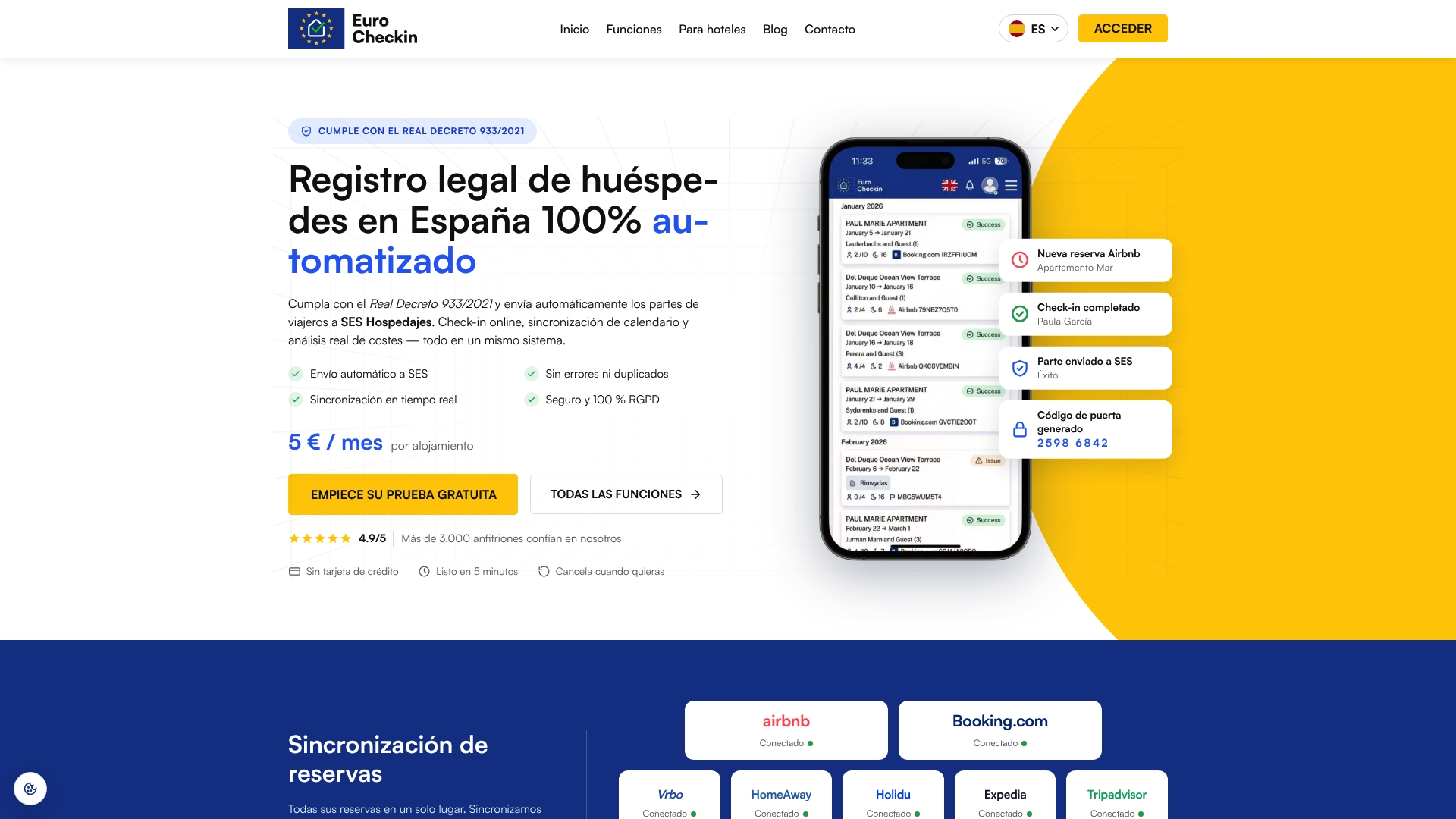
- Multilingual online check-in links for popular booking platforms.
- Integration with smart locks to enable autonomous self check-in.
- Tools to offer guests extras with payment options like Apple Pay or Google Pay.
Property owners, small management companies, and boutique hotels tend to see the fastest return, since they carry the compliance burden without a dedicated admin team. Pricing for EuroCheckin para alojamientos starts from 5 EUR per month per accommodation, with a free trial available before you commit. Start with a small pilot batch of properties, confirm your SES.HOSPEDAJES submissions run cleanly, then expand from there.
Sources
- Real Decreto 933/2021, BOE
- HOTREC press release on Spanish Royal Decree
- Customers’ acceptance towards self-service technologies and the impact on usage intention
FAQ
How do I check a guest in?
You send the guest a link tied to their reservation, they fill in the required fields and sign electronically, and the system stores the record and files it with authorities when required. Access details, like a smart-lock code, typically follow automatically once the form is complete.
Is guest check-in software legitimate for legal compliance?
Software built specifically around Real Decreto 933/2021 and SES.HOSPEDAJES can meet your legal reporting obligations, provided it submits the correct fields on the required timelines. Always confirm a vendor’s SES.HOSPEDAJES integration works before relying on it fully.
Can a guest check into a property without the host present?
Yes, self check-in through a digital form, smart lock, or lockbox lets guests arrive without the host on site, as long as the required guest data is still collected and reported correctly. Research on self-service technology acceptance suggests guests generally respond well to this when the process feels simple and reliable.
Who is legally responsible for guest check-in records?
The property owner or manager remains responsible for collecting the required guest data and submitting it to SES.HOSPEDAJES on time, even when the process itself is automated. Using software to handle the workflow doesn’t shift that legal responsibility away from the host.