



The most reliable way to avoid overbooking rentals is to connect every listing through a channel manager or PMS that syncs by API in real time, not through iCal. Real-time sync closes the gap where two guests can book the same night. Layer on strict booking policies, an inventory buffer for high-demand dates, and a habit of checking your sync logs weekly, and double bookings become the exception instead of the risk you plan around. Platforms like SES Hospedajes and some digital check-in tools fit into this same prevention framework.
TL;DR:
- Switching from iCal to an API-based channel manager reduces sync delays from 15-30 minutes to seconds, significantly lowering double booking risks during peak demand periods.
- Implementing strict booking policies, such as instant confirmation payments and inventory buffers, prevents overbooking caused by manual and technical errors.
- Regularly auditing rate-plan alignment and avoiding manual calendar updates help maintain accurate availability across all platforms.
- Immediately resolving double bookings by verifying timestamps, following official cancellation procedures, and documenting incidents can limit long-term damage.
- Using integrated platforms like EuroCheckin that handle calendar sync and legal guest registration ensures compliance and reduces manual errors altogether.
Table of Contents
- Why Do Rental Overbookings Happen in the First Place?
- iCal vs API Channel Manager: Which Actually Prevents Double Bookings?
- What Operational Safeguards Reduce Booking Conflicts?
- What to Do When You Discover a Double Booking
- How Real Sync and Compliant Registration Work Together
- Why Prevention Beats Reacting Every Time
- A Platform Built to Sync Calendars and Handle Compliance Together
- Sources
- FAQ
Why Do Rental Overbookings Happen in the First Place?
Overbooking happens when your calendar on one platform doesn’t reflect a reservation made on another, even for a few minutes. Most of the time, the culprit is technical, not human error, though both play a role.
iCal feeds, the free calendar links most owners set up between Airbnb, Vrbo, and their own site, refresh on a pull schedule rather than pushing updates instantly. That typically means a 15 to 30 minute window where a night is technically sold on one platform but still shows open on another. During a flash sale, a holiday rush, or a group booking scramble, that window is plenty of time for two guests to book the same date.
Human error compounds the problem. Common triggers include:
- Manually editing availability in one extranet and forgetting to update the others
- Mapping errors between room types or unit categories across platforms
- Group or block bookings held on one calendar but never synced back
- Late unblocking of dates after a cancellation, leaving a gap open on some channels but not others
Pro Tip: When you catch a double booking, compare the reservation timestamp against your channel manager’s activity log before you blame staff. If two bookings landed inside the same sync window and one channel never received the decrement, the cause is latency, not a mistake anyone made. This diagnostic step, recommended by HotelTechUpdate, tells you whether to fix a process or fix your technology stack.
iCal vs API Channel Manager: Which Actually Prevents Double Bookings?
The architectural difference between iCal and API-based sync is the entire story here. iCal is a one-way, pull-based feed: each platform checks in periodically to see what’s changed, and nothing pushes an update the instant it happens. An API connection through a channel manager or integrated PMS works the opposite way. The moment a reservation confirms, it pushes a block to every connected channel within seconds.
That distinction matters most exactly when you can least afford a mistake: a holiday weekend, a local festival, or the week your listing gets featured in a platform’s search results.
Where the remaining bottlenecks live, even with a channel manager in place:
- OTA-side rate limits that throttle how often updates can push through
- PMS confirmation delays on the property’s end
- Room-type or rate-plan mapping mismatches between connected platforms
- Manual overrides that bypass the API and go straight into an extranet
Properties relying purely on iCal face a structural sync gap of 15 to 30 minutes per update cycle, while API-connected channel managers close that same gap to seconds, according to Jurny’s analysis of double bookings at scale.
So when does the upgrade actually pay for itself? A single host managing one or two units with modest booking velocity can often get by on iCal, at least for a season. Once you’re running multiple properties, listing on three or more platforms, or seeing regular booking activity during peak periods, manual sync stops being a viable long-term strategy and the sync window becomes a recurring liability rather than a rare accident. Portfolios above roughly 15 properties reach a point where human error and sync latency become close to inevitable without a direct API connection.
What Operational Safeguards Reduce Booking Conflicts?
Software alone won’t save you if your booking policies and internal habits work against it. A handful of operational rules close most of the remaining gap, whether you’re already on a channel manager or still weighing the investment.
- Tighten your booking rules. Require instant confirmation payment or a short payment window rather than leaving reservations pending for hours, and disable instant book on channels where your sync is weakest.
- Build a dynamic buffer. Hold back one or two nights of inventory on your highest-demand dates and release them manually once you’ve confirmed no conflicting requests are pending. Revenue management systems can automate this, protecting risky nights while still selling low-demand ones freely.
- Centralize your inbox. Route every platform’s messages and booking alerts into one dashboard so nothing gets missed during a busy week.
- Ban direct extranet edits. Make your channel manager the single source of truth, and require any manual change to go through it rather than a platform’s native calendar.
- Verify after every direct booking. Anytime a guest books outside a platform (phone, email, referral), confirm the date is blocked everywhere before you send a confirmation.
- Audit your rate-plan mapping monthly. Room types and rate plans that drift out of alignment between platforms are a quiet, common cause of overbooking that has nothing to do with sync speed.
Pro Tip: Set a recurring 10 minute calendar check every Monday morning to compare your channel manager’s dashboard against each platform’s calendar directly. Most sync problems get caught here, long before a guest ever notices.
What to Do When You Discover a Double Booking
Finding a double booking is stressful, but a consistent process limits the damage to your revenue and your reviews. Follow this sequence.
- Confirm the timestamps. Pull both reservations’ booking times from each platform and your channel manager’s activity log to establish which one is legitimate and which resulted from the sync gap.
- Decide which booking to honor. Generally, the earlier confirmed reservation stays; the platform where the conflict originated typically has its own rules for resolution, so check that platform’s policy before acting.
- Contact the affected guest immediately. Be direct, apologize plainly, and offer concrete options: a comparable property, a refund, or compensation for the inconvenience.
- Cancel through the platform’s official flow, not manually. Booking.com and other platforms have specific procedures for resolving double bookings that protect the guest’s rights and limit penalties to your account, and a host-initiated cancellation outside that flow risks harsher consequences.
- Log the incident. Record what happened, why, and how it was resolved.
- Run a root-cause review. Was it a sync delay, a mapping error, or a manual mistake? Tighten the buffer or SOP that failed.
A single avoidable cancellation can hurt more than the immediate cost of relocating a guest. AirROI notes that host-initiated cancellations can damage search ranking and status standing on platforms like Airbnb for months afterward.
How Real Sync and Compliant Registration Work Together
Prevention isn’t only about calendars. In Spain, every booking also carries a legal reporting obligation, and the two problems tend to surface together when a property’s systems are disconnected. EuroCheckin’s platform links calendar sync with guest registration for exactly this reason: it synchronizes availability automatically across Airbnb, Booking, and more than 12 other platforms, while also sending guest data to SES Hospedajes in line with Real Decreto 933/2021 and GDPR, hosted on infrastructure inside the European Union.

A hotel in Madrid using EuroCheckin reduced reporting errors to SES Hospedajes while streamlining guest registration overall. A separate case involving real-time sync between Airbnb and Booking helped a property avoid the kind of double booking that a delayed iCal connection would have missed. In Valencia, a property resolved a late SES Hospedajes registration warning by tightening its automated reporting process, the same discipline that also keeps availability accurate.
Pro Tip: When you evaluate any platform for this job, check four things specifically: full API sync coverage (not iCal fallback), direct SES Hospedajes integration if you operate in Spain, EU-based data hosting, and an activity log you can audit yourself.
- Does it sync by API to every platform you actually use, or does it fall back to iCal on some?
- Does it handle SES Hospedajes reporting automatically, or does that stay a manual task?
- Where is guest data hosted, and does that meet GDPR requirements?
- Can you pull a timestamped activity log when something goes wrong?
Why Prevention Beats Reacting Every Time
A single overbooking rarely costs just one night’s revenue. It costs the guest relocation, the refund, the platform penalty risk, and often a review that sits on your listing for years. Weigh that against the cost of a sync tool, and the math tends to favor prevention for anyone running more than a listing or two. Multi-platform distribution keeps growing across the industry, and that growth raises the stakes on getting sync right, not lowers them, according to Skift’s ongoing travel industry coverage.
My honest read: most owners don’t underinvest in prevention because they doubt it works. They underinvest because nothing goes wrong for months, until it does. Pull your last 90 days of booking timestamps against your channel manager’s logs this week. If you find even one near miss, that’s your signal to fix the gap before it becomes a guest’s canceled trip.
— Sofía Herrera
A Platform Built to Sync Calendars and Handle Compliance Together
Running availability sync and legal guest registration as two separate systems is where most of the manual error in this article creeps back in. Some platforms offer a single dashboard combining automated calendar sync across multiple platforms to help prevent double bookings, paired with automatic guest data reporting to SES Hospedajes under Real Decreto 933/2021, hosted on secure EU infrastructure.
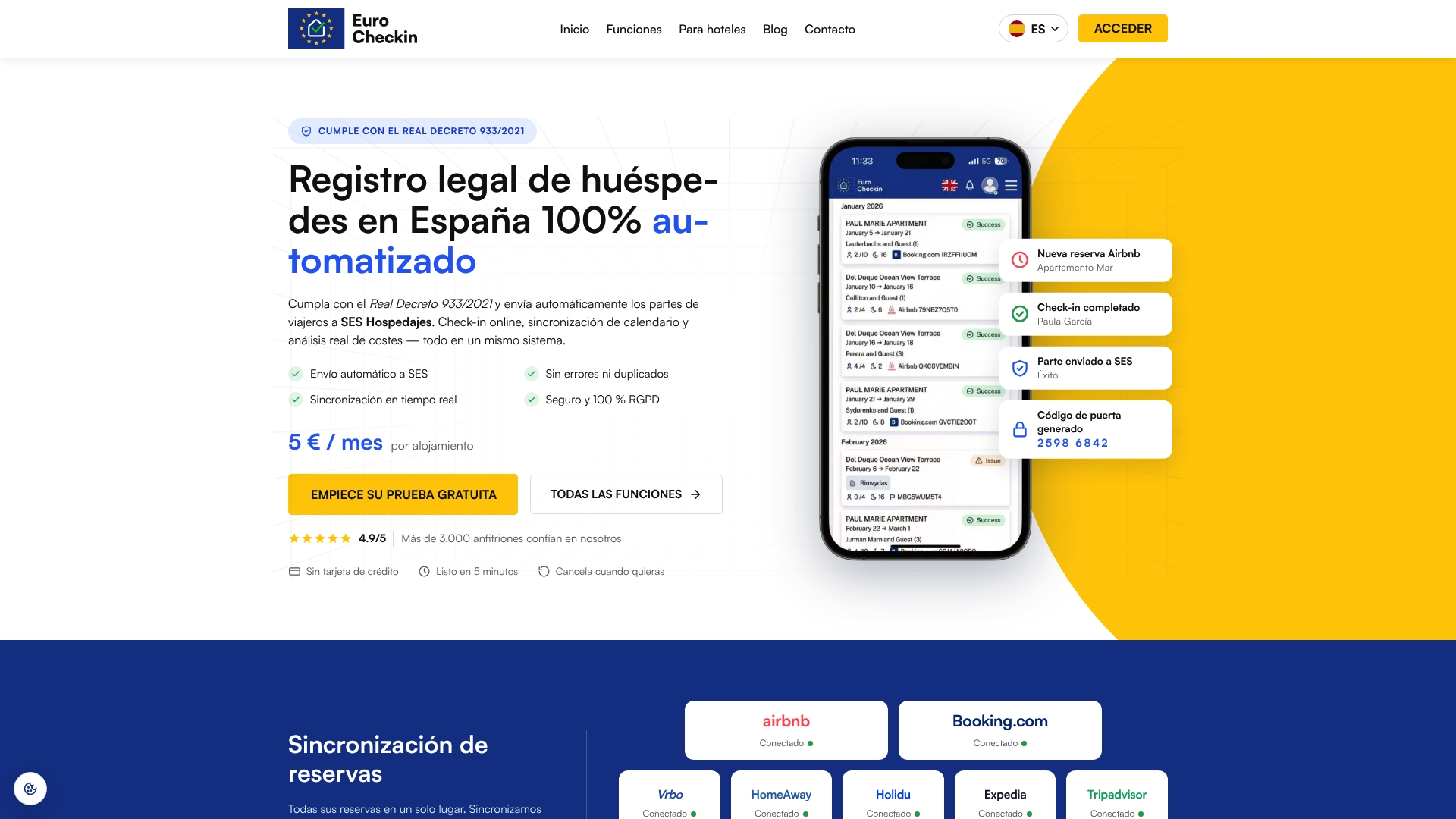
If you manage individual rental units, EuroCheckin para alojamientos starts at 5 EUR per month per accommodation, with a free trial to test the sync and registration flow on your own calendar before committing. Hotel operators can review EuroCheckin para hoteles, priced at 3 EUR per month per room, which covers the same SES Hospedajes integration at hotel scale. If you only need compliant traveler registration without the full platform, SES Hospedajes registration is available from 79 EUR as a one-off setup per accommodation. Run a free trial this week and audit your first sync log before your next busy weekend.
Sources
- Double Bookings in Vacation Rentals: Why They Happen at Scale and How to Eliminate Them | Jurny
- How to Fix Overbooking Caused by Channel Manager Sync Delays | HotelTechUpdate
- What Is Double Booking in Short-Term Rentals | AirROI
- Avoid Overbooking: 2026 Channel Manager Tips
- Booking partner help: all you need to know about double bookings
FAQ
Is It Legal for a Hotel to Overbook and Deny a Confirmed Room?
Hotels can legally practice controlled overbooking as a yield-management strategy in most markets, but denying a guest with a confirmed reservation still triggers obligations under each platform’s policies, typically covering relocation, refunds, or compensation. What’s not protected is a host canceling casually and expecting no consequences; Booking.com’s own partner guidance requires resolution through its official cancellation flow specifically to protect guest rights.
How Do I Deal With a Double Booking Once It Happens?
Confirm which reservation is legitimate by comparing timestamps, contact the displaced guest immediately with a clear apology and options, then cancel through the platform’s official process rather than manually. Log the incident afterward and trace the root cause, whether it was a sync delay or a manual mapping error, so you can close that specific gap.
What’s the Fastest Way to Stop Rental Overbooking Going Forward?
Switch every platform connection from iCal to a real-time API sync through a channel manager or integrated PMS, since iCal’s 15 to 30 minute refresh window is the single most common technical cause of double bookings. Pair that with a dynamic inventory buffer on high-demand dates and a weekly log check to catch anything the sync missed.
Does EuroCheckin Help Prevent Overbooking Directly?
Yes. EuroCheckin synchronizes calendars automatically across Airbnb, Booking, and more than 12 other platforms in real time, closing the same sync gap that causes most double bookings, while also handling SES Hospedajes guest registration in the same platform.