



A deposit authorization form is a signed guest consent that lets you hold or charge a security deposit for damage or incidentals during a stay. Collect it before check-in, not after, and pair it with a documented inspection so any deduction stands up to scrutiny. Whenever the payment method allows it, choose a card pre-authorization over a captured charge, since it holds funds without moving money.
Here’s your immediate next step:
- Draft the form with a clear amount, specific triggers, and a refund timeline.
- Send it before arrival and gate check-in instructions until it’s signed.
- Keep photo and invoice evidence tied to every deduction you make.
A platform like Eurocheckin can automate this entire sequence, from sending the form to storing the signed record alongside your SES Hospedajes reporting.
Key Takeaways
A deposit authorization form only protects a host when it pairs explicit, evidence-backed triggers with a gated pre-arrival collection process and a documented inspection trail.
| Point | Details |
|---|---|
| Define the hold type | State clearly whether the deposit is a pre-authorization hold or a captured charge, with an exact maximum amount. |
| List specific triggers | Name concrete triggers like damage, missing items, or smoking instead of vague “any damage” language. |
| Gate check-in on signature | Withhold access codes until the guest signs the form, ideally sent 1 to 3 days before arrival. |
| Keep evidence tied to deductions | Match every retained amount to a photo, invoice, or contractor quote before notifying the guest. |
| Automate the sequence | A platform like Eurocheckin can bundle the authorization into your existing check-in and compliance flow. |
Table of Contents
- Building a Deposit Authorization Form That Holds Up
- When Should You Collect the Deposit Authorization?
- Pre-Authorization, Capture, or Bank Transfer: What Fits Your Property?
- What Evidence Do You Need to Justify a Deduction?
- Copy This Checklist Into Your Own Deposit Form
- Why Most Hosts Get This Backward
- Sources
- FAQ
Building a Deposit Authorization Form That Holds Up
Every enforceable form starts with one decision: are you holding funds or taking them? A pre-authorization places a hold on the guest’s card without transferring money. A capture actually charges the card and requires a refund process afterward. State which one you’re using, and give the maximum amount as an exact figure, not a vague range like “up to $500 depending on damage.”
Vague trigger language is where most hosts get into trouble. Abogacía Española warns that clauses allowing automatic retention without objective evidence are considered abusive, so a form that says “withheld for any damage” without documentation requirements won’t protect you in a dispute. List the specific triggers instead:
- Physical damage to furniture, appliances, or fixtures
- Missing items from the inventory
- Excessive cleaning beyond normal turnover
- Smoking in a non-smoking unit
- Unauthorized guests beyond the booked occupancy
Your form also needs a refund timeline stated in days, a named refund method (card refund or bank transfer), and the currency. Add a line requiring the guest to acknowledge the house rules and reference the signed rental contract. Finally, include an explicit consent statement for the hold or capture, plus a note that a pre-authorization can temporarily reduce the guest’s available credit.
Pro Tip: Write the trigger list in plain language a guest would actually understand (“burns, tears, or stains on furniture”) rather than legal phrasing like “material impairment of chattel.” Guests who understand the terms dispute less.
When Should You Collect the Deposit Authorization?
Timing determines whether your consent is defensible. Collect it too late, and you’re chasing a guest who’s already checked in with no leverage left.
- Send the form 1 to 3 days before arrival. This window gives guests time to read it without letting it get buried under other pre-trip messages.
- Gate check-in details behind form completion. Practitioner guidance on short-term rentals consistently warns against sending access codes immediately at booking; codes should stay locked until the deposit authorization, ID, and house rules are all signed.
- Use an e-signature flow compatible with eIDAS standards and store the signed PDF with a timestamp. Dispute panels and small-claims processes look for proof of when the guest agreed and to what, not a verbal assurance.
- Disclose the deposit in the listing and house rules first, then link to the actual authorization form in your booking confirmation and pre-arrival messages. A reusable deposit payment link sent right after booking confirmation creates a clean audit trail from the first message onward.
- Bundle everything into one flow. Document guides recommend collecting booking confirmation, ID, signed contract, house rules, and deposit authorization together rather than as scattered messages, which cuts guest friction and strengthens your evidence file if something goes wrong.
Pro Tip: If your check-in flow already collects an ID photo, add the deposit authorization to the same screen instead of a separate email. Guests who are already mid-task are far more likely to finish a second short form than open a new one.
Pre-Authorization, Capture, or Bank Transfer: What Fits Your Property?
Card pre-authorization is widely treated as the standard approach because the funds stay on the guest’s card without an actual transfer, which means no refund process if nothing goes wrong. The hold typically releases automatically within a set window after checkout, though the exact timing depends on the card issuer. The tradeoff is that a pre-authorization does reduce the guest’s available credit for the duration of the hold, so disclose that plainly in the form.
Card capture and refund makes sense when your property manager needs actual funds in hand, such as high-value villas or long stays. If you capture the deposit, you must document exactly why any portion is retained, since a refund reversal without evidence invites a chargeback dispute.
Manager-held bank transfers work for larger deposits but come with more overhead: you need a dedicated business account, a named refund window in writing, and a transaction record that ties directly back to the booking.
Third-party damage waivers are worth considering as an alternative to a deposit entirely, particularly for lower-risk short stays where the administrative cost of chasing a deposit outweighs the protection it buys.
- Disclose the deposit method in your listing before booking, not after.
- Time your authorization request to avoid last-minute card declines near arrival.
- Pre-authorizations preserve funds without an actual transfer, which is why many hosts default to them for standard stays.
What Evidence Do You Need to Justify a Deduction?
An authorization form only protects you if you can back up the deduction with proof. The workflow is straightforward, but skipping a step is what turns a fair deduction into a losing dispute.
- Photograph the unit at check-in using consistent angles for each room, and name files with the booking reference and timestamp so nothing gets mixed up across properties.
- Photograph again at check-out and compare against your inventory list; a signed departure note from the guest strengthens your position further.
- Build an itemized deduction file for anything you plan to withhold: a photo, a contractor quote or invoice, a written description, and the date discovered.
- Notify the guest within a defined window rather than deducting silently. This single step is often what separates a resolved case from an escalated one.
- Store everything alongside the signed authorization in an exportable format, since a dispute panel will want the full chain, not just the final invoice.
Villa and large-rental industry norms point to a common refund window of 7 to 21 days, with itemized deductions and supporting invoices expected as standard practice.
Copy This Checklist Into Your Own Deposit Form
You don’t need a lawyer to draft a workable first version. Start with these prompts and adapt the wording to your property:
- Guest full name and ID reference
- Booking reference number
- Deposit amount and type (hold or capture)
- Full list of retention triggers
- Refund timeline and method
- Signature line with date
Then run this go-live checklist before your next guest arrives:
- Deposit disclosed clearly in the listing and house rules
- Pre-arrival message set to include the authorization link
- E-signature flow tested end to end
- Check-in instructions gated until documents are complete
Pro Tip: Keep the wording around “damage” concrete with one or two examples, like “stains that require professional cleaning” or “broken glassware.” Guests contest fewer deductions when they can picture exactly what counts.
For a deeper look at regional registration and consumer-law obligations that vary by property type, review a clear guide to regulation for vacation rentals before finalizing your wording.
Why Most Hosts Get This Backward
The conventional advice treats the deposit authorization form as a legal shield: longer clauses, more warnings, more fine print. That’s backward. A shorter, plain-language form paired with an actual inspection record protects you far better than dense legalese a guest skims and forgets. Abogacía Española’s own guidance on abusive retention clauses makes this explicit: enforceability comes from objective evidence, not from how intimidating the wording sounds.
Where most hosts also fall short is timing. They treat the deposit form as paperwork to send whenever, rather than a gate. If a guest can get into the property before the form is signed, you’ve lost your leverage and your evidence trail starts late.
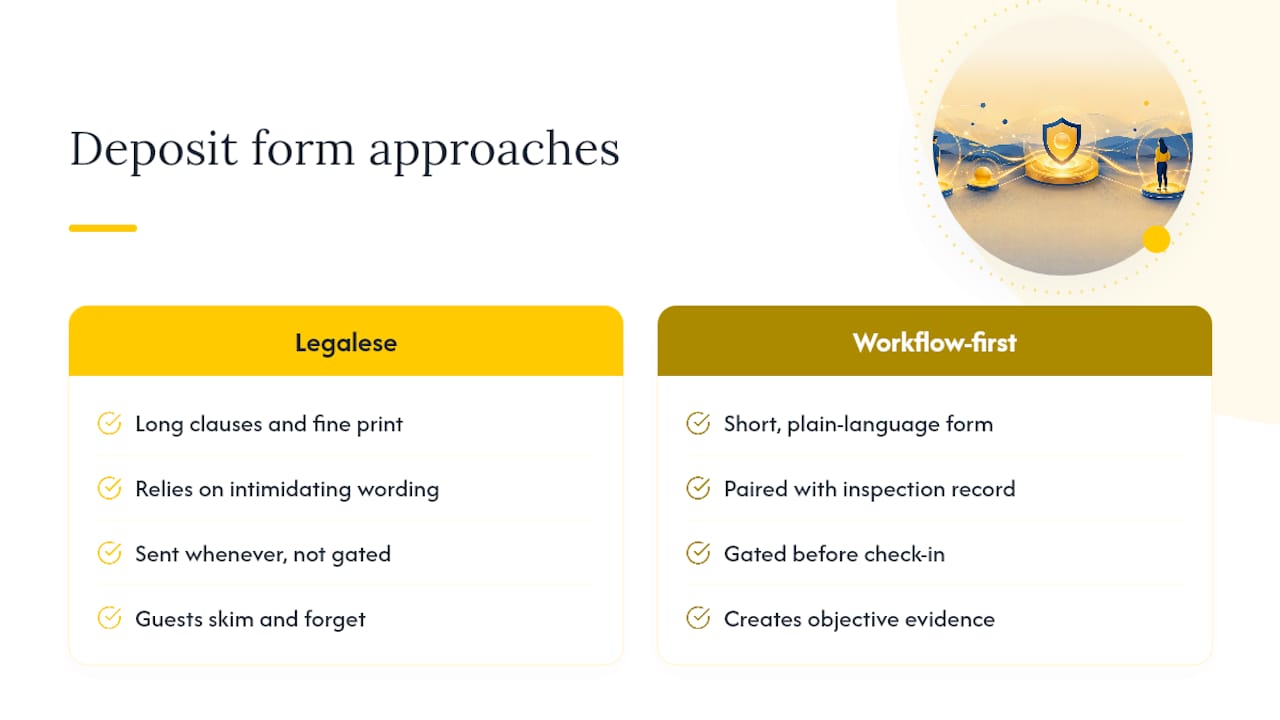
Prioritize the workflow, not the wording. A basic form linked to a real inspection process, sent on a fixed schedule and gated ahead of check-in, will outperform a beautifully drafted clause that nobody enforces consistently. Practical tourist-rental commentary keeps pointing to the same regional variation issue: what’s compliant in one region’s tourism decree isn’t automatically compliant in another, so checking regional rules matters more than perfecting your legal phrasing.
Sources
- Consumer rights and tourist apartments – Abogacía Española
- Rental law Spain guide 2026 – CostaLuzLawyers
- Short Term Rentals Security Deposit: The 2026 Host’s Guide (Amounts, Holds, Refunds & Disputes) | PayRequest
- Short-Term Rental Documents: Complete Guide for Hosts
FAQ
What Is a Deposit Authorization Form?
It’s a signed guest consent that lets a host hold or charge a security deposit for damage or incidentals, specifying the amount, triggers, and refund terms in advance.
Should I Use a Pre-Authorization or Capture the Payment?
Pre-authorization is generally preferred for standard stays because funds stay on the card without transferring, avoiding refund friction; capture makes more sense for higher-value properties needing funds in hand.
When Should I Send the Deposit Authorization Form?
Send it 1 to 3 days before arrival and gate check-in instructions until the guest completes it, which keeps your consent explicit and your access control intact.
What Evidence Do I Need to Justify a Deduction?
You need timestamped check-in and check-out photos, an itemized description of the issue, and a supporting invoice or contractor quote, stored alongside the signed authorization.
How Long Should the Refund Window Be?
Common practice runs 7 to 21 days after checkout, with itemized deductions and evidence provided if any amount is withheld.