



Digital rental contracts, in a short-term hosting context, are guest agreements and house rules that you deliver, sign, and store entirely through your online check-in process, not long-term tenancy leases. To comply with Spanish law, your platform needs to collect 17 required data points, support e-signature, and submit guest data to SES.HOSPEDAJES within the legal window. The fastest way to hit all three at once: turn on an automated check-in system that connects directly to SES.HOSPEDAJES and stores everything on EU-based servers, the way Eurocheckin does for its hosts.
Here’s what that actually requires in practice:
- A guest agreement and house rules signed electronically before or at arrival
- Automatic transmission of guest registration data to the Ministry of Interior
- Encrypted storage of records for at least three years
- No manual re-entry of the same guest data across multiple systems
Key Takeaways
Compliant digital rental contracts require automated SES.HOSPEDAJES submission, e-signature capture, and three-year encrypted retention working together, not as separate manual steps.
| Point | Details |
|---|---|
| Definition matters | Digital rental contracts here mean short-term guest agreements and house rules, not long-term leases. |
| Seventeen data points | Real Decreto 933/2021 requires collecting 17 specific guest data fields and signatures from anyone 14 or older. |
| Three-year retention | Records must stay encrypted and available to security forces for three years after the stay ends. |
| Timing is strict | Submit guest data at reservation formalization or stay start, within the legal 24-hour reporting window. |
| Automate, then verify | Reconcile OTA booking feeds against your SES.HOSPEDAJES submission log monthly to catch silent filing failures. |
| Eurocheckin handles the workflow | Eurocheckin automates SES.HOSPEDAJES filing, e-signatures, and EU-hosted storage in one connected check-in flow. |
Table of Contents
- What Are the Legal Requirements for Digital Rental Contracts?
- Why Do Digital Rental Contracts Pay Off for Hosts?
- How Do You Build a Compliant Digital Rental Contract Checklist?
- Which Integrations Actually Matter for Automated Compliance?
- What Mistakes Put Hosts at Compliance Risk?
- Why This Shift Matters More Than Hosts Realize
- Get Compliant Digital Rental Contracts Running in Minutes, Not Weeks
- Where to Verify the Legal Details
- Sources
- FAQ
What Are the Legal Requirements for Digital Rental Contracts?
Spain’s guest registration rules changed substantially with Real Decreto 933/2021, and if you manage a vacation rental, hostel, or small hotel, this decree is the one that governs your paperwork now. It obligates every short-term accommodation provider to record and communicate specific guest data to the state, and it explicitly permits doing so through electronic records rather than paper logbooks.
That communication happens through SES.HOSPEDAJES, the Ministry of Interior’s electronic gateway that replaced older, clunkier portals many hosts remember struggling with. If you were submitting guest data manually through a legacy system before, SES.HOSPEDAJES is the destination you need your check-in tool pointed at now.
The decree expanded what you must collect. Where older forms asked for basics, current requirements run to 17 distinct data points per guest, covering identity document details, contact information, payment method, and stay dates. Guests aged 14 or older staying at your property must sign the entry record themselves.
- Collect full identity and contact data for every guest 14 or older.
- Capture payment method and reservation details tied to the stay.
- Obtain a signature from each qualifying guest on the entry record.
- Transmit the completed record to SES.HOSPEDAJES within the legal timeframe.
- Retain the record, encrypted, for the required period.
Retention runs three years from the end of service, and hosts must be able to produce those records for security forces on request, per the same decree. Timing matters just as much as content: data communication should happen either when the reservation or contract is formalized, or at the start of the stay, within legally defined reporting windows.
Why Do Digital Rental Contracts Pay Off for Hosts?
Manual check-in eats time you don’t get back, and it multiplies the chance of a typo landing in a government submission. Automating the contract and reporting process fixes both problems while opening up revenue you weren’t collecting before.
- Guests complete identity verification and sign before they ever touch your front door, cutting check-in time to minutes
- Automated SES.HOSPEDAJES submissions remove the manual data entry that causes late or incomplete filings
- Auditable logs give you proof of compliance the moment an inspector asks for it
- In-stay upsells (early check-in, parking, breakfast) become simple add-ons guests pay for instantly with Apple Pay or Google Pay
- Faster, friendlier arrivals tend to show up in your review scores on Airbnb, Booking, and Google
Pro Tip: Run your digital contract and house rules through the same link guests use for identity verification. Splitting them into separate steps is where most hosts lose guests halfway through check-in.
How Do You Build a Compliant Digital Rental Contract Checklist?
A digital rental contract only protects you if it contains the right fields and gets stored correctly. Treat this as a build order, not a wish list.
- Contract elements: reference number, check-in and check-out dates, full guest identity fields, property address, payment details, house rules, and a signature block with timestamp.
- E-signature capture: the signature needs a minimal audit trail showing who signed, when, and from what device, since digital signatures and digital logbooks are now explicitly permitted under current hospitality regulation.
- Storage and retention: keep records encrypted on EU-hosted infrastructure, accessible to authorities on request, for the full three-year window set by Real Decreto 933/2021.
- Delivery and timing: send the contract and check-in link before arrival, tied to the moment the reservation or contract is formalized, using smart links for online check-in that pull straight from OTA bookings.
- Proof and reconciliation: keep a log of every SES.HOSPEDAJES submission and cross-check it against your OTA reservation data.
Skipping any one of these leaves a gap. A contract without a proper audit trail on the signature is hard to defend if a guest disputes the agreement later. Storage without retention discipline creates exposure the moment a security force requests records you no longer have. And reconciling OTA feeds against your own submission log catches the silent failures, like a booking that synced to your calendar but never generated a SES.HOSPEDAJES filing.
Which Integrations Actually Matter for Automated Compliance?
Not every feature on a check-in platform’s list deserves your attention. A handful of integrations do most of the compliance and operational work, and the rest is convenience layered on top.
SES.HOSPEDAJES submission needs to happen automatically, not as a manual export you remember to run weekly. The integration should generate an audit trail alongside the submission itself, since proof of compliance during an inspection depends on showing both the filing and the record behind it.
The gap between hosts who pass an inspection cleanly and hosts who scramble usually comes down to one thing: whether their submission log and their booking calendar agree with each other before anyone asks.
Calendar synchronization across Airbnb, Booking, Vrbo, and other channels prevents overbookings, and it also controls when your contract gets sent, since the guest agreement should go out tied to the actual reservation timeline, not a manual trigger you might forget.
Beyond compliance, a few integrations pay for themselves operationally:
- Multilingual check-in forms so international guests can read and sign in their own language
- E-signature capture built into the same flow as identity verification
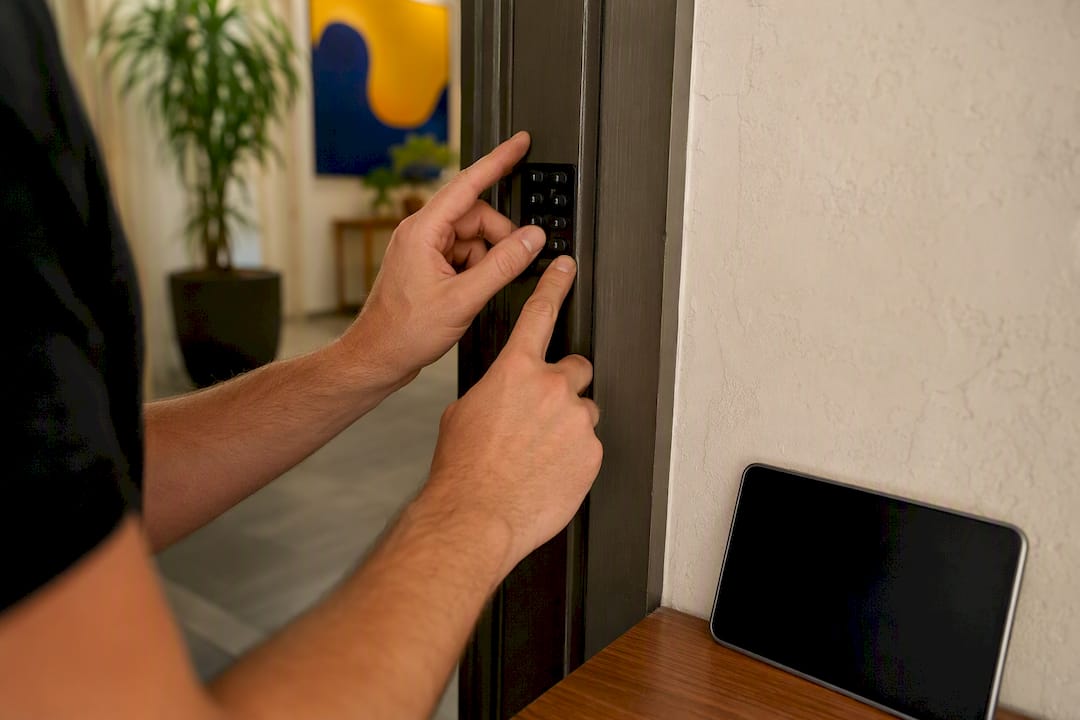
- Smart lock integration (Nuki, TTLock, Yale are common choices) for fully autonomous arrivals
- Payment processing for upsells, plus invoice OCR to simplify expense tracking across properties
The Single Digital Platform for Leases under Royal Decree 1312/2024 adds another layer: registration numbers now need to be visible, and platforms face monthly activity reporting obligations that make automated recordkeeping less optional than it used to be.
What Mistakes Put Hosts at Compliance Risk?
Most compliance failures aren’t dramatic. They’re small gaps that compound.
Incomplete data fields top the list. A missing identity number or an unsigned entry record for a 15-year-old traveling with family turns a routine filing into a liability. Late SES.HOSPEDAJES submission is the second most common issue, usually from hosts who batch-process reporting instead of automating it, missing the legal reporting windows. And relying solely on OTA booking feeds without your own submission record leaves you with no independent proof if a filing silently failed.
- Audit your data fields against the full 17-point requirement, not last year’s shorter form
- Automate submission timing rather than trusting a weekly manual routine
- Keep a reconciliation report that flags any booking without a matching SES.HOSPEDAJES filing
- Store records on EU-hosted infrastructure with encryption and documented access controls for GDPR purposes
- Train staff (even a two-person team) on what a compliant record looks like before an inspection happens
Pro Tip: Run a monthly reconciliation between your booking calendar and your SES.HOSPEDAJES submission log, even if your system claims full automation. Software fails silently more often than it fails loudly.
Why This Shift Matters More Than Hosts Realize
Most hosts treat digital rental contracts as a paperwork upgrade. That undersells it. The real shift is that compliance stopped being something you do once a guest checks in and became something your systems do continuously, whether you’re watching or not.
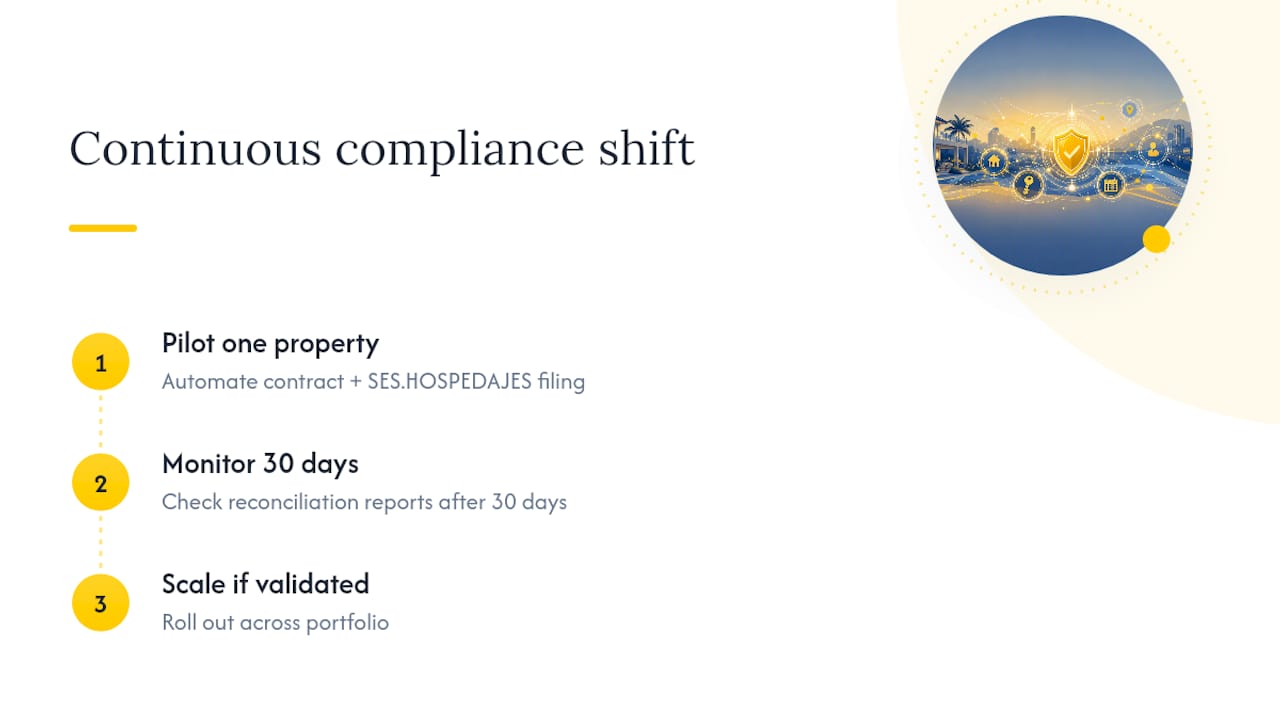
Deployments that automate both the contract and the SES.HOSPEDAJES filing tend to show fewer reporting gaps and faster check-ins than manual setups, based on how these workflows behave once submission and signature happen in the same step. Before rolling automation across an entire portfolio, test it on one property first. Watch how the reconciliation reports look after thirty days, then scale.
— Sofía Herrera
Get Compliant Digital Rental Contracts Running in Minutes, Not Weeks
Building the checklist above yourself means stitching together an e-signature tool, a separate SES.HOSPEDAJES export process, and a spreadsheet to track retention dates. Eurocheckin replaces that patchwork with one system: guests sign digital contracts and house rules during online check-in, and their data flows automatically to SES.HOSPEDAJES the moment it’s captured.
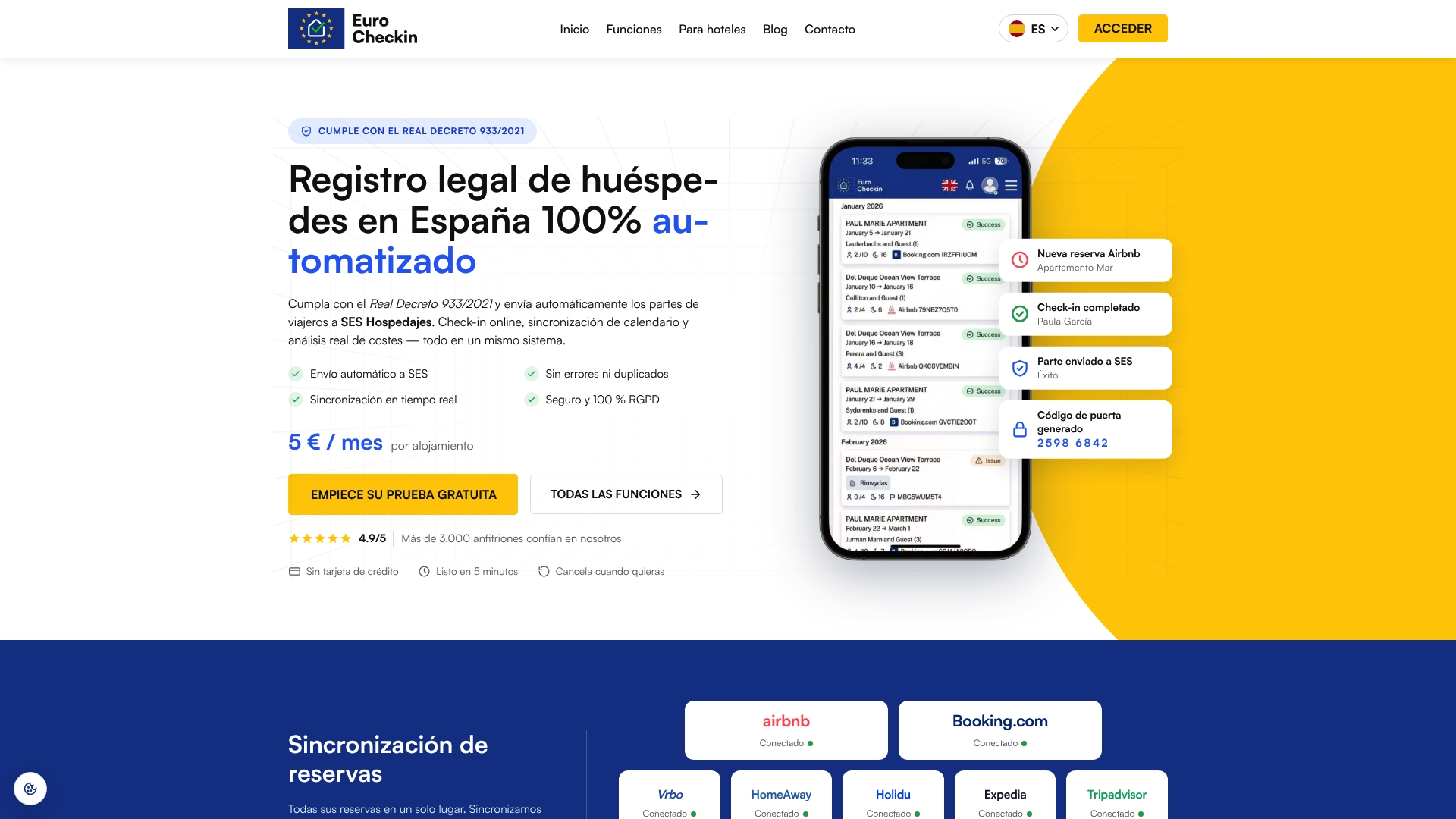
Every submission is logged on EU-hosted infrastructure with the audit trail an inspection actually requires, and calendar sync across Airbnb, Booking, and more than a dozen other platforms keeps your contract timing tied to real reservations, not guesswork. Smart lock integration with Nuki, TTLock, and Yale rounds out fully autonomous arrivals, while built-in payment support lets guests pay for upsells with Apple Pay or Google Pay in seconds. If you manage even one property, start a free trial and see your first automated SES.HOSPEDAJES submission go through without touching a manual form.
Where to Verify the Legal Details
For the exact legal text and implementation specifics behind everything above, these are the sources worth bookmarking:
- SES.HOSPEDAJES official portal from the Ministry of Interior
- Real Decreto 933/2021 full text via the BOE
- Royal Decree 1312/2024 on the single rental registration platform
- Eurocheckin’s SES.HOSPEDAJES integration page for implementation details
Sources
- SES.HOSPEDAJES — Ministry of Interior (Spain)
- Real Decreto 933/2021 (BOE) — guest registration obligations
- Royal Decree 1312/2024 (BOE) — single rental registration
- New regulation allowing digital signature in hotels for check‑in — Mobbeel
FAQ
Are digital rental contracts legally valid in Spain?
Yes. Current hospitality regulation explicitly permits digital signatures and digital logbooks, making fully paperless check-in workflows legally acceptable.
What data must I collect for SES.HOSPEDAJES?
You need 17 data points covering guest identity, contact details, payment method, and stay dates, with signatures required from every guest aged 14 or older under Real Decreto 933/2021.
How long must I keep guest registration records?
Three years from the end of service, with records available to security forces on request during that period.
When do I need to submit guest data to SES.HOSPEDAJES?
Submit at the point the reservation or contract is formalized, or at the start of the stay, respecting the legal 24-hour reporting windows.
Can automation reduce my compliance risk?
Automating submission and signature in one flow, as platforms like Eurocheckin do, creates the auditable trail inspectors look for and cuts the manual errors that cause late or incomplete filings.