



Guest registration is a legal obligation under Real Decreto 933/2021. Every host in Spain must collect specific data from each traveler and report it to SES.HOSPEDAJES within 24 hours of booking or arrival. If a guest refuses to provide the required data, you are legally entitled to refuse the stay.
TL;DR:
- Hosts must report guest data to SES.HOSPEDAJES within 24 hours of booking, arrival, or check-in, or face increased inspection risks.
- Only specific data is required: ID type and number, full name, sex, date of birth, nationality, stay dates, address, and signature for guests aged 14 or over.
- You can legally refuse accommodation if a guest refuses to provide the required registration data, but must document the refusal properly.
- Use digital verification methods such as visual ID checks, payment correlation, or one-time codes to comply while minimizing data collection risks.
- Automating registration and reporting with tools like EuroCheckin simplifies compliance and helps retain records securely for at least three years.
Table of Contents
- What the law requires: RD 933/2021, Ley Orgánica 4/2015, and SES.HOSPEDAJES
- Which guest data to collect, partes de entrada, and handling minors
- Data protection and verification: what AEPD guidance actually says
- If a guest refuses to provide data: what to do at the door
- Operational best practices: a compliance checklist for daily operations
- How automation maps to compliance: what a platform like EuroCheckin actually does
- Balancing compliance and guest experience
- Your next steps toward full SES compliance
- Sources
- FAQ
What the law requires: RD 933/2021, Ley Orgánica 4/2015, and SES.HOSPEDAJES
Real Decreto 933/2021 rewrote the rulebook for guest registration in Spain, and it applies to a wide net of accommodation types: hotels, hostels, vacation rentals, campsites, and any property offering short-term lodging for payment. If you rent out a room, an apartment, or a whole villa to travelers, this decree applies to you, regardless of whether you list on Airbnb, Booking, or take direct reservations.
The reporting itself happens through SES.HOSPEDAJES, the Ministry of the Interior’s digital platform built to replace the old paper-based traveler ledgers. The Ministry activated this system specifically as a public security tool, not a bureaucratic formality, which is why enforcement has tightened rather than loosened since its rollout.
Timing matters more than most hosts realize. The rule is straightforward:
- Report guest data at the time of booking, contract formalization, or the start of the stay.
- If you can’t report at that exact moment, you have no more than 24 hours from booking or arrival to submit it.
- Every operator taking paying guests must comply, whether you manage one apartment or a portfolio of properties.
Miss that window consistently and you’re not just risking a paperwork headache. You’re building a pattern that inspectors notice.
Which guest data to collect, partes de entrada, and handling minors
The required fields come from Anexo I of the decree, and they’re narrower than most hosts assume. You need:
- Document type and number (passport, national ID, or residence permit)
- Full name and sex
- Date of birth and nationality
- Check-in and check-out dates
- Home address
- Signature (for guests 14 and older)
That signature requirement is the part hosts most often skip. Every guest aged 14 or over must sign the parte de entrada, either on paper or through a digital form with an electronic signature. For children under 14, the accompanying adult provides their data on the same form. You don’t need a separate signature from a nine-year-old, but you do need their name, birthdate, and nationality recorded accurately.
Data protection and verification: what AEPD guidance actually says
Here’s where a lot of hosts get nervous and overcorrect. The Agencia Española de Protección de Datos has been explicit: you are not required to photograph or photocopy a guest’s ID, and doing so routinely crosses into excessive data collection. The AEPD has gone further in a public press note, stating plainly that requesting a copy of a DNI or passport for registration purposes is not permitted and increases the risk of identity theft if that image gets stored or leaked.
So what’s acceptable instead? The AEPD lists several verification methods that satisfy the data minimization principle:
- A visual check of the ID against the guest in person, without retaining a copy
- Digital certificates for remote verification
- Correlating the guest’s stated identity with the payment method used to book
- Sending a one-time code by SMS or email as a second authentication factor
If you use a property management system or a third-party integration to handle this, remember that automating the process doesn’t transfer the legal responsibility. You’re still accountable for the accuracy of whatever data reaches SES.HOSPEDAJES, according to the Ministry of the Interior.
Pro Tip: Build your pre-check-in form to collect only the Anexo I fields, nothing more. Every extra field you ask for is extra liability you don’t need under GDPR’s data minimization rule.
If a guest refuses to provide data: what to do at the door
Refusal isn’t a gray area. Spanish law gives you the legal basis to deny accommodation when a guest won’t provide the required registration data, and treating that refusal calmly protects both you and your business.
- Explain the requirement clearly. Tell the guest that Spanish law under RD 933/2021 requires this data before check-in, and cite that you’re legally obligated to collect it.
- Offer an in-person alternative. If they’re uneasy about a digital form, let them provide the same information verbally while you enter it, or hand over a paper parte de entrada instead.
- Log the refusal. Note the time, the channel of communication, and what was said or written, so you have a record if a dispute follows.
- Cancel the reservation if the refusal stands. You are not obligated to house someone who won’t complete registration.
- Notify the booking platform or, in serious cases, local police if the situation escalates or the guest becomes aggressive about the requirement.
Documenting each step matters more than most hosts think. If a complaint or fine follows, a dated log showing you tried to comply and the guest refused is your best defense.
Operational best practices: a compliance checklist for daily operations
Turning legal text into daily habit is where most hosts fall short, not because the rules are unclear but because nobody wrote down a process. A few habits close that gap fast.
- Collect the mandatory fields before arrival, through an automated pre-check-in link sent right after booking confirmation.
- Train staff or yourself on a short verification script: ask for ID, confirm the name matches the reservation, and explain the legal basis if a guest hesitates.
- Keep your digital register for three years from the end of each stay, since that’s the retention window the Ministry of the Interior specifies, and organize it so you can produce records fast during an inspection.
- Use an automated flow that syncs with your booking calendars, so a same-day reservation doesn’t slip past the 24 hour deadline.
Pro Tip: Set your pre-check-in reminder for the moment a booking confirms, not the day of arrival. Late-night check-ins are where most hosts blow past the 24 hour SES deadline.
How automation maps to compliance: what a platform like EuroCheckin actually does
Every requirement above maps directly onto a feature set, which is why manual registers are becoming the exception rather than the rule. Digital partes de entrada with e-signatures satisfy the Anexo I signature requirement without printing a single form. One-click reporting to SES.HOSPEDAJES enforces the 24 hour window automatically, instead of relying on someone remembering to log in and submit data at 11 p.m.
Secure hosting within the European Union addresses the data retention and GDPR concerns the AEPD raises, and calendar synchronization across platforms like Airbnb, Booking, and Vrbo closes the gap where a last-minute reservation gets registered late simply because nobody saw it come in. Eurocheckin builds its reporting workflow around exactly this chain: collect the minimum required fields, verify without storing ID copies, and submit before the clock runs out.

Balancing compliance and guest experience
Compliance creates friction, and pretending otherwise helps nobody. But the friction is legally necessary, not optional. Clear pre-arrival messaging about what data you need and why, paired with automated verification, keeps that friction off your doorstep and out of a heated conversation at check-in. Invest in a short staff script and a workflow that runs itself. That combination prevents most disputes before they start.
— Sofía Herrera
Your next steps toward full SES compliance
Three moves get you compliant this week. Register your property with SES.HOSPEDAJES if you haven’t already, build a pre-check-in form that collects exactly the Anexo I fields (nothing more), and write a two-line refusal script your staff can use without hesitation at the door.
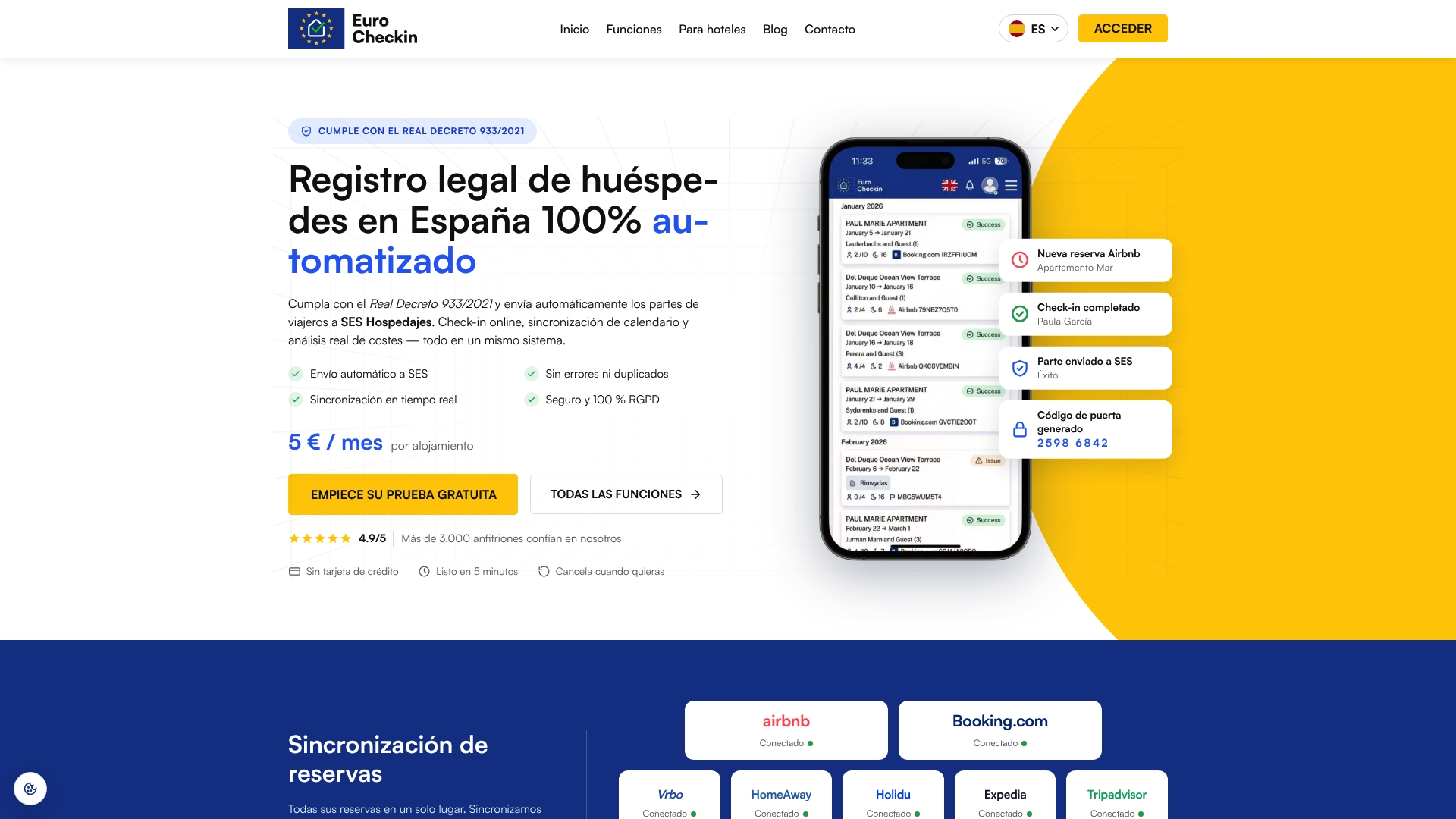
Eurocheckin is the alternative to chasing paper registers and manual SES submissions by hand. Instead of logging into the Ministry’s platform for every arrival, hosts using EuroCheckin para alojamientos get automatic SES reporting, digital partes de entrada with e-signatures, and calendar sync across more than a dozen booking platforms, starting at €5 per month per property. Hotels and larger operations can look at EuroCheckin para hoteles at €3 per month per room, and if you’d rather have the setup handled for you, the SES Hospedajes registration service starts at €79 one time per property. Some platforms offer free trials allowing hosts to try automated reporting before their next guest arrives.
Sources
For the primary legal text, read Real Decreto 933/2021 on the BOE. For registration procedures and platform access, check the Ministry of the Interior’s lodging services page. For data protection specifics, review the AEPD’s guidance note on guest registration.
This article is general information, not a substitute for advice from a qualified lawyer. Consult a qualified legal professional about your own circumstances before acting on anything here.
- Ministerio del Interior — Hospedajes y alquiler de vehículos
- AEPD — Note on guest registration and identity document copies
FAQ
What is the 24-hour rule for guest registration in Spain?
Hosts must report guest data to SES.HOSPEDAJES at booking, contract signing, or arrival, or no later than 24 hours after any of those events. Missing this window consistently increases your exposure to fines under Ley Orgánica 4/2015.
What documents do I need to complete a guest registration?
You need a valid ID document (passport, national ID, or residence permit), plus the guest’s name, sex, date of birth, nationality, and travel dates for the parte de entrada. You do not need a photocopy of the document itself, per AEPD guidance.
Can I refuse a guest who won’t provide their ID?
Yes. Spanish law gives hosts the legal basis to deny accommodation when a guest refuses to provide the data required under RD 933/2021. Document the refusal, including the time and communication channel, before canceling the reservation.
How long must I keep guest registration records?
Hosts must retain the digital register for three years from the end of the stay. Keeping records digitally, rather than on paper, makes producing them for an inspection considerably faster.
Does using a platform like EuroCheckin remove my legal responsibility?
No platform removes your legal responsibility for data accuracy, but a tool like EuroCheckin automates the reporting so submissions happen within the 24 hour window without manual entry. You remain the accountable party if the data submitted is inaccurate.