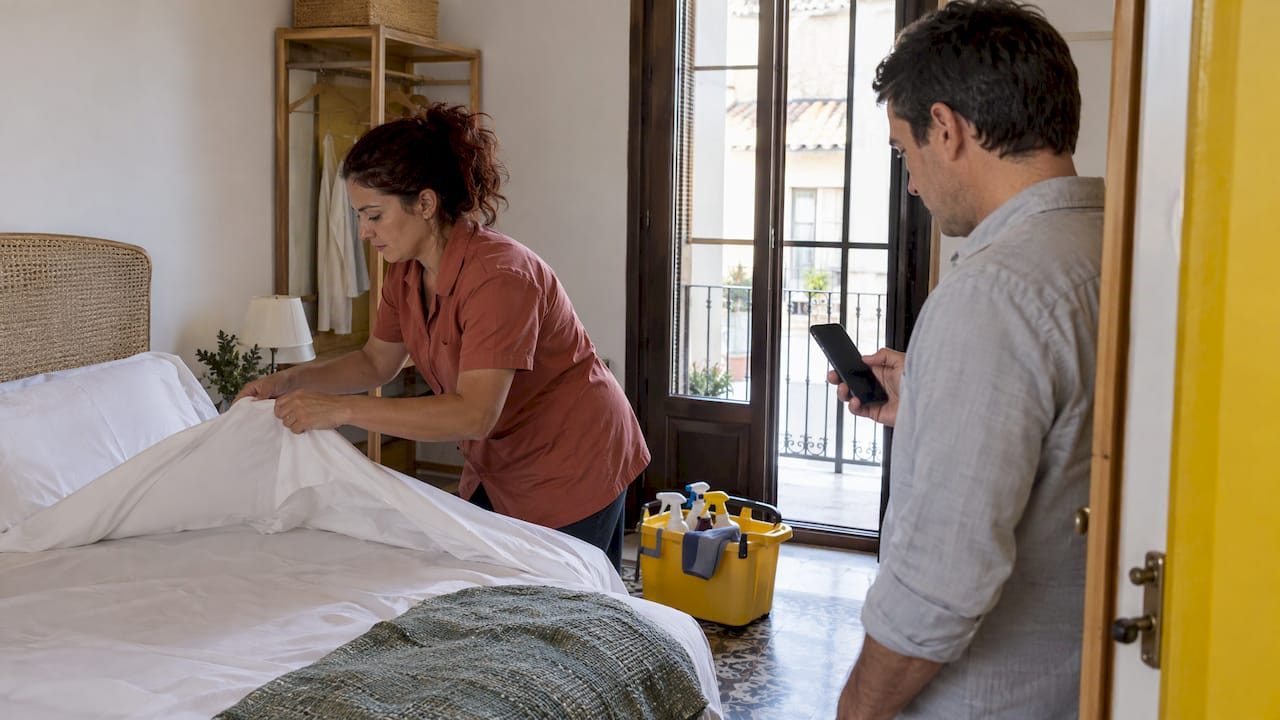



If you host guests in Spain, you must collect a defined set of personal data from every traveler, report it to the Ministry of the Interior through SES.Hospedajes within 24 hours, and avoid collecting anything beyond that, including photocopies of IDs. This checklist shows the required fields, the data you should not request, and the order of work from booking to deletion.
It applies to hotels, hostels, tourist apartments and vacation rentals alike. The Ministry of the Interior states that the obligation covers all of them, with no exemption for size or frequency.
TL;DR
- Collect only the fields listed in Royal Decree 933/2021: identity, date of birth, nationality, sex, place of residence, family relationship for minors, plus transaction and payment details.
- Report to SES.Hospedajes immediately and in any case within 24 hours of the booking, contract or start of the service.
- Do not ask for copies of passports or national ID cards. The AEPD, Spain’s data protection authority, says this is not allowed.
- Keep the records for three years after the service ends, then delete them.
Table of Contents
- Who needs this checklist
- Step 0: Register your accommodation first
- The checklist: data you must collect
- What you should not collect
- How to verify identity without copying documents
- The timeline: from booking to deletion
- Common mistakes
- Our perspective: a form is a compliance decision
- Automating the checklist with EuroCheckin
- A printable pre-arrival checklist
- FAQ
- Sources
Who needs this checklist
The Royal Decree distinguishes between professional and non-professional hosts. Professionals must register themselves and their accommodations, report guest data and keep a register. According to the Ministry, non-professional hosts are exempt from the documentary register and retention duties but must still report the data.
In practice, if you rent out a flat, run a guesthouse or manage a hotel, you need the list below. If you want the legal background first, we explain it in our guide to Real Decreto 933/2021 for Spanish hosts.
Step 0: Register your accommodation first
Before any guest data can be sent, the accommodation must exist in the Ministry’s system. The Ministry says you must register it in its electronic office before starting the activity, or within 10 days after completing the prior administrative procedures.
Have these ready:
- Your own registration as a professional host.
- The registration of each accommodation.
- The web service credentials your software needs to send data on your behalf (the web service user, the landlord code and the password). Copy them exactly as they appear, with no extra spaces.
If you would rather not do this yourself, our SES Hospedajes registration service is offered from €79 one-off per accommodation.
The checklist: data you must collect
The decree sets out the information that goes into the traveler entry record. Use this list as the fields of your check-in form.
Per traveler
| Field | Notes |
|---|---|
| First name and surname | As on the identity document |
| Type of identity document | National ID card, passport, residence card and so on |
| Document number | Type and number, not an image |
| Date of birth | Needed to identify minors |
| Nationality | |
| Sex | |
| Place of residence | Full habitual address |
| Family relationship | Only for minors traveling with an adult |
These fields come from the text of the decree. Every adult in the group should be recorded, and minors too, with the relationship to the adult they travel with.
Per stay
- Contract or booking date.
- Check-in and check-out dates.
- Number of travelers.
- Address of the accommodation.
- Payment details: method and the data identifying the payment instrument, as set out in the decree.
The Ministry asks for the same data that businesses already gather to manage a booking, as it explains in its launch announcement. Nothing here should surprise a guest who has booked online.
What you should not collect
This is where most hosts go wrong. Many still ask guests to upload a photo of their passport “just in case”. The AEPD has said this is disproportionate. A document copy contains data you do not need, such as the photo, the expiry date or the parents’ names, and it does not even contain everything the decree requires.
The data protection authority has also acted on this. A published AEPD case file concerns a hotel that was found to breach the data minimization principle of the GDPR (article 5.1.c) by collecting document details beyond what was needed. Its recommendation is a form that collects only the fields the decree requires.
So, as a rule:
- Do not request photocopies, scans or photos of IDs or passports.
- Do not request data with no legal purpose, such as marital status or profession.
- Do not store extra data “for marketing” under the registration legal basis. Marketing needs its own consent.
- Do not keep data past the retention period.
The purpose of citizen security and terrorism prevention does not justify indiscriminate collection of document copies, according to the AEPD.
How to verify identity without copying documents
You must still be able to stand behind the data you report. The AEPD sets out different routes depending on the check-in type.
In-person check-in
A visual check of the original document is enough. You do not need to scan or file a copy, as the AEPD press note states.
Remote or self check-in
The AEPD lists several options for authenticating the data online:
- A digital certificate.
- Cross-checking against the data linked to the payment method.
- A security code sent to a verified phone number or email address.
The AEPD also stresses that the host is the data controller. It is up to you to evaluate and demonstrate that the method you chose is compatible with data protection rules, and there is no single universal solution. Document your choice in writing: which method you use, why it is proportionate, and which tool applies it.
The timeline: from booking to deletion
- At booking: send your guests the check-in link with the list of fields and a short privacy notice.
- Before arrival: guests complete the form, and you verify with your chosen method.
- Within 24 hours: report the data to SES.Hospedajes. The deadline runs from the booking or contract, or from the start of the service, and the Ministry says it applies regardless of how check-in happens, in person or self-service.
- During the stay: make sure that late changes, such as an extra traveler, are also reflected.
- After check-out: keep the record for three years if you are a professional host, then delete it.
The adaptation period for SES.Hospedajes extended until 1 October 2024, so the system is now fully in force.
Common mistakes
- Waiting for the guest to arrive. The deadline can start at booking, so a late-night arrival is not an excuse.
- Asking for a passport photo in the same form that collects the fields. It is excess data.
- Entering credentials with extra spaces or typing the landlord code from memory. Copy exactly as it appears.
- Registering the same guest twice because the booking platform and your software both send data.
- Forgetting minors or leaving the family relationship blank.
- Keeping data indefinitely in email inboxes or WhatsApp chats.
Our perspective: a form is a compliance decision
We see the same pattern with the hosts we work with. The data checklist itself is short. What causes trouble is where the data travels: guests send photos by chat, a team member retypes them into the Ministry portal, and copies stay in a phone gallery. Each step adds risk and delays the 24-hour report.

That is why we built EuroCheckin around a single online form that asks only for the fields the decree requires, in the guest’s language, and sends them to SES.Hospedajes automatically. Data is hosted on secure infrastructure inside the European Union. The point is not to add one more tool but to remove manual copying, so there is nothing to forget and no document images to protect.
Our advice: before you pick any system, run it against this article. Does it ask for more than the list? Does it store ID images? Can you explain your verification method to the AEPD? If any answer is unclear, fix that first.
— Sofía Herrera
Automating the checklist with EuroCheckin
If you manage one or several properties, a form plus automatic reporting removes most of the work above. EuroCheckin for accommodations costs €5 per month per accommodation, with a free trial. Hotels can use EuroCheckin for hotels at €3 per month per room.
The platform includes unlimited multilingual online check-in, smart links for Airbnb, Booking and Vrbo, instant arrival alerts, calendar sync, digital contracts with e-signature, and integration with Nuki, TTLock and Yale smart locks for self check-in. Once the registration data flows, you can also use the same guest journey for extras: see how to upsell to guests in Spain.
A printable pre-arrival checklist
Copy this into your own operations manual.
Setup (once per accommodation)
- Host and accommodation registered with the Ministry of the Interior
- Web service user, landlord code and password stored securely
- Privacy notice written and linked in the check-in form
- Identity verification method chosen and documented
Per booking
- Check-in link sent to the lead guest
- All travelers recorded, including minors and their relationship
- Required fields complete: identity, birth date, nationality, sex, residence
- Payment details recorded
- No document copies requested or stored
- Data reported within 24 hours
- Confirmation of submission saved
After the stay
- Record retained for three years (professional hosts)
- Deletion scheduled when the period ends
FAQ
Can I ask guests to send a photo of their passport?
No. The AEPD says requesting a copy of an ID or passport at accommodations is not permitted, because it is disproportionate and breaches data minimization. Use a form with the required fields and verify identity by one of the accepted methods instead.
What is the deadline to report guest data in Spain?
The report must be immediate and in any case within 24 hours of the booking or contract, or of the start of the service. The Ministry of the Interior applies this to both in-person and self check-in.
How long do I keep guest data?
Professional hosts must keep the records for three years after the service ends. Non-professional hosts are exempt from the register and retention duties but still have to report the data.
Does a small vacation rental need to do this?
Yes. The Ministry of the Interior says there is no exemption by size or frequency. Even a non-professional host has to communicate the data.
Sources
- Real Decreto 933/2021, BOE
- Ministerio del Interior: Hospedajes y alquiler de vehículos
- Ministerio del Interior: Interior activa el nuevo registro de hospedaje
- AEPD note on identity document copies in accommodations
- AEPD press release on ID and passport copies
- AEPD case file EXP202502936