


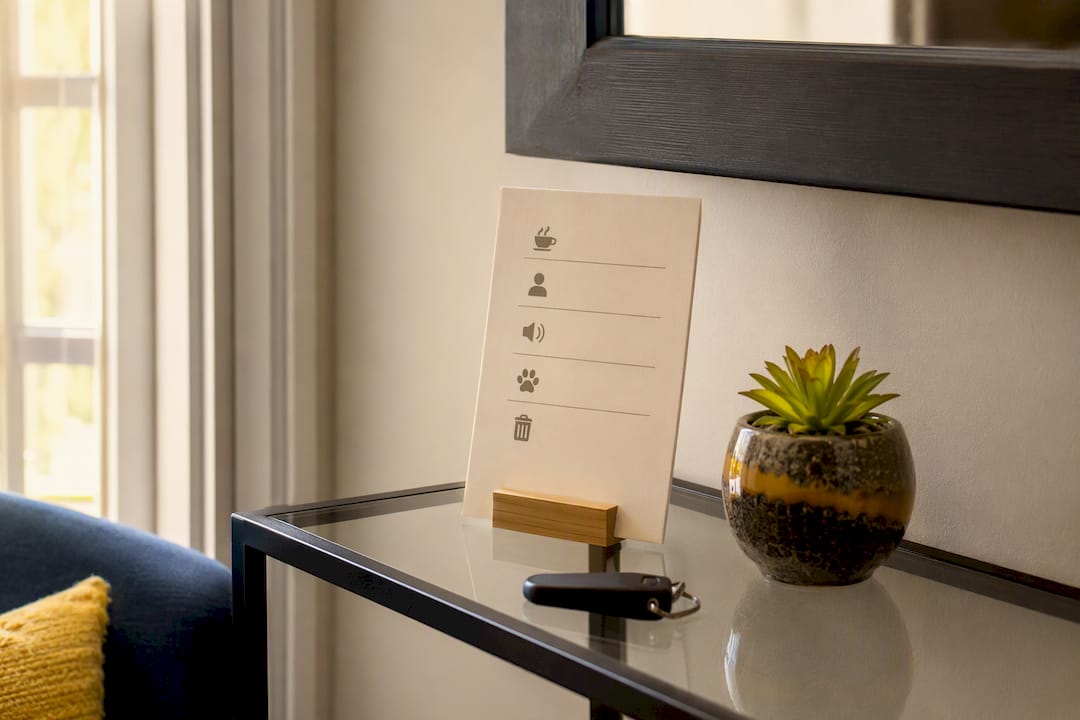
A high-impact house rules list contains 6 to 8 specific, enforceable items: maximum occupancy, no parties or events, quiet hours with exact times, a clear smoking policy, a pet policy, check-in and checkout times, and trash or parking instructions. These rules only work if guests see them before they book and confirm them again in a signed digital agreement.
Here’s the core set every listing needs:
- Maximum occupancy: state the exact number of registered guests allowed
- No parties or events: name the consequence, not just the prohibition
- Quiet hours: give exact times (e.g., 10:00 PM to 8:00 AM)
- Smoking policy: indoor ban plus a designated outdoor spot
- Pet policy: allowed with a fee, or not allowed at all, stated plainly
- Check-in/checkout times: with the late-checkout fee spelled out
- Trash, recycling, and parking: where bins go and where cars park
A tool like Eurocheckin can automate this delivery: it pushes rules to guests before arrival, records their signed acknowledgment, and feeds the same compliance data into Spain’s official reporting system.
Key Takeaways
Enforceable house rules combine specific wording, pre-booking visibility, and a documented, signed acknowledgment that a guest actually received them.
| Point | Details |
|---|---|
| Keep the visible list short | Show 6 to 8 critical rules in the listing summary; put the full 8 to 12 item set in the guestbook or agreement. |
| Use numbers and times | Replace vague phrasing like “be quiet” with exact hours, fees, and occupancy limits. |
| Document before, not after | A rule is enforceable when shown pre-booking and confirmed again in a signed agreement. |
| Match rules to property type | Pools, fire pits, and shared walls each need their own safety-specific rule lines. |
| Track Spain’s VUDA requirement | Display your rental registration number and file the annual informative return on time. |
| Automate delivery with Eurocheckin | Eurocheckin delivers house rules, collects e-signatures, and reports guest data to SES Hospedajes in one flow. |
Table of Contents
- Essential House Rules Examples for Listings and Guestbooks
- Writing Rules That Are Enforceable, Not Just Polite
- House Rules Templates by Property Type
- Spain’s Rental Code and What It Means for Your Rules
- Where to Show Rules: Listing, Confirmation, and Guestbook
- Handling Guest Disputes Over House Rules
- A Quick Test Before You Publish Your Rules
- Automate Rule Delivery and Get Signed Proof With Eurocheckin
- Sources
- FAQ
Essential House Rules Examples for Listings and Guestbooks
Copying vague advice like “be respectful of neighbors” gets you nowhere when a dispute lands in your inbox. What works is short, specific language a guest can’t misread. Below are ready-to-use lines you can drop straight into a listing description, a digital guestbook, or a printed welcome sheet.
- Maximum occupancy: “This property sleeps a maximum of [X] guests. Unregistered visitors are not permitted overnight.”
- No parties or large gatherings: “Parties, events, and gatherings of more than [X] guests are not allowed. Violation results in immediate booking cancellation without refund.”
- Quiet hours: “To respect our neighbors, quiet hours run from 10:00 PM to 8:00 AM. No amplified music or outdoor noise is permitted during this window.”
- Smoking policy: “This is a smoke-free property. Smoking is permitted only in the designated outdoor area near [location]. A cleaning fee of $150 applies for smoking indoors.”
- Pets (allowed): “Well-behaved pets are welcome for a $40 fee per stay. Please crate pets when unattended and clean up after them in shared areas.”
- Pets (not allowed): “This property does not permit pets, including short visits. A pet discovered on-site incurs a deep-cleaning fee deducted from the security deposit.”
- Check-in / checkout: “Check-in is after 4:00 PM; checkout is by 11:00 AM. Late checkouts without prior approval are billed at $25 per hour.”
- Trash and recycling: “Place trash bags in the gray bin and recyclables in the blue bin, both located at the curb by 7:00 AM on collection day.”
- Parking: “One vehicle may park in the driveway. Street parking requires a permit, available at check-in.”
- Pool or hot tub access: “Pool hours are 9:00 AM to 9:00 PM. No glass containers near the water. Children under 12 must be supervised at all times.”
- Hot tub safety: “Hot tub temperature is capped at 104°F. Please shower before entering and shut the cover after use to conserve energy.”
Pro Tip: Pair every restrictive rule with a short reason. “Quiet hours protect our neighbors’ sleep” reads very differently from a flat “No noise.” Guests comply more often when they understand why the rule exists.
Writing Rules That Are Enforceable, Not Just Polite
Vague rules lose disputes. “Be respectful” or “keep noise reasonable” gives a guest room to argue interpretation, and it gives you nothing to point to when a neighbor complains at midnight. Specific wording, tied to a number or a time, holds up.
Compare these two versions:
- Weak: “No loud noise late at night.”
- Strong: “Quiet hours are 10:00 PM to 8:00 AM. Outdoor speakers and amplified music are not permitted during this window.”
- Weak: “Please don’t have too many guests over.”
- Strong: “Maximum occupancy is 6 registered guests. Additional visitors must leave by 10:00 PM and cannot stay overnight.”
Specificity is only half the equation. A rule becomes enforceable when it appears in the listing itself and again in a booking confirmation or signed rental agreement, before the stay begins. Host guidance recommends listing several total rule items, but keeping the visible listing summary to 6 to 8 critical items so it doesn’t scare off bookers, while the full set lives in the guestbook or agreement.
When you attach a consequence, tie it to something concrete: a flat cleaning fee, a percentage deducted from the security deposit, or a note that the card on file will be charged. Airbnb’s own hosting guidance confirms that standard house rules shown before booking, covering key topics such as pets, events, smoking, quiet hours, and occupancy, are generally treated as enforceable and can support a resolution case if a guest violates them.

House Rules Templates by Property Type
A one-size list rarely fits every property. A condo with shared walls and a mountain cabin with a wood stove need different priorities up front. Adapt these four starter sets rather than building from scratch.
Condo or apartment unit
- Quiet hours: 10:00 PM to 8:00 AM, strictly enforced due to shared walls
- One assigned parking spot only; visitor parking is not guaranteed
- No moving furniture in shared hallways or elevators during move-in/out
- Building access code is confidential; do not share with non-guests
Family house with a pool
- Pool hours: 9:00 AM to 9:00 PM; no diving, no glass near the water
- Children under 12 must be supervised by an adult at all times near the pool
- Trash and recycling go to curbside bins by 7:00 AM on collection day
- No lifeguard on duty; swim at your own risk
Mountain cabin
- Fires permitted only in the designated fire pit or wood stove; never left unattended
- Store all food in sealed containers due to local wildlife activity
- Winter guests: 4-wheel drive or chains required on the access road after snowfall
- Firewood provided is for on-site use only
Luxury villa
- Events and gatherings require prior written approval and an additional deposit
- Household staff may access common areas between 9:00 AM and 1:00 PM on scheduled days
- Damage exceeding normal wear is billed directly to the card on file
- Outdoor speaker use limited to daylight hours out of respect for neighboring estates
Spain’s Rental Code and What It Means for Your Rules
Spain has moved from regional patchwork rules toward a national framework, and it changes what has to appear in your listing, not just what you say in your house rules. Under the current national rental code, hosts must display a VUDA registration number in listings that process bookings or payments, and failing to do so risks fines or having the listing pulled entirely.
Owners who let properties on platforms with online booking must register in VUDA and submit an annual informative return in February covering the prior year’s occupancy. Missing this deadline is treated the same as never registering at all.
That reporting duty sits alongside, not instead of, your usual traveler registration obligations. Before you publish any rule set, check your regional tourist licence requirements and confirm your community of owners hasn’t imposed its own restrictions on short-term guests, noise, or shared-space use. A rule that conflicts with a building’s bylaws won’t protect you in a dispute.
Where to Show Rules: Listing, Confirmation, and Guestbook
Getting the placement right matters as much as the wording. Here’s the sequence that works:
- Listing summary: show your 4 to 6 highest-impact rules, occupancy, parties, quiet hours, pets, since these directly influence a guest’s decision to book.
- Booking confirmation and digital check-in: deliver the complete rule set and collect a signed acknowledgment before arrival.
- On-site posting: laminate and post safety-critical rules, like pool or hot tub instructions, right at the point of use.
Pro Tip: Don’t bury your top rules in a 12-item guestbook page nobody reads. Guests skim. The listing summary is the only place you can guarantee they’ll actually see something before they hand over payment.
Handling Guest Disputes Over House Rules
Most house rule disputes come down to a single question: can you prove the guest saw the rule and agreed to it? That’s why documentation matters more than the rule’s wording once a conflict actually happens.
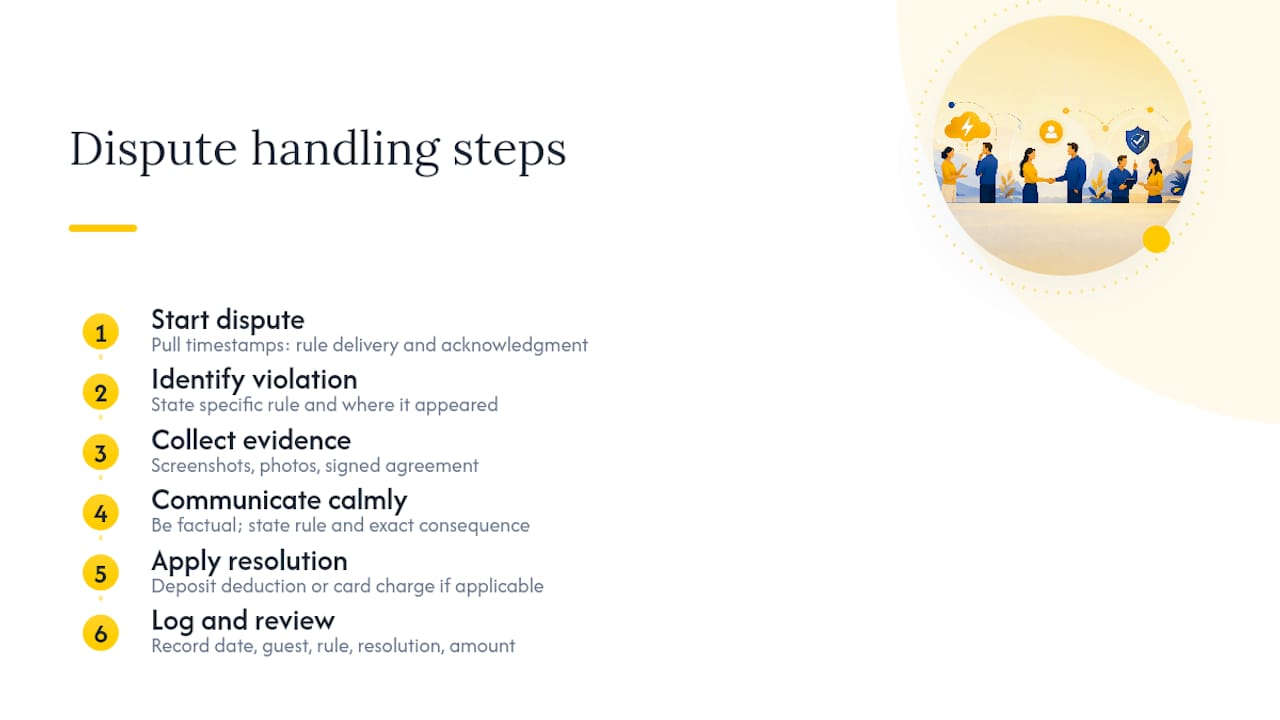
Start every dispute the same way: pull the timestamp on when the rule was delivered, whether in the listing, the booking confirmation, or a signed digital agreement, and the timestamp of the guest’s acknowledgment. If a guest disputes a smoking fee or a noise complaint, that paper trail is what platforms like Airbnb and Booking ask for during a resolution case. Screenshots of message threads, photos of any damage, and a copy of the signed agreement all strengthen your position.
Keep communication factual and non-confrontational, even when a guest pushes back hard. State the specific rule that was violated, reference exactly where it appeared, and state the consequence you’re applying, whether that’s a deposit deduction or a card charge. Avoid vague language like “you broke the rules” in favor of “quiet hours ran from 10:00 PM to 8:00 AM per the signed agreement, and noise was reported at 1:00 AM.”
Log every dispute, even minor ones, in a simple record: date, guest name, rule violated, resolution, and amount charged if any. Patterns matter. A single noise complaint is a guest problem. Three noise complaints across different bookings at the same property might mean your quiet hours wording, or your neighbor relations, need attention.
A Quick Test Before You Publish Your Rules
Hand your listing summary, and only the summary, to someone unfamiliar with your property. Ask them to name your top three rules in under a minute. If they can’t, your wording is too buried or too vague. I’d also test any new phrasing in a local host group before it goes live. Other hosts spot ambiguity faster than you will, because you already know what you meant.
— Sofía Herrera
Automate Rule Delivery and Get Signed Proof With Eurocheckin
Manually chasing guests to read and sign a rules document is the kind of task that eats an evening every week once you manage more than one property. Eurocheckin replaces that entire chase with automated delivery: guests receive your house rules through a multilingual online check-in, sign them electronically as part of their digital guest guide, and that signed record sits ready if a dispute ever comes up.
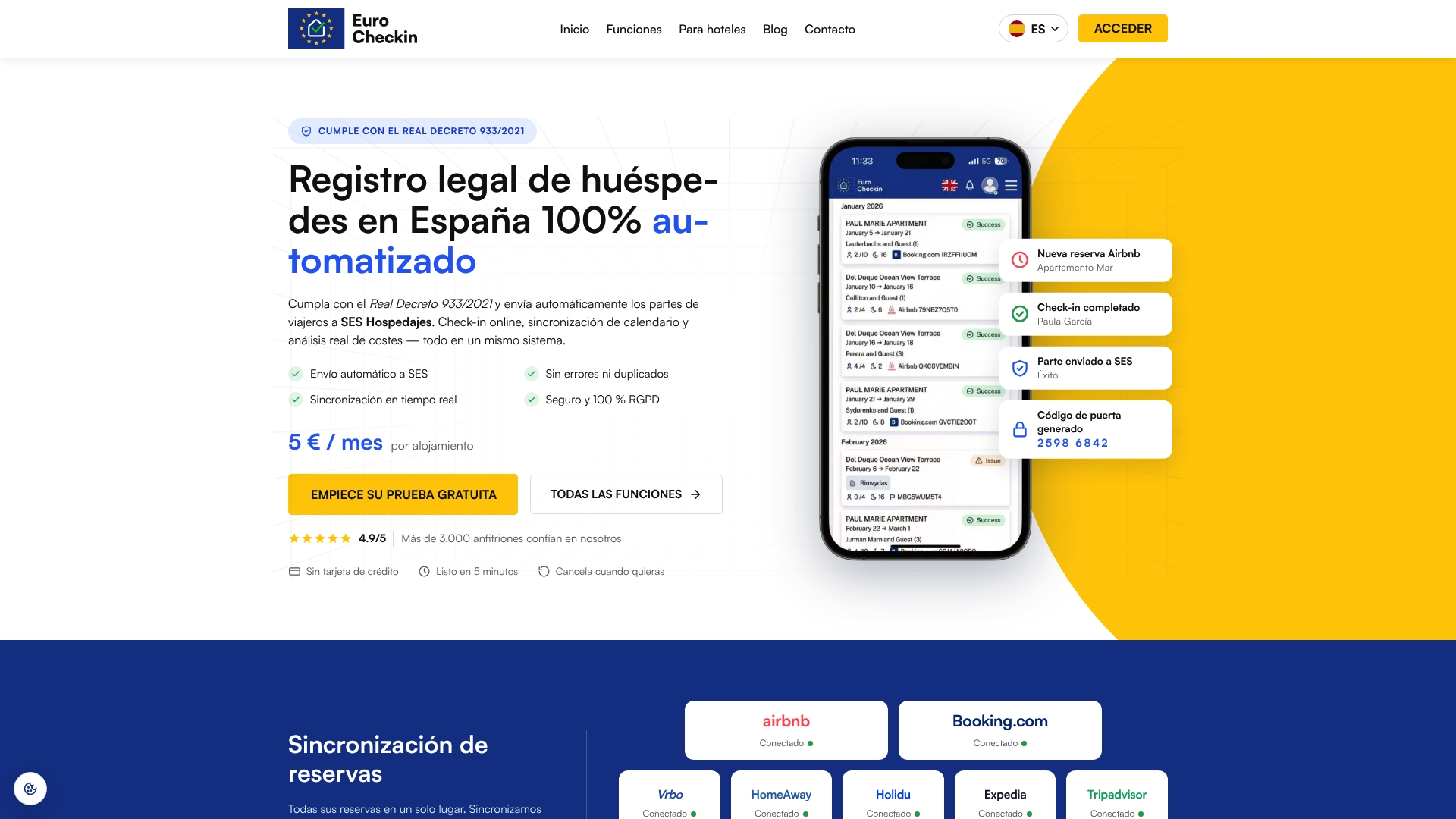
The same platform handles the regulatory side this article just covered. Guest data flows automatically to SES Hospedajes under Real Decreto 933/2021, so your traveler registration and your house rules acknowledgment happen in one guest flow instead of two separate systems. Calendar sync across Airbnb, Booking, Vrbo, and other platforms keeps your check-in timing accurate, which cuts down on the late-checkout disputes this article’s rule templates are designed to prevent. Integration with Nuki, TTLock, and Yale smart locks means the signed rules and the door code arrive together, autonomously.
Start a free trial and see how automated delivery and signed acknowledgment fit into your own check-in flow.
Sources
- Spain rental rules: what non-resident property owners must know
- Ground rules for guests - Resource Center - Airbnb
- Vacation Rental House Rules: What to Include 2026
FAQ
How many house rules should a listing have?
Aim for 8 to 12 total rules, but show only 6 to 8 in the listing summary so the full list doesn’t discourage bookings.
When do house rules become legally enforceable?
Rules become enforceable once they’re visible before booking and confirmed again through a booking agreement or signed digital acknowledgment, in line with Airbnb’s own hosting guidance.
What should I do about guests throwing unauthorized parties?
State a clear “no parties” rule with a named consequence, such as immediate cancellation or a deposit deduction, and document the violation with photos or messages for a platform dispute case.
Do I need to register my property under Spain’s VUDA code?
Yes, if you list on a platform that processes bookings or payments, you must display your VUDA registration number and file an annual informative return in February covering the prior year.
Can Eurocheckin help deliver and document house rules?
Yes. Eurocheckin delivers house rules through a multilingual digital guest guide, collects an e-signature before arrival, and stores that record alongside SES Hospedajes reporting data.