



To stop double bookings, move to an API-backed multi-calendar sync (a channel manager or an integrated property platform), and treat iCal as a temporary bridge, not your permanent setup. Airbnb only refreshes linked iCal calendars at regular intervals that can be several hours apart, which leaves a real gap where two guests can book the same night. EuroCheckin closes that gap with automatic calendar sync across Airbnb, Booking, Vrbo and more than 12 other platforms.
- Switch from iCal to an API connection as soon as you list on two or more platforms
- Confirm your provider syncs availability, not just occupancy
- Choose one master calendar and document it for your whole team
Key Takeaways
API-backed multi calendar sync eliminates the hours-long lag that causes most double bookings, while iCal remains a workable stopgap only for single-listing, low-volume operations.
| Point | Details |
|---|---|
| Prioritize API over iCal | Move to an API-backed connection once you list on two or more platforms regularly. |
| Watch the sync gap | Airbnb refreshes linked iCal calendars roughly every three hours, leaving room for double bookings. |
| Fix discipline, not just speed | Document a single master calendar and confirm your whole team knows which system is authoritative. |
| Monitor after cutover | Check sync logs, refresh timestamps, and recent bookings daily for the first 72 hours after migration. |
| Choose compliance-first tools | Eurocheckin pairs automatic sync across 12+ platforms with SES Hospedajes reporting and GDPR-compliant, EU-hosted infrastructure. |
Table of Contents
- What Is Multi Calendar Sync for Vacation Rentals?
- Why Does Reliable Calendar Sync Matter So Much?
- iCal, API, or Channel Manager: What’s the Real Difference?
- How Do You Set Up Multi Calendar Sync Without Losing Bookings?
- What Causes Most Calendar Sync Errors?
- How Does EuroCheckin Handle Multi Calendar Sync?
- What Happens When Managers Actually Switch Sync Methods?
- How Does EuroCheckin Compare With Other Sync Approaches?
- The Real Problem Isn’t Sync Speed, It’s Sync Discipline
- Ready to Automate Your Calendar Sync?
- Sources
- FAQ
What Is Multi Calendar Sync for Vacation Rentals?
Multi calendar sync, in this context, means keeping availability and reservation data aligned across every booking platform where you list a property. It has nothing to do with syncing your personal Google Calendar or Outlook schedule. This is about your Airbnb calendar, your Booking.com calendar, your Vrbo calendar, and your direct booking site all reflecting the same reality at the same time.
The core job is simple: block a date on one platform and it disappears from all the others before a second guest can grab it. Depending on the connection type, sync can cover:
- Availability and reservation blocking (the baseline every method should handle)
- Rate and pricing distribution (API connections only)
- Minimum-stay and preparation-time rules (API connections only)
- Guest and reservation metadata for reconciliation (API connections only)
A basic iCal link handles only the first item. Anything built on an API can handle all four, which is exactly why the method you choose matters more than most managers assume.
Why Does Reliable Calendar Sync Matter So Much?
A double booking rarely costs you just one canceled reservation. You typically eat a refund, sometimes a relocation fee to rebook the guest elsewhere, a dent in your review score, and in some cases a penalty or visibility drop from the platform itself. Multiply that by a busy summer weekend and a single sync failure can wipe out a month of margin on a property.
Listing on more platforms increases your booking reach, but it also multiplies the number of places a stale calendar can betray you. Each additional channel is a new door double bookings can walk through if sync lags behind.
Channel managers tend to become cost-effective when you use them on two or more platforms regularly, and iCal is generally sufficient for a single listing but may not reliably support multiple units or high-volume operations. Use this as your decision line:
- One listing, one or two channels, low turnover: iCal can hold for now
- Two or more channels, frequent bookings, or seasonal price changes: move to an API-backed connection
- Multiple properties or high nightly rates: the cost of one missed sync already outweighs the price of upgrading
iCal, API, or Channel Manager: What’s the Real Difference?
Each method moves different information at a different speed, and that gap is exactly where double bookings come from.
- iCal feeds. Airbnb’s iCal links refresh roughly every three hours and transmit only blocked or open dates, nothing about rates, minimum stays, or prep time between guests. It is free and simple to set up, which is why so many small operators start here, but the lag is baked into the format itself.
- API connections. Industry benchmarks report API sync times typically range from seconds to a few minutes, while iCal sync intervals can be much slower, sometimes measured in hours. APIs also carry rates, house rules, and often reservation details, so your pricing and your calendar stay aligned automatically instead of drifting apart.
- Channel managers and integrated platforms. These sit above the individual connections, orchestrating API links to every OTA at once, pushing rate changes outward, and pulling every reservation into one dashboard. You are not managing five separate sync jobs; you are managing one system that talks to five platforms.
Airbnb, Booking.com, and Vrbo all support API-level connections through certified partners, and that’s the reliability difference that matters most: an API failure typically triggers an error you can see and fix, while an iCal lag fails silently until a guest shows up to a locked door.
Pro Tip: Don’t treat iCal as a permanent fix just because it’s free. Plan the migration to an API connection the moment your booking volume or nightly rate rises enough that one missed sync would cost more than the upgrade.
How Do You Set Up Multi Calendar Sync Without Losing Bookings?
Cutting over your sync method carries risk only if you skip the prep work. Follow this sequence and you’ll avoid the two failure modes that catch most managers off guard: missed reservations and duplicated blocks.
- Export every current reservation from each portal you use and keep an archived copy before touching anything.
- Pick your master calendar. One system has to be the source of truth for availability. Write it down and tell every cleaner, co host, and team member which one it is.
- Favor API connections over iCal wherever the platform supports it. Save iCal for smaller listings or as a stopgap while an API integration gets approved.
- Import existing reservations into your central system, then reconcile any dates that don’t match across platforms before you go live.
- Schedule the cutover for a slow week, and run a few test bookings to confirm blocks actually appear on every connected channel.
- Watch the sync logs for the first 72 hours. Check refresh timestamps daily and confirm new bookings land everywhere they should.
Some platforms move faster than others here. Vrbo integrations usually require business verification steps that can extend onboarding by a few business days, so build that lag into your timeline rather than assuming every channel connects on the same day.
Pro Tip: When you import from multiple sources at once, bring in the platforms that supply full reservation data (guest names, booking IDs) first, so your system has something concrete to match against the thinner iCal feeds that follow.
What Causes Most Calendar Sync Errors?
Nearly every sync failure traces back to one of a handful of causes, and most of them are easy to catch once you know where to look.
- Latency blind spots. If a channel only offers iCal, check the last-updated timestamp before trusting it. A calendar that “synced” six hours ago is not synced now.
- Import duplicates. Reconcile overlapping reservations manually the first time you migrate. A reservation showing up twice under different IDs is the most common early glitch.
- Platform-specific quirks. Some OTAs enforce their own prep-time or blocked-by-platform rules that don’t always translate cleanly through iCal, so verify prep buffers on each channel individually.
- Rate limits on refresh requests. Airbnb limits the frequency of manual refresh requests on linked calendars, so hammering the refresh button won’t fix a lag; it can make it worse.
- API outages. Even reliable connections drop occasionally. Build a fallback check into your routine rather than assuming “connected” always means “current.”
Make three things part of your daily routine: scan the sync log, review the most recent bookings across every channel, and confirm blocked dates match on all platforms. Five minutes a day catches almost everything before it becomes a guest complaint.
How Does EuroCheckin Handle Multi Calendar Sync?
Eurocheckin was built around the same principle this article opens with: sync has to be fast enough that a human never gets the chance to double-book a room. The platform connects to Airbnb, Booking, Vrbo, and more than 12 other channels, and it uses API-backed connections wherever a platform supports one rather than defaulting to slower iCal feeds. You can read the technical detail behind the real-time Airbnb and Booking sync update if you want to see how the connection actually behaves under load.
Sync speed solves half the problem for Spanish operators. The other half is legal exposure, and Eurocheckin folds that into the same platform:
- Automatic guest data reporting to SES Hospedajes, aligned with Real Decreto 933/2021
- GDPR-compliant handling with infrastructure hosted inside the European Union
- Digital check-in, smart lock integration (Nuki, TTLock, Yale), and guest upsells layered onto the same dashboard
- OCR-based expense analysis so financial tracking doesn’t sit in a separate tool
A typical migration follows the same shape as the checklist above: export your existing reservations, onboard the API connections platform by platform, import and reconcile mismatches, then run a 72-hour monitoring window after cutover. Most managers moving from a spreadsheet or a single-channel setup complete that sequence within a week, faster if you’re only connecting two or three platforms.
What Happens When Managers Actually Switch Sync Methods?
The pattern across small vacation-rental operators who move off manual or iCal-only sync is consistent: the double-booking problem doesn’t shrink gradually, it disappears almost immediately, because the failure mode (a stale calendar) gets removed rather than managed.
A host running four apartments through separate Airbnb, Booking, and Vrbo listings faces a specific math problem. Three platforms, each on its own iCal refresh cycle, means three overlapping windows where a booking can slip through unblocked. Once those connections move to an API-backed system, that overlap collapses to something close to zero, because updates propagate in seconds rather than hours.
The same shift shows up in day-to-day workload. Managers who previously checked three separate extranets each morning, cross-referencing blocked dates by hand, report that the daily check becomes a single glance at one dashboard. That’s not a marginal time save when you’re running a hostel with a dozen rooms or a portfolio of ten apartments. It’s the difference between calendar management eating twenty minutes a day and eating two.
The properties that benefit most are the ones with the highest channel count and the highest average nightly rate, because that’s exactly where a sync failure does the most financial damage. A studio listed on one platform can survive an occasional iCal lag. A boutique hotel spread across four OTAs at peak season cannot.
How Does EuroCheckin Compare With Other Sync Approaches?
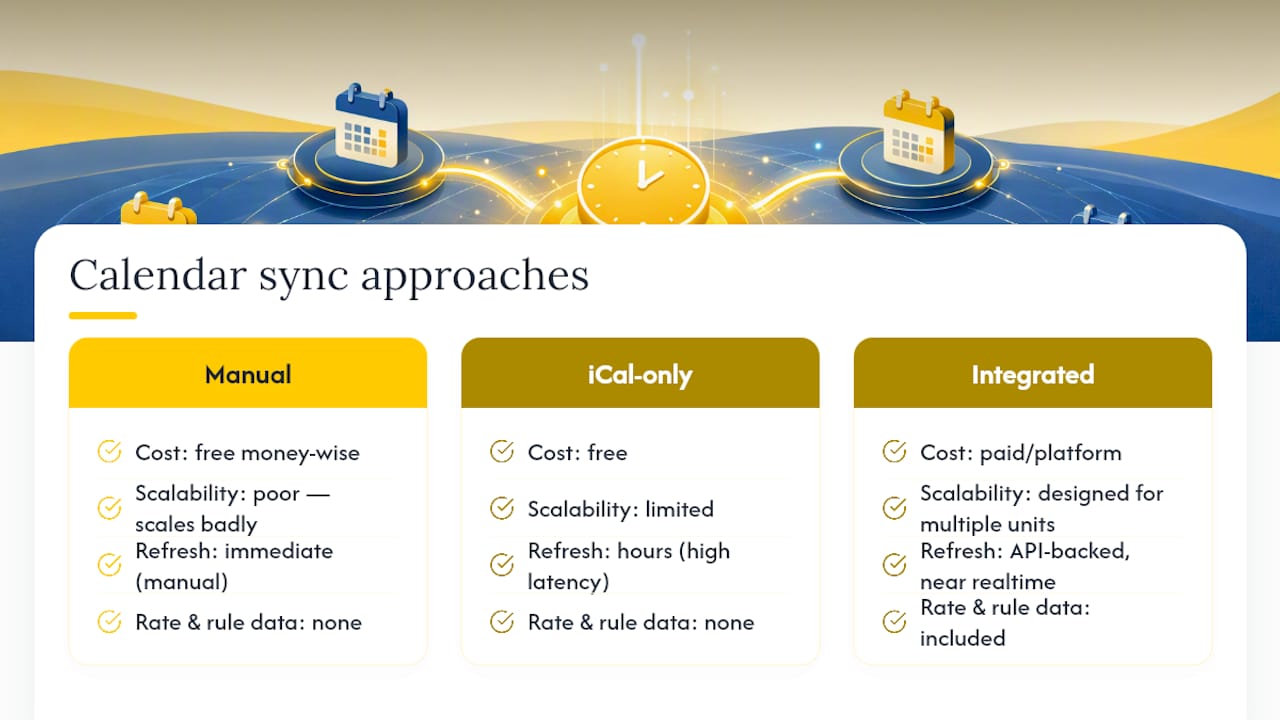
Three broad approaches exist for keeping calendars aligned across platforms, and each has a clear ceiling.
Manual updates cost nothing but your time, and that time cost scales badly. Past two platforms or a handful of bookings a week, manual blocking becomes the single biggest source of double bookings a small operation faces.
Free iCal-only tools solve the cost problem but inherit the latency problem: refresh windows measured in hours, no rate or rule data, and no compliance layer at all. They’re a reasonable starting point for a single listing and a poor long-term fit for anyone running multiple units or channels.
Integrated platforms like Eurocheckin combine API-backed sync with the compliance and guest-management work that Spanish hosts have to handle regardless of which sync method they choose. That combination matters specifically because SES Hospedajes reporting and calendar sync solve two different problems that most operators end up juggling across separate tools anyway. Consolidating them removes a second daily task, not just the sync risk. For a property manager already required to report guest data under Real Decreto 933/2021, handling sync and compliance in one login is a meaningfully different proposition than adding a standalone channel manager on top of a separate compliance tool.
The Real Problem Isn’t Sync Speed, It’s Sync Discipline
Most advice on this topic treats calendar sync as a purely technical decision: pick the fastest connection type and the problem solves itself. That’s incomplete. The research here backs a different conclusion: most sync failures trace back to a missing master calendar and undocumented team habits, not to the sync method itself. A property manager running API connections on every channel can still get double-booked if a co-host manually edits availability on the wrong platform.
The conventional wisdom oversells the switch to API sync as a silver bullet and undersells the migration discipline around it: the export, the reconciliation, the 72-hour monitoring window. Skip that groundwork and even a fast API connection inherits the mess of your old system.
If you take one thing from this article, prioritize the master calendar decision before the platform decision. Write down which system is authoritative, tell every person who touches your bookings, and only then worry about whether you’re on iCal or API. Speed without discipline just moves the same double-booking risk to a faster clock.
Ready to Automate Your Calendar Sync?
Eurocheckin gives you one dashboard where calendar sync, guest compliance, and check-in automation stop being three separate jobs. Instead of stitching together a channel manager, a SES Hospedajes reporting workaround, and a check-in app, you get automatic sync across Airbnb, Booking, Vrbo and more than 12 other platforms alongside built-in compliance for Spanish hosts, starting at around $5/month per accommodation with a free trial.
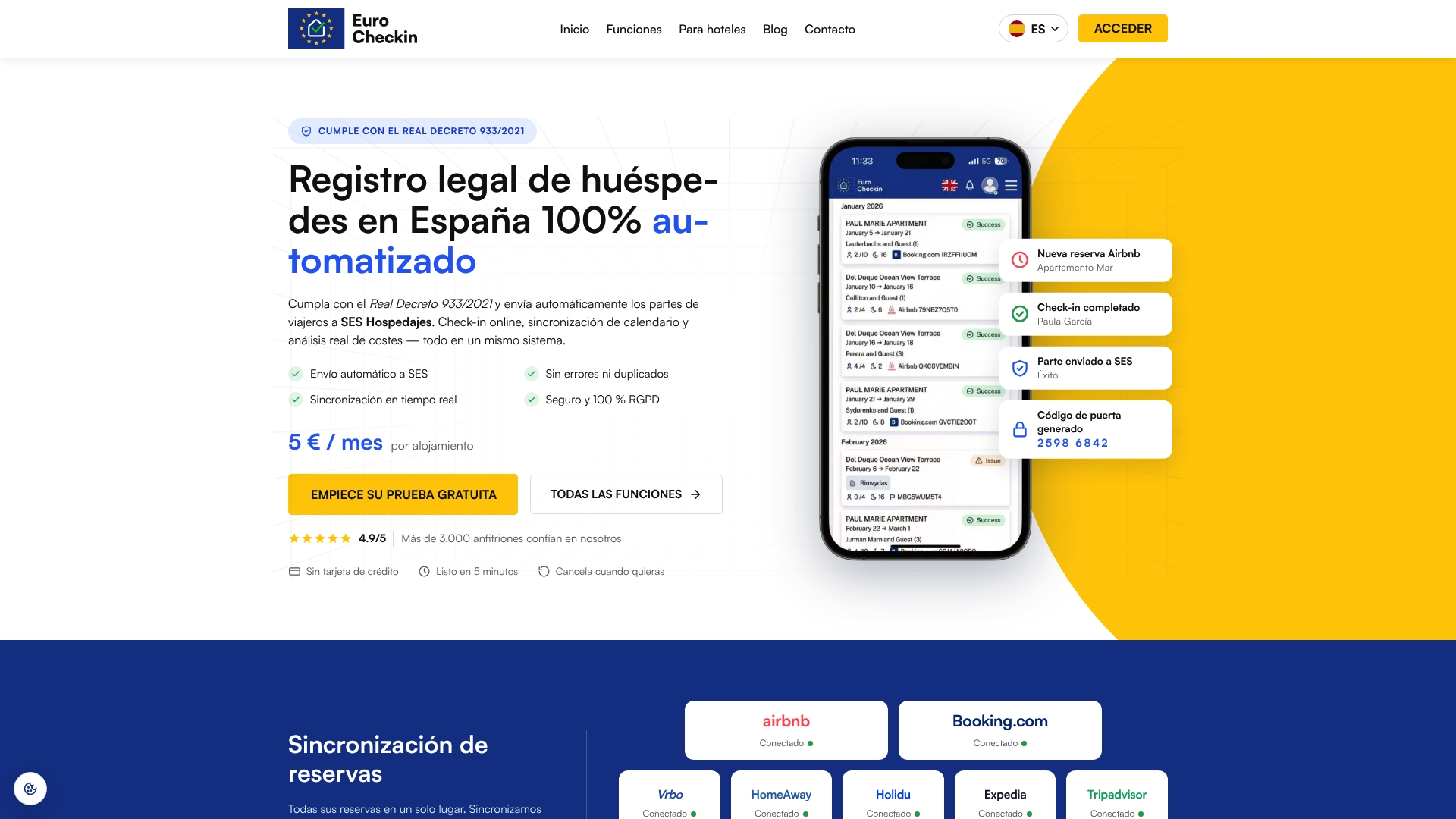
If you’re still juggling iCal links and manual blocks across multiple extranets, the fastest way to see the difference is to try it on one property first. Check out the check-in and platform integration features and start your free trial to see how sync, reporting, and check-in run from a single login.
Sources
- How to import and export your calendar (Airbnb Help)
- Why a channel manager is essential (fewofy Insights)
FAQ
What Is the Difference Between iCal and API Calendar Sync?
iCal only transfers blocked or available dates and refreshes on a delay of anywhere from 15 minutes to several hours, while API connections sync in seconds to minutes and can also carry rates and booking rules.
Which Booking Platforms Support Multi Calendar Sync?
Airbnb, Booking.com, and Vrbo all support calendar syncing, with API-level connections offering more reliability than basic iCal links; Eurocheckin connects to all three plus more than 12 other platforms.
How Often Should I Check My Calendar Sync Is Working?
Review your sync logs, recent bookings, and blocked dates daily, and pay closer attention during the first 72 hours after any migration or platform change.
When Should I Upgrade From iCal to a Channel Manager?
Upgrade once you’re active on two or more platforms with regular bookings, since that’s the point where a channel manager or API connection becomes cost-effective against the risk of a missed sync.
Does EuroCheckin Handle Calendar Sync and Legal Compliance Together?
Yes. Eurocheckin combines automatic calendar sync across Airbnb, Booking, Vrbo and other platforms with automated SES Hospedajes reporting under Real Decreto 933/2021 and GDPR-compliant, EU-hosted infrastructure.