


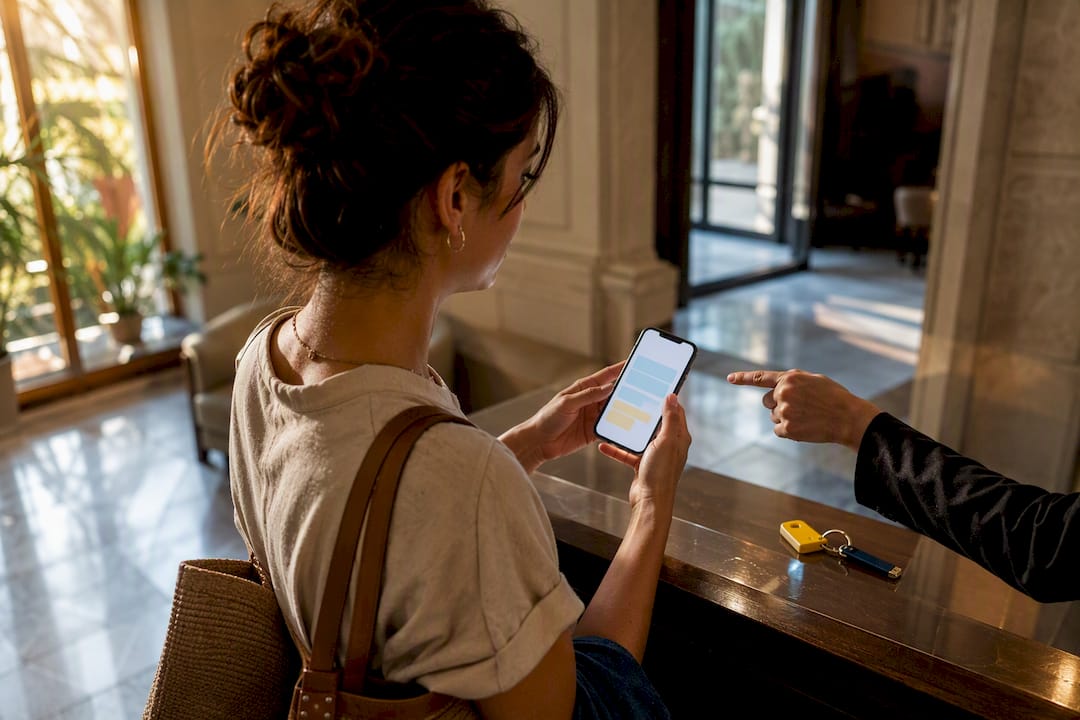
Multilingual check-in lets guests complete registration, review house rules, and get answers in their own language, from a localized pre-arrival link to translated in-stay messaging. Properties that offer it see higher form completion and fewer front-desk translation delays than those relying on staff language skills alone. Solutions like EuroCheckin pair this with automatic SES Hospedajes reporting and GDPR-compliant EU hosting, so language support and legal compliance run through the same system.
TL;DR:
- Most properties benefit most from auto-translated static content, which handles routine questions like house rules and Wi-Fi instructions before they reach staff.
- Proper system setup includes language detection, localized pre-check-in links, and calendar synchronization across booking platforms to prevent errors and improve guest experience.
- Automated translation tools are reliable for legal, medical, or payment disputes, but require human escalation rules to avoid costly miscommunications.
- Using EuroCheckin simplifies compliance with Spanish regulations and streamlines multilingual check-in through integrated forms, smart-lock support, and automated reporting.
- Adding an AI concierge is justified only after high volume of repetitive questions, while complex or safety-critical queries should always be handled by trained staff.
Table of Contents
- Why Multilingual Check-In Matters for Hotels and Vacation Rentals
- The Three Technical Layers That Make Multilingual Check-In Work
- Essential Features and Integrations to Look For
- How to Deploy Multilingual Check-In at Your Property
- Operational Rules and Edge Cases to Handle
- EuroCheckin as a Practical Solution for Multilingual, Compliant Check-In
- When to Add AI Concierge and When to Keep Humans in the Loop
- Get Multilingual Check-In Running Without Adding Headcount
- Sources
- FAQ
Why Multilingual Check-In Matters for Hotels and Vacation Rentals
A guest who cannot read your house rules or Wi-Fi instructions in their own language does not just feel confused. They leave a lukewarm review or call the front desk at midnight because the printed instructions might as well be blank paper. That single friction point compounds across every touchpoint of a stay.
Offering multilingual guest communication changes three numbers that matter to your bottom line:
- Pre-arrival form completion rates, because guests abandon forms they cannot understand
- Front-desk labor hours spent translating or re-explaining instructions
- In-stay ancillary spend, since guests who understand your upsell menu actually buy from it
Statistic to watch: hotels that auto-translate static content like guides and menus before enabling live chat translation deflect the largest share of guest questions with the least staff effort, according to industry analysis from Hotel Tech Insight. Hiring multilingual staff to cover five or six languages around the clock is not realistic for most independent properties. Software is.
The Three Technical Layers That Make Multilingual Check-In Work
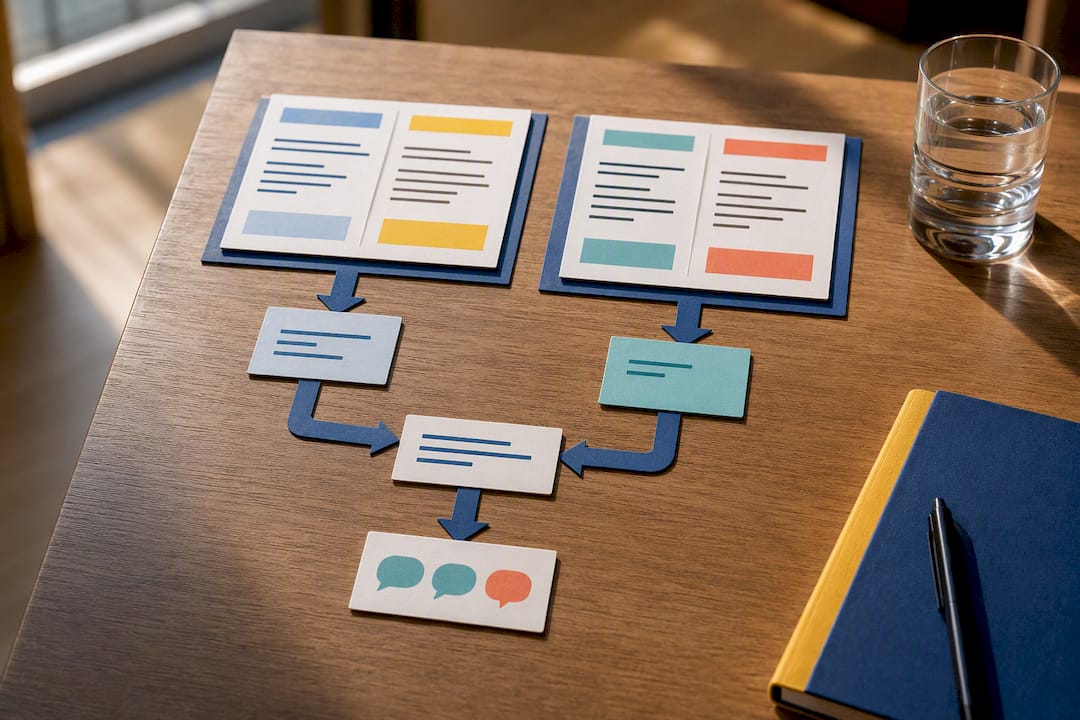
Multilingual check-in is not one feature. It is three layers stacked on top of each other, and each solves a different problem.
- Auto-translated static content. Your pre-check-in form, digital guidebook, Wi-Fi instructions, and menu get translated once and served automatically based on the guest’s language. This layer handles the bulk of routine questions before they ever reach your inbox.
- Live message translation. When a guest sends a message in Portuguese and your staff only speaks Spanish, real-time chat translation keeps the conversation moving without a delay. This layer protects you during incidents, not routine chatter.
- AI concierge. Once your property sees enough repeated multilingual queries to justify it, an AI layer can answer routine questions (checkout time, parking, breakfast hours) without staff involvement.
Each layer costs more and adds more complexity than the one before it. Most properties get most of the benefit from Layer 1 alone.
Pro Tip: Translate your guest guide and menu before you touch chat translation. It deflects more questions than any other single change, and it costs almost nothing to maintain.
Essential Features and Integrations to Look For
A multilingual check-in tool is only as good as what it connects to. Before you commit to a platform, confirm it handles these pieces without manual workarounds.
- Language detection and storage. The system should detect a guest’s preferred language from their browser or reservation data and save that preference against the booking record, not just the session.
- PMS and calendar synchronization. Reservation data, language preference, and arrival details should sync automatically across your property management system and booking channels like Airbnb, Booking, and Vrbo.
- SES Hospedajes reporting. For properties operating in Spain, guest data must reach the official SES Hospedajes portal without manual re-entry, in compliance with Real Decreto 933/2021.
- Smart-lock and payment support. Integration with locks like TTLock, Nuki, and Yale enables self check-in once identity is verified, and Apple Pay or Google Pay support lets guests pay for upsells in seconds.
How to Deploy Multilingual Check-In at Your Property
You do not need every language on earth. You need the languages your actual guests speak.
- Audit your guest-language mix. Pull nationality and language data from your PMS booking history and identify your top four or five languages by volume. Support those first.
- Write and translate canonical source texts once. Build your master guest guide, Wi-Fi instructions, and house rules in your primary language, then translate each into your priority languages and publish them to your pre-check-in portal.
- Enable browser-language detection with manual fallback. Test the flow on a phone, a tablet, and a desktop browser to confirm the correct language loads automatically, and provide a QR code fallback for guests with spotty signal.
- Turn on live chat translation for staff channels. Set clear escalation rules: if a message involves a safety issue, a payment dispute, or medical need, it routes to a human immediately, translated or not.
Pro Tip: Test your multilingual setup at 11 p.m. on a Saturday, not at 10 a.m. on a Tuesday. Late-night failures are where guests get stranded, and that is exactly when your system needs to work.
Operational Rules and Edge Cases to Handle
Machine translation handles a checkout-time question perfectly well. It handles a legal clause, a medical emergency, or a payment dispute far less reliably. Hotel Tech Insight’s analysis flags idiom, legal language, and medical nuance as the areas where automated translation breaks down most often, and those are exactly the moments where a mistranslation carries real consequences.
Build these rules into your workflow before you scale up automation:
- Flag any message involving legal terms, medical details, or payment disputes for human review before it goes out translated.
- Never translate or reformat identity fields. Names, passport numbers, and document numbers must stay exactly as entered, character for character.
- Maintain a tested human-escalation path for the hours your front desk is unstaffed.
- Track three numbers monthly: pre-arrival completion rate, incident rate tied to language confusion, and guest sentiment expressed in their original language, not just the translated version you see.
The real test of a multilingual setup isn’t how many languages it lists. It’s whether a stressed guest, at 2 a.m., gets understood the first time.
EuroCheckin as a Practical Solution for Multilingual, Compliant Check-In
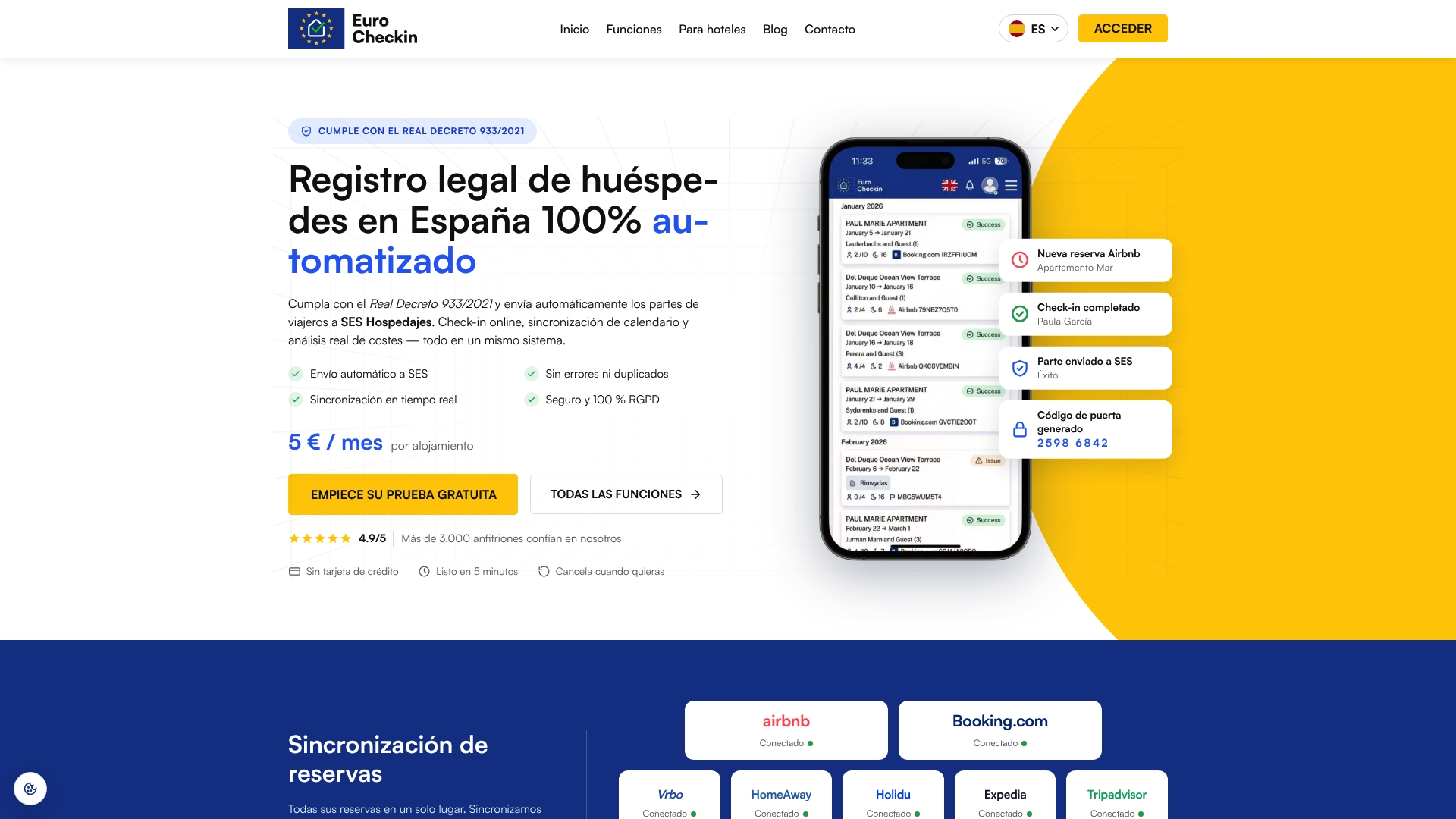
For properties operating in Spain, multilingual check-in and legal compliance are not separate projects. EuroCheckin handles both at once. Guest data collected through its unlimited, multilingual check-in forms flows automatically to SES Hospedajes, satisfying Real Decreto 933/2021 and GDPR requirements without duplicate manual entry, and everything is hosted on infrastructure within the European Union.
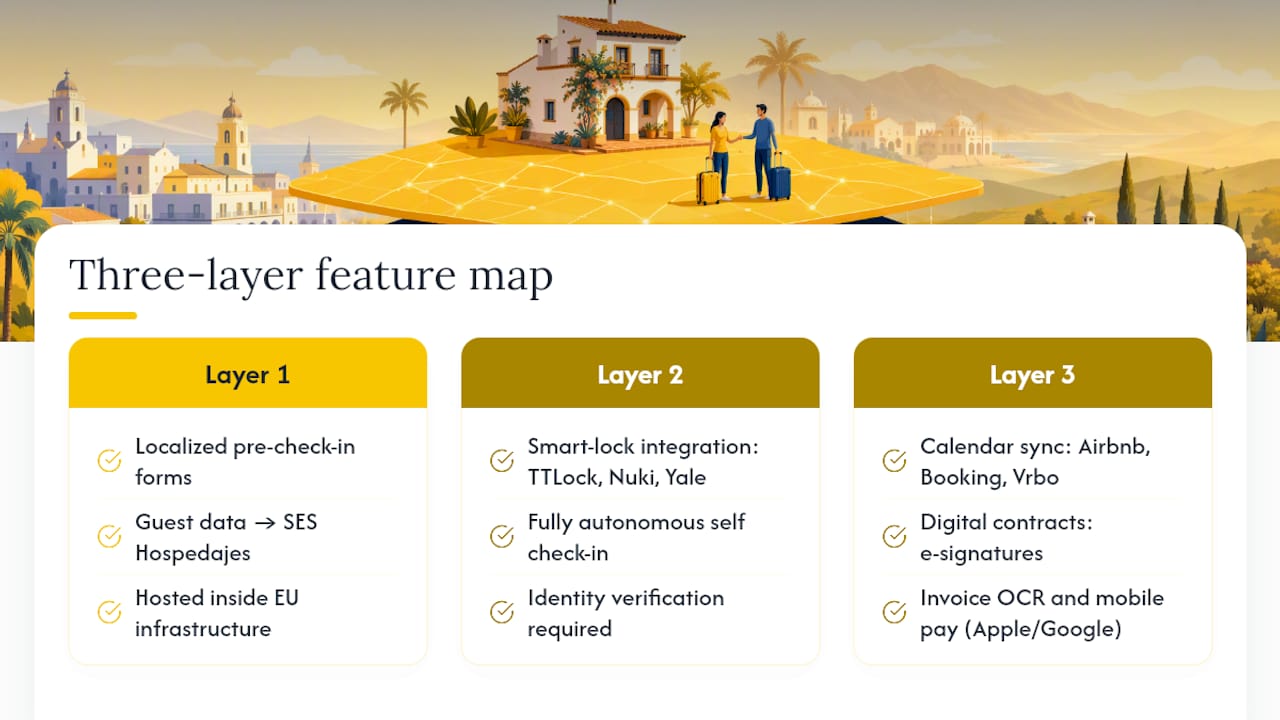
The platform maps directly onto the three-layer model. Localized pre-check-in forms cover Layer 1. Smart-lock integration with TTLock, Nuki, and Yale enables fully autonomous self check-in once identity is verified. Calendar sync across Airbnb, Booking, Vrbo, and more than a dozen other platforms keeps availability accurate and prevents overbookings. Digital contracts with e-signatures and invoice OCR reduce the manual paperwork that typically eats into a manager’s week, while Apple Pay and Google Pay support lets guests pay for extra services in seconds.
When to Add AI Concierge and When to Keep Humans in the Loop
Add an AI concierge once your staff fields the same multilingual questions repeatedly and volume justifies the investment. Keep a human in the loop for anything nuanced, legal, or safety-critical, no exceptions. A workable rule: only automate a query type once your translated auto-response accuracy and incident rate both meet the minimums you would accept from a trained staff member.
— Sofía Herrera
Get Multilingual Check-In Running Without Adding Headcount
Hiring bilingual front-desk staff around the clock costs far more than a monthly software subscription, and it still leaves gaps whenever your one Portuguese-speaking employee is off shift. EuroCheckin closes that gap for property managers in Spain with unlimited multilingual check-in forms, automatic SES Hospedajes reporting, and smart-lock integration, all running from one dashboard with affordable plans per accommodation and a free trial included.
If you manage a vacation rental or boutique hotel and want guests checking themselves in in their own language without extra paperwork, start with the online check-in setup for vacation rentals in Spain. Hotels focused specifically on registration compliance can go straight to the SES Hospedajes compliance page for hotels to see how automated reporting fits into an existing front-desk workflow. Either path gets you testing localized pre-check-in language features within a day.
Sources
Property managers verifying compliance obligations should confirm submission procedures directly through the official SES Hospedajes portal and general regulatory guidance from Spain’s Ministry of the Interior. For a deeper look at the three-layer translation model referenced throughout this guide, Hotel Tech Insight’s 2026 analysis covers implementation order and business impact in more detail. Readers managing traveler registration end to end may also find the complete guide to traveler registration in Spain useful for cross-referencing required fields.
FAQ
What does “multilingual” mean in a check-in context?
It means guests can complete registration, read property information, and message staff in their preferred language rather than being forced into the property’s default language.
What is a multilingual check-in form?
It is a pre-arrival registration form that detects or lets a guest select their language, then displays house rules, required fields, and instructions translated into that language before the guest arrives.
What does multilingual guest support mean for a hotel?
It means the property can handle guest questions, messages, and service requests in more than one language, typically through a combination of translated static content, live chat translation, and staff protocols for escalation.
Is a multilingual website the same as multilingual check-in?
No. A multilingual website translates marketing pages for browsing guests, while multilingual check-in translates the operational registration flow, guides, and messaging guests use once they have booked.
Does EuroCheckin support multilingual check-in for properties in Spain?
Yes. EuroCheckin offers unlimited multilingual online check-in with automatic SES Hospedajes reporting, smart-lock integration, and EU-hosted data storage, built specifically for Spanish property owners, managers, and hotels.