



For most professional hosts, pre check-in is the better default because it lets you collect the legally required guest data and signatures before arrival while staying inside the framework set by Real Decreto 933/2021 and the data minimization principles the AEPD has published. On-site check-in still has a place, but it should be the fallback, not the main process. Once you understand why, the next step is building a compliant pre check-in flow, which we walk through below.
TL;DR:
- Collect required Anexo I fields, obtain signatures from guests aged 14 or older, and have an accompanying adult sign for younger guests.
- Retain only required registration records for three years; avoid identity document images and payment details you no longer need to meet data minimization rules.
- Submit records promptly when reservation, contract, or service start events trigger reporting, rather than waiting for a fixed daily batch.
- Use a phone or email code for routine bookings, add payment matching for higher value stays, and keep in person verification for nonresponses.
- Write fallback rules for form nonresponses, unverified group members, and bookings of five or more guests; train staff to apply them.
Table of Contents
- Pre check-in vs on-site check-in: how the two workflows actually differ
- Legal checklist: required fields, signatures, SES reporting, and data limits
- Step by step: building a compliant pre check-in flow
- Technology that reduces legal and operational risk
- When a hybrid approach is the safer choice
- EuroCheckin: automate compliant pre check-in and SES reporting
- FAQ
- Sources
Pre check-in vs on-site check-in: how the two workflows actually differ
Pre check-in means you send guests a form before arrival, usually by e-mail or through a booking confirmation message, and they fill in their own data, upload identification, and sign the entry report before they get the keys. On-site check-in means reception or the host collects the same information in person, typically by photographing or photocopying an ID document and asking the guest to sign on paper or on a tablet.
The two paths diverge on three points: how you verify identity, who signs what, and when the data reaches SES.Hospedajes. With pre check-in, verification usually relies on a one-time code sent to the guest’s phone or e-mail, a payment method match, or a government ID check run through software; the guest signs the parte de entrada electronically. With on-site check-in, verification is visual: someone looks at the physical document and compares it to the guest standing in front of them, then collects a signature on paper.
Each approach carries its own trade-offs:
- Pre check-in reduces front-desk time, lets you report to SES.Hospedajes before the guest even arrives, and removes the temptation to photocopy ID documents, which the AEPD guidance on identity-document copies flags as a data minimization risk.
- On-site check-in gives you a face-to-face identity check, which matters for groups, unverified bookings, or guests who never respond to the pre-arrival form.
- Pre check-in depends on guest cooperation and a working verification step, so you need a fallback for no-shows on the form.
- On-site check-in concentrates staff workload at arrival time, which increases friction during busy check-in windows and overbooking-prone periods.
Neither option removes your legal obligations. They change when and how you satisfy them.
Legal checklist: required fields, signatures, SES reporting, and data limits
Whichever workflow you run, the legal floor is the same. Real Decreto 933/2021 sets out the Anexo I fields you must collect for every stay and defines a three-year retention period for those records.
- Collect full name, nationality, document type and number, date of birth, and travel document details for every guest listed on the booking.
- Have every guest aged 14 or older sign the parte de entrada; for guests under 14, the accompanying adult provides and signs the data, according to the Ministry of Interior’s guidance on entry reports.
- Submit the data to SES.Hospedajes promptly, since reporting triggers are tied to reservation, contract, or service start events rather than a fixed daily batch.
- Avoid retaining full copies or photographs of identity documents: the AEPD note on identity-document copies states this practice risks breaching GDPR data minimization, and an AEPD technical review confirms that automated capture is acceptable only when systems do not retain extraneous document images and access stays controlled.
The practical consequence is simple: keep the Anexo I fields and the signed parte de entrada for three years, and avoid storing anything beyond that, including scanned document photos or payment card details you no longer need. Our guide to GDPR retention for guest data breaks down what belongs in your records and what you should purge.
Step by step: building a compliant pre check-in flow
Switching from reception-based capture to pre check-in does not require new legal groundwork, since the Anexo I fields and signature rules stay the same. What changes is where and when you collect them.
- Design your form around Anexo I only. List the exact fields RD 933/2021 requires and nothing more; a shorter form also gets completed faster.
- Add an e-signature step for the parte de entrada. Every guest aged 14 or older needs to sign it, so build that into the form flow rather than treating it as a separate task.
- Pick a verification method that fits the booking. A phone or e-mail one-time code works for most leisure bookings; a payment confirmation match adds a second layer for higher-value stays; keep an in-person fallback for anyone who does not respond.
- Automate the SES.Hospedajes submission or, at minimum, build a daily export routine so no reservation slips past the reporting window.
- Set a retention and deletion policy that matches the three-year rule and removes document images you never needed to keep in the first place.
- Train staff on the fallback path. Someone needs to know what to do when a guest arrives without having completed the form.
- Write short, clear booking messages that explain what the guest needs to do and by when.
A booking message template might read: “Please complete your pre-arrival check-in within 48 hours of booking using this secure link. It takes about three minutes and lets you skip the front desk on arrival.” For guests who show up without completing the form, a short in-person script covers the same ground: “We just need your ID and a signature on this form. It takes two minutes and we’ll have your key ready right after.”
Pro Tip: Send the pre check-in link the moment a reservation is confirmed, not the day before arrival. Guests who get more time tend to finish the form before you even start worrying about it.

Technology that reduces legal and operational risk
Not every integration matters equally. A few make the difference between a form that merely looks compliant and one that holds up under review.
- Automatic filing to SES.Hospedajes removes the same-day manual submission risk that the Ministry of Interior’s platform announcement says the system was built to support.
- Calendar sync across booking channels prevents the overbooking errors that complicate guest verification before arrival.
- Smart-lock integration lets verified guests access the property without a staff member present at the door.
- E-signature capture satisfies the parte de entrada requirement without printing paper or chasing physical signatures.
- EU-based data hosting keeps guest records under the jurisdiction GDPR expects for data originating from European guests.
We built EuroCheckin around exactly this set of requirements: it sends guest data automatically to SES Hospedajes in compliance with RD 933/2021 and GDPR, without manual work or duplicate records, and it hosts every record on secure infrastructure inside the European Union. When you evaluate any platform for this job, check four things first: does it automate SES filing, where does it host data, how many booking platforms does it sync with, and which smart locks does it support.
When a hybrid approach is the safer choice

Pure pre check-in works until it does not. Groups with unverified members, bookings where a guest never responds to the form, or reservations that include minors without a signing adult present all call for an in-person fallback. Document the rule in writing, not just in staff memory, so an auditor sees a deliberate, risk-based policy rather than an improvised exception.
A small rental might require in-person verification only when the guest fails to complete the form within 24 hours of arrival. A small hotel might require it for any booking of five or more guests, where mismatched names are harder to catch remotely.
— Sofía Herrera
EuroCheckin: automate compliant pre check-in and SES reporting
We have created a platform that automates traveler registration in Spain end to end, for owners, property managers, and hotels who want to meet legal requirements without losing hours to administrative work. It sends guest data automatically to SES Hospedajes in line with RD 933/2021 and GDPR, with no manual entry and no duplicate records, and the traveler register itself is fully digital and compliant.
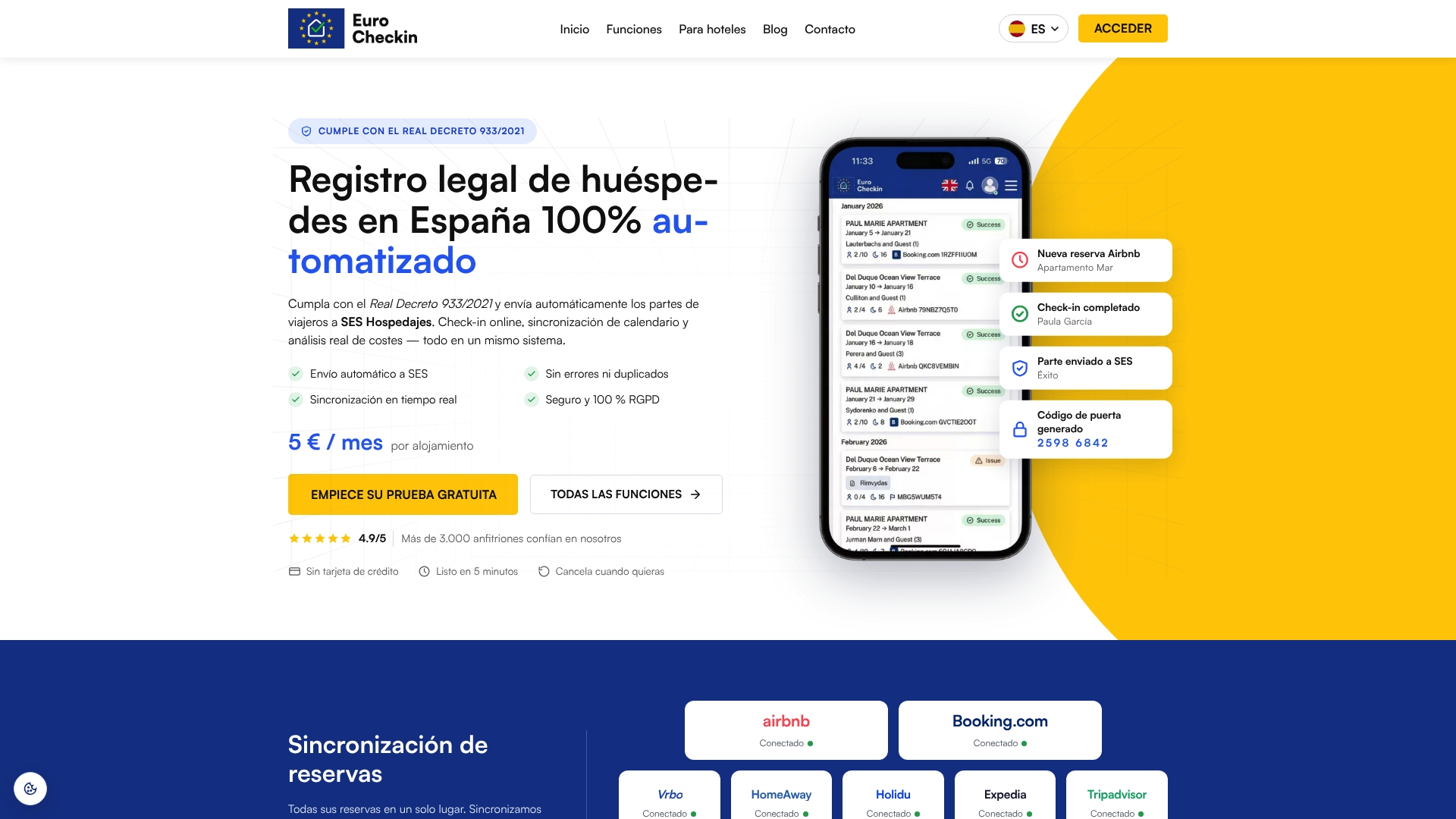
Our online check-in supports unlimited entries and multiple languages, with integration links for leading booking platforms, plus alerts to help track arrivals in real time. Calendar synchronization keeps availability current across multiple booking platforms, helping to reduce overbooking risks that complicate guest verification. Additionally, digital contracts with e-signatures, a digital guest guide, and integration with various smart lock systems support autonomous self check-in.
- Automated SES.Hospedajes filing with no manual submission step
- Calendar sync across 12+ booking platforms to prevent double bookings
- E-signature contracts and smart-lock integration for unattended arrivals
- EU-hosted infrastructure built for GDPR-aligned data handling
A demo walks through the SES automation, the calendar sync setup, and the e-signature flow from a guest’s point of view. Plans for accommodations start from 5 EUR per month per property, and hotel plans run from 3 EUR per month per room, both with a free trial; dedicated SES Hospedajes registration setup is also available from 79 EUR one-off per property. Visit EuroCheckin to start a trial or book a walkthrough.
FAQ
What is the difference between pre check-in and on-site check-in?
Pre check-in collects the legally required guest data and signature before arrival through an online form, while on-site check-in captures the same information in person at reception. Both must satisfy the Anexo I fields and signature rules set out by the Ministry of Interior, so the legal requirement does not change, only the timing and method of capture.
Do guests always need to sign the parte de entrada in person?
No, an electronic signature satisfies the requirement as long as every guest aged 14 or older signs it, based on guidance from the Ministry of Interior. Guests under 14 have their data provided and signed by the accompanying adult instead.
Is it legal to collect guest ID data online instead of at reception?
Yes, collecting ID data through an online pre check-in form is legal, provided the form gathers only the Anexo I fields and does not store full document copies or photographs. The AEPD’s guidance on identity-document copies specifically supports online forms that avoid unnecessary data collection over photocopying documents at the desk.
How long should we keep guest registration records?
Guest registration records tied to Anexo I fields must be kept for three years under RD 933/2021, and nothing beyond those fields should be retained once that period ends. Our guide to retention rules for Spanish hosts walks through setting up deletion policies that match this window.
What happens if a guest never completes the pre check-in form?
Build a fallback into your process: if a guest has not completed the form within a set window before arrival, switch to in-person verification using the same Anexo I fields and signature rule. This keeps you compliant even when remote verification fails, since the legal requirement applies regardless of which workflow ultimately captures the data.
Sources
- Ministerio del Interior | Parts d’entrada i obligacions de registre documental
- AEPD note on identity-document copies for lodging registration