



Every establishment you manage must be registered individually with SES.Hospedajes, and every guest aged 14 or older must be reported promptly after arrival. That obligation comes from Real Decreto 933/2021 and Ley Orgánica 4/2015, and it applies whether you run two apartments or twenty. Collect only the data fields the law requires, skip copying ID documents, and lean on automation once your portfolio grows past a handful of properties.
TL;DR:
- Each property must have its own registration in SES.Hospedajes, with a unique identifier, even if managed by a single organization or owner.
- Guests aged 14 and older require only the specified data fields; storing additional ID copies breaches data minimization principles.
- The reporting obligation falls on the party with the final contract with the guest, not on intermediaries or platforms involved in the reservation chain.
- Automated SaaS tools can significantly reduce errors and ensure timely submissions for large portfolios by syncing bookings and delivering audit logs.
- Fines for late, incorrect, or unsubmitted reports can range from €100 to €30,000, making reliable, automated compliance essential as the portfolio scales.
Table of Contents
- What Is SES.Hospedajes and Where Does the Requirement Come From?
- What Guest Data Fields Does SES Actually Require?
- Who Is Responsible for Reporting When Several Parties Are Involved?
- How Do You Register Multiple Properties and Guests on SES.Hospedajes?
- What Operational Habits Keep Multi-Property Reporting Accurate?
- What Happens if You Miss a Deadline or Report Incorrectly?
- Why Automation Changes the Compliance Equation for Portfolios
- Automate SES Reporting Across Every Property You Manage
- Where to Verify These Requirements Yourself
- Sources
- FAQ
What Is SES.Hospedajes and Where Does the Requirement Come From?
SES.Hospedajes is the digital platform operated by the Ministry of the Interior’s Secretaría de Estado de Seguridad to record who stays where in Spain. It replaced the old paper-based traveler logs and has been operative since January 2023, when the Ministry activated the new lodging and vehicle rental register for hotels, vacation rentals, and rental agencies nationwide.
The legal backbone is Real Decreto 933/2021, which sets out registration duties in detail, backed by Ley Orgánica 4/2015 on public security. The government frames this less as paperwork and more as a security tool, tied to Spain’s broader obligations for crime and terrorism prevention across the Schengen area. For a manager, that framing matters: inspectors treat gaps in your traveler log as security lapses, not clerical oversights.

What Guest Data Fields Does SES Actually Require?
Annex I of RD 933/2021 defines exactly what you must collect for every guest aged 14 and older, and nothing more. Requesting extra documents beyond this list creates GDPR exposure without any compliance benefit.
- Full name and gender
- Identity document type, number, and support number
- Nationality and date of birth
- Habitual residence (address, city, country)
- Phone number and email address
- Number of travelers in the booking, plus the relationship to any minors included
Retention rule: Records must be kept for three years from the end of the stay, per Annex I of RD 933/2021.
Guests under 14 don’t need individual records beyond being counted and linked to an adult on the booking. On identification, the AEPD has been explicit: keeping a copy of a DNI or passport breaches data minimization principles. Verify identity visually at check-in, or through payment matching and confirmation codes, instead of storing a scanned document.
Who Is Responsible for Reporting When Several Parties Are Involved?
Multi-property portfolios rarely involve just an owner and a guest. A booking might pass through an OTA, a property manager, and the legal owner before it reaches SES. Ministry guidance resolves this cleanly: the obligation falls on whoever holds the direct, final contractual relationship with the guest, not on every intermediary that touched the reservation.
In practice, this breaks down into a few recurring scenarios:
- Owner books directly (own website, phone, walk-in): the owner reports.
- Manager holds the booking relationship on the owner’s behalf: the manager reports, but needs documented authorization from the owner.
- Booking arrives through an intermediary platform that merely facilitates the reservation without becoming the contracting party: the accommodation still reports, not the platform.
Whoever delegates reporting should keep written authorization on file and confirm the delegate’s system is technically compatible with SES submission formats. A property manager working across a dozen listings without clear authorization paperwork is the single most common cause of duplicate or missing reports.
How Do You Register Multiple Properties and Guests on SES.Hospedajes?
Getting set up requires a few prerequisites before you submit a single guest record.
Before you start:
- Register your organization or self-employed activity with SES.
- Obtain Cl@ve or a digital certificate from FNMT for authenticated access.
- Have a unique identifier ready for each establishment (cadastral reference or equivalent).
Setting up your properties:
- Create a separate establishment record for each property, even if they share an owner or manager.
- Assign each record its own identifier and map it to the correct booking channels (Airbnb, Booking, Vrbo, direct bookings).
- Verify each mapping against the platform’s confirmation before your first live submission.
Reporting guests:
- Submit the Annex I fields for every guest aged 14+ within 24 hours of arrival.
- Decide between single-entry submission for low volume or batch submission via web service (
usuario web service) for higher volume across properties. - Reconcile SES acknowledgements against your booking calendar daily to catch missed or duplicate entries early.
Error handling matters more at scale. A ten-property operator submitting manually multiplies the chance of a typo in a document number or a missed 24-hour window. Building a reconciliation routine, checking SES responses against your channel exports every day, catches these before they become sanctionable gaps.
What Operational Habits Keep Multi-Property Reporting Accurate?
Collect only the Annex I fields, and standardize how you authenticate each guest across every property you manage. A visual ID check at arrival, a payment method match, or an SMS confirmation code all satisfy identity verification without the privacy risk of storing a document copy, a point the AEPD has reinforced repeatedly.
Structurally, a few patterns separate managers who scale smoothly from those who accumulate errors:
- Keep one central property registry mapping every listing to its unique establishment identifier.
- Sync calendars across channels so a booking never gets reported twice under two different platform references.
- Build retry logic for failed SES submissions rather than relying on someone remembering to resubmit manually.
- Log every submission and its SES response for the full three-year retention window.
Pro Tip: Assign each guest a single internal reference number the moment a booking is confirmed, and carry that number through every system touchpoint, from your calendar to your SES submission log. It’s the fastest way to catch a duplicate before it becomes two conflicting reports.
What Happens if You Miss a Deadline or Report Incorrectly?
Sanctions scale with the severity of the failure. Minor infractions, things like late submissions, small data errors, or formatting mistakes, carry fines between €100 and €600. Major infractions, such as failing to register an establishment at all or never reporting guest data, carry fines from €601 up to €30,000 under Ley Orgánica 4/2015.
The 24-hour window is the trigger point inspectors check first, so it’s worth treating as non-negotiable across every property you run. If you receive an inspection notice or sanction letter:
- Pull your submission logs for the property in question immediately.
- Cross-check the flagged booking against your SES acknowledgement record.
- Respond within the stated administrative deadline, with documentation attached, rather than waiting.
Why Automation Changes the Compliance Equation for Portfolios
Manual reporting works for one property. It breaks down fast once you’re managing five, ten, or fifty, where a missed field or a late submission on any single listing carries the same fine exposure as a single-property host running one unit. Automated submission removes the human error that creeps in when someone is juggling ten check-ins by lunchtime.
A hotel client we’ve worked with in Madrid saw its SES reporting errors drop close to zero after moving from manual entry to automated submission, simply because the system stopped relying on staff remembering deadlines. If you’re scaling a portfolio, prioritize auditability from day one. It’s far cheaper to build a clean audit trail now than to reconstruct one during an inspection.
— Sofía Herrera
Automate SES Reporting Across Every Property You Manage
Certain SaaS platforms are designed as compliance shortcuts for multi-property managers when spreadsheets and manual SES entries become impractical. Instead of logging into SES separately for each listing, Eurocheckin sends guest data automatically the moment a reservation is confirmed, pulling from a multilingual online check-in form that collects exactly the Annex I fields and nothing more.
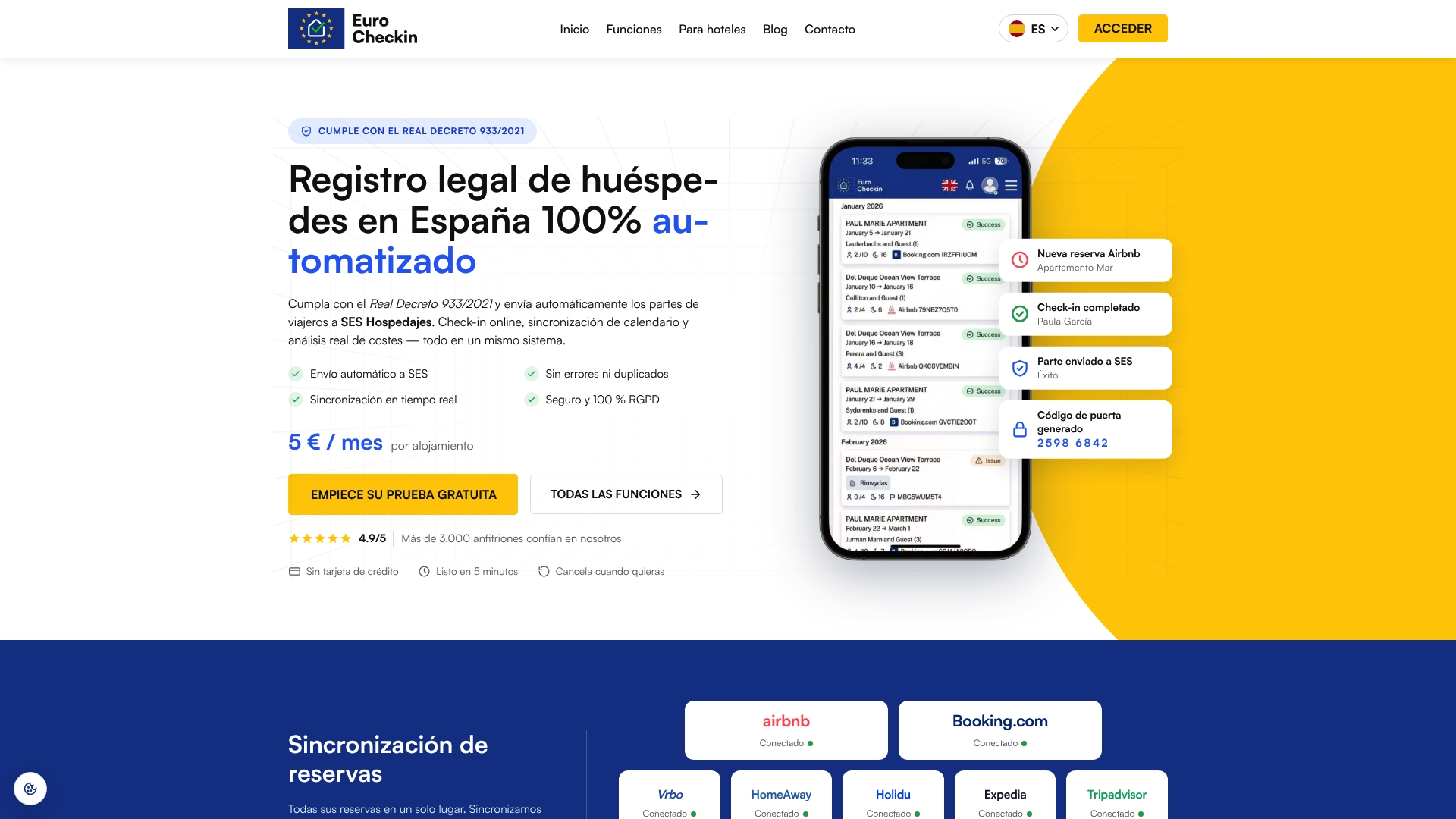
Calendar synchronization across Airbnb, Booking, Vrbo, and other channels helps keep properties mapped correctly, avoiding duplicate or missed reports. Submissions are logged, providing audit-ready records stored on infrastructure within the European Union. For managers who want to see how automating SES submission works across a real multi-property setup, EuroCheckin para alojamientos starts at €5 per month per accommodation, with a free trial to test the workflow before committing.
Where to Verify These Requirements Yourself
Regulations shift, and cross-checking primary sources protects you better than relying on secondhand summaries.
- Real Decreto 933/2021 (BOE), the full legal text and Annex I field list.
- SES.Hospedajes pages, the Ministry of the Interior’s official platform guidance.
- AEPD guidance on identity documents, on data minimization in hospitality.
- FNMT for digital certificate issuance, and Cl@ve for account access.
For a broader look at check-in process design beyond SES specifically, this hotel check-in workflow guide covers operational sequencing that pairs well with compliance automation.
This article is general information, not a substitute for advice from a qualified lawyer. Consult a qualified legal professional about your own circumstances before acting on anything here.
Sources
- Real Decreto 933/2021 (BOE) — consolidated text
- Hospedajes y alquiler de vehículos — Ministerio del Interior
- AEPD: It is not permitted to request a copy of DNI or passport in hospedajes
FAQ
Do I Need a Separate SES Account for Each Property?
You need a separate establishment record for each property within SES, though they can sit under one organizational account if you manage them all. Each property gets its own unique identifier, which you’ll use when mapping booking channels and submitting guest data.
What Counts as the 24-Hour Deadline Starting Point?
The clock starts when the guest physically arrives at the property, not when the booking was made or confirmed. Guests aged 14 and older must be reported to SES within that 24-hour window regardless of how many properties or channels you’re managing simultaneously.
Can I Ask Guests for a Copy of Their Passport or DNI?
No. The AEPD has stated clearly that requesting or storing a copy of an ID document violates data minimization rules. Verify identity visually or through payment confirmation instead, and collect only the fields listed in Annex I.
How Much Does EuroCheckin Cost for a Multi-Property Portfolio?
EuroCheckin para alojamientos runs €5 per month per accommodation, with a free trial available before you commit. Hotels and larger portfolios use EuroCheckin para hoteles, priced at €3 per month per room.
What Happens if a Booking Platform Reports Instead of Me?
The legal responsibility stays with whoever holds the direct, final contractual relationship with the guest, even if a platform or manager submits the data on your behalf. Keep written authorization on file for any third party reporting for you, since you remain liable for accuracy under Ministry guidance.