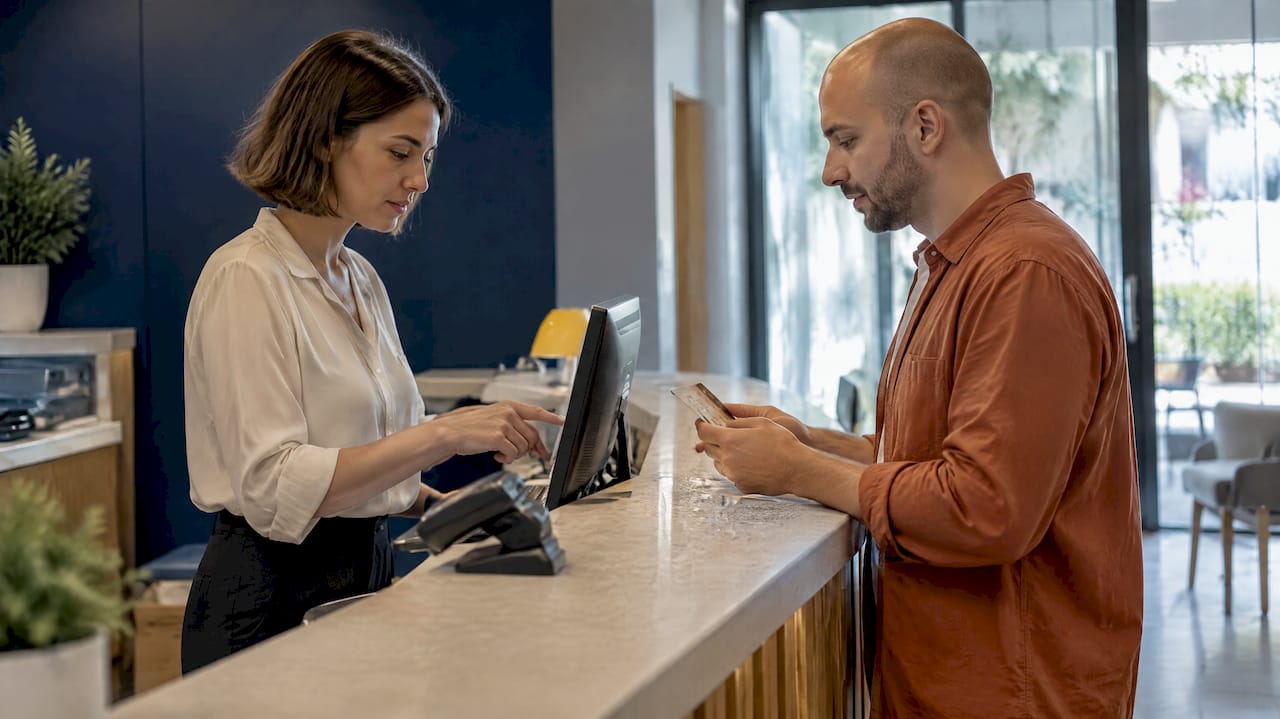
For a tourist accommodation in Spain, digital identity capture means collecting the legally required data of each guest through an online form, checking that it matches the guest’s identity document, and sending it to the Ministry of the Interior on time. You do not need a photocopy of the passport or a selfie. You need the right data fields, a reliable way to verify them, a signature and a report sent within 24 hours.
This guide explains the rules step by step, so you can set up a check-in process that is fast for guests and safe for you.
TL;DR
- Spanish operators must collect the guest data listed in Annexes I and II of Royal Decree 933/2021 and send it through the Ministry of the Interior’s SES.HOSPEDAJES system.
- Collect data, not documents: the data protection agency (AEPD) says operators should not request a copy of the ID.
- For online check-in, verify identity with methods the AEPD describes, such as a digital certificate, payment-method matching or a code sent by SMS or email.
- Every guest over 14 signs the entry form. An accompanying adult supplies the details of guests under 14.
- Reservation and service-start data must be sent immediately and no later than 24 hours after the event.
Table of Contents
- What digital identity capture means for a host in Spain
- What data you must collect
- How to verify identity at check-in
- What not to collect
- How to protect the identity data you hold
- When and how to report to SES.HOSPEDAJES
- Common mistakes that lead to incomplete or late registration
- Our point of view
- Automate capture and reporting with EuroCheckin
- FAQ
- Sources
What digital identity capture means for a host in Spain
In the fintech world, “digital identity capture” often means scanning a document and a face. In Spanish hospitality the meaning is narrower and more practical. The law asks you to record specific data about each traveler before the stay starts, and the guest’s identity is the core of that data.
The purpose of the rule is public security. According to the AEPD note on the accommodation register, Royal Decree 933/2021 aims to protect people and property and maintain public tranquillity. That purpose explains why the scope is strict: the state wants a defined set of data, and data protection law limits you to that set.
The decree applies to professional and non-professional providers alike. Both must collect guest data for registration and communication, although the documentary duties differ, as explained below. For a full walkthrough of the decree, see our guide to Real Decreto 933/2021 for Spanish hosts.

What data you must collect
Annex I of the decree sets the list. The BOE text includes the guest’s name, ID number and type, date of birth, sex, nationality, stay dates and payment method, along with contact details. The Ministry of the Interior confirms that the data to communicate are those in Annexes I and II: reservation data and service-start data.
Since SES.HOSPEDAJES was activated on 2 December 2024, operators must also specify the payment method and identify the transaction when applicable.
A practical grouping for your form:
| Block | What the form asks | Notes |
|---|---|---|
| Identity | Full name, sex, date of birth, nationality | Must match the identity document |
| Document | Type and number | Record the data, not a copy |
| Contact | Address and phone or email | Also used for authentication codes |
| Stay | Check-in and check-out dates, number of guests | Linked to the reservation |
| Payment | Method and, when applicable, transaction identifier | Required in SES.HOSPEDAJES |
| Signature | Guests over 14 | Electronic signature on the entry form |
Our guest data checklist for Spain shows field by field what to collect and what to leave out.
How to verify identity at check-in
Collecting a name is easy. Proving it belongs to the person in front of you, or the person booking remotely, is the real task. The law makes you responsible: the lodging provider must ensure the recorded data match the identity document or an identity-verification system.
In-person check-in
The AEPD says operators may visually compare the data provided with the guest’s identity document. The guest fills in the form, you check it against the document, and you do not keep the document.
Online check-in
For remote check-in, the same AEPD note describes several methods: a digital certificate, matching payment-method data, or sending authentication codes by SMS or email. In practice, a host chooses one or more of these and documents the choice in the process.
The Ministry of Consumer Affairs has also addressed digital tools. It clarifies that digital innovation in check-in is legal as long as it streamlines data extraction without going beyond the legal scope of the required data. A scan that fills in the form fields is acceptable in that logic. A system that stores more than the law requires is not.
Signatures and minors
Travelers over 14 must sign the entry forms provided by the accommodation. For guests under 14, an accompanying adult supplies the details. Build this into the form: one signature per adult and teenager over 14, and a separate field for the children’s data.
What not to collect
More data is not safer. Under the AEPD’s reading, operators should not request a copy of the identity document. A form with only the data required by Annex I is enough, and it can be completed online or on site. The agency states that requesting the copy violates the GDPR principle of data minimization.
Two related warnings come from the Galician tourism cluster, a professional body:
- It advises against asking for a guest selfie for identity validation, because Annex I does not require it and it may breach data minimization.
- It also warns that consent to excessive collection, such as ID copies, may not be freely given if guests fear losing their booking.
The second point matters in practice. A checkbox that says “I agree to send my passport photo” does not turn an unnecessary request into a lawful one when the guest feels there is no alternative.
How to protect the identity data you hold
The core protection is to hold less. If your form captures only Annex I fields, there is no passport image to leak, lose or share in a messaging group. Beyond that, apply ordinary GDPR hygiene:
- Limit access. Only the people who manage check-ins should see guest records.
- Stop using chats and email for documents. Guests often send photos of IDs through booking-platform messages. Redirect them to the check-in form and tell them you do not need the photo.
- Use one secure place. Keep the records in a single system, hosted in the European Union, instead of spreadsheets and phone galleries.
- Respect retention. Professional operators must keep the electronic record with the Annex I and II data for three years from the end of the contracted service. Non-professional operators are exempt from the documentary record and retention duties, but still have the communication duty.
- Mind your calendars. Calendar links can reveal more than you intend. Our article on booking calendar privacy covers how to protect guest data there.
When and how to report to SES.HOSPEDAJES
The submission is electronic, through the Ministry of the Interior’s SES.HOSPEDAJES procedure. The Ministry sets these deadlines:
- Establishment or activity registration: before operations begin, within 10 days after the required administrative formalities.
- Reservation or cancellation data: immediately and no later than 24 hours after the event.
- Service-start data: the same 24-hour limit.
All of this is stated on the Ministry’s hospitality page.
The same page explains the intermediary rule. Each obliged party transmits the information it holds, and where several intermediaries take part, the party with the direct and final contractual relationship with the customer is responsible for the communication. If you rent through Airbnb or Booking, check which data each side sends, and read our guide to Airbnb host registration in Spain.
The system also allows integration with external applications and bulk uploads, so reports can be sent automatically instead of typed in by hand.
Common mistakes that lead to incomplete or late registration
The BOE text makes providers responsible for the accuracy of the data and requires telematic communication, except for non-professional lodging operators. These are the failures we see most often, drawn from the obligations in the decree:
- Leaving out Annex I or II fields, such as payment method or the second guest’s data.
- Missing the signature of a guest over 14, or missing the adult’s details for children under 14.
- Sending the report after the 24-hour limit.
- Not reporting cancellations or changes to the establishment’s details.
- Typing data by hand, which creates errors and duplicates.
A short internal check helps. Before each arrival, confirm that every adult has completed the form, that the identity check is done and that the report has gone out.
Our point of view
Most of the hosts we talk to start with the wrong question. They ask which tool scans a passport best. The better question is which data the law actually needs, because that answer shapes everything else: the form, the verification method, the storage and the report.

We built EuroCheckin around that logic. The guest completes a multilingual online form, the platform sends the data to SES.HOSPEDAJES in line with Royal Decree 933/2021 and GDPR, and the register is digital and hosted on secure infrastructure inside the European Union. There are no duplicate records and no manual re-entry. We think a host should spend time on the guest’s arrival, not on copying passport numbers into a government portal.
Our advice is simple: collect only what Annex I lists, verify it in a way you can explain, and automate the report so the 24-hour deadline never depends on someone remembering.
— Sofía Herrera
Automate capture and reporting with EuroCheckin
If you manage one apartment or a whole hotel, you can run the process above from one platform. EuroCheckin for accommodations costs €5 per month per accommodation, with a free trial. EuroCheckin for hotels costs €3 per month per room. If you would rather have us handle the registration itself, our SES Hospedajes registration service starts from €79 one-off per accommodation.
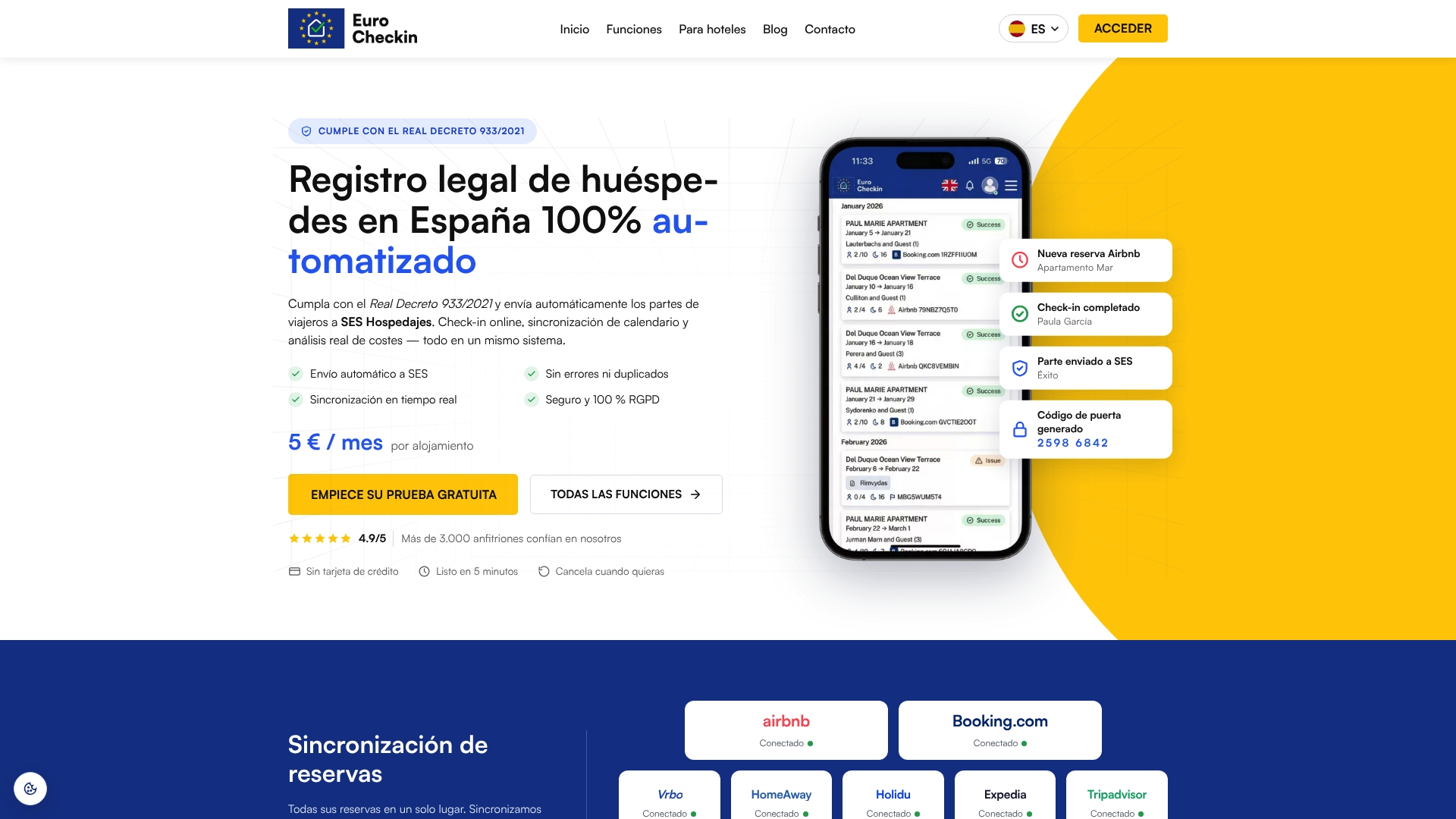
The platform also covers unlimited multilingual online check-in, digital contracts with e-signature, smart-lock integration with Nuki, TTLock and Yale, and a custom branded check-in for managers and boutique hotels.
FAQ
Do I need to keep a copy of my guests’ passports or ID cards?
No. The AEPD says operators should not request a copy of the identity document, because it conflicts with data minimization. A form containing only the Annex I data is enough. You still record the document type and number and check them against the guest’s document.
Can guests check in online without meeting me?
Yes. For online check-in, the AEPD describes methods such as digital certificates, matching payment-method data, or authentication codes sent by SMS or email. Choose a method, apply it consistently and make sure the data you record match the identity document or verification system.
Who signs the entry form?
Every guest over 14 signs the form provided by the accommodation. For guests under 14, an accompanying adult supplies the details. The signature can be collected electronically as part of the online check-in.
How fast must I send the data to the authorities?
Reservation or cancellation data and service-start data must be sent immediately and no later than 24 hours after the event. The submission goes through the Ministry of the Interior’s SES.HOSPEDAJES system, which also accepts integrations with external applications.
Does a private owner have the same duties as a hotel?
The communication duty applies to both. Professional operators must also keep the electronic record for three years from the end of the service, while non-professional operators are exempt from the documentary record and retention duties. Check which category applies to you before choosing a process.
Sources
- AEPD note on the accommodation register
- Real Decreto 933/2021, consolidated text (BOE)
- Real Decreto 933/2021, BOE no. 257 of 27 October 2021
- Ministry of the Interior: Hospedajes y alquiler de vehículos
- Ministry of the Interior: activation of the new accommodation register
- Ministry of the Interior: entry forms and record-keeping duties
- Ministry of Consumer Affairs: is it legal for a hotel to scan my ID
- Cluster Turismo de Galicia: traveler register FAQ