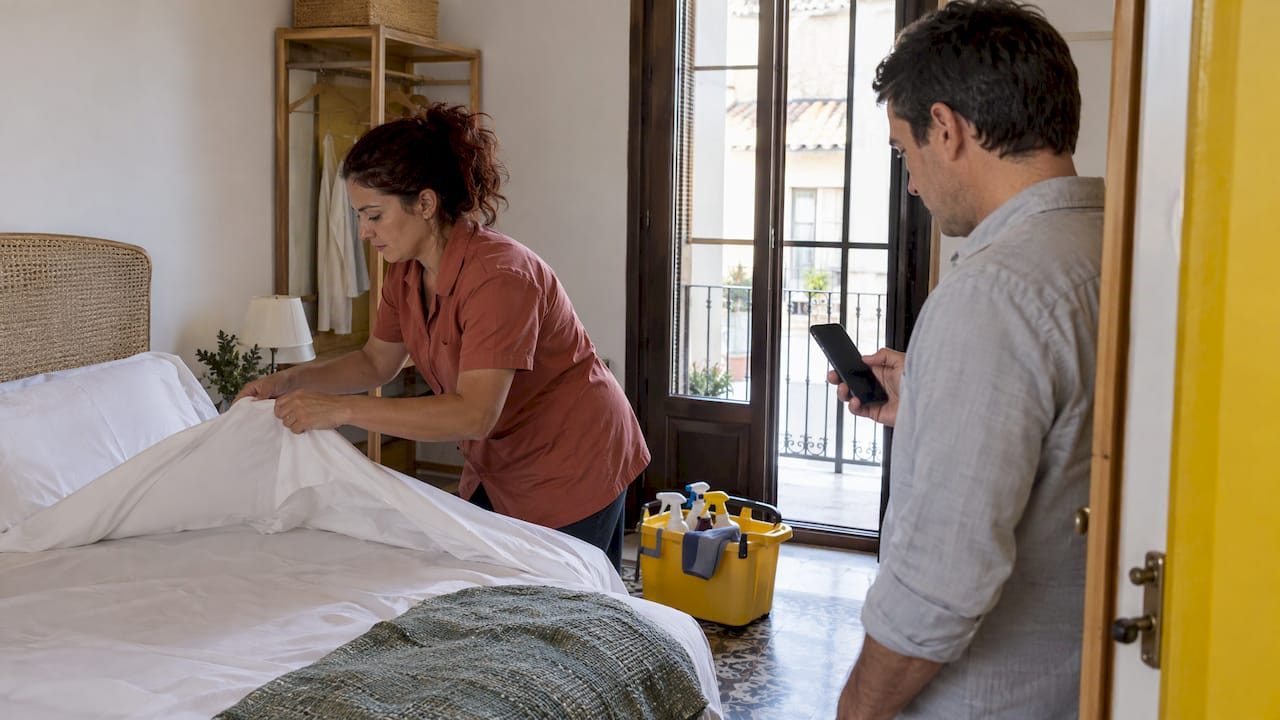



To comply with SES Hospedajes, you register your accommodation on the Ministry of the Interior platform, send the required reservation and guest data within the deadlines, and keep the records for three years. This guide walks you through each duty, the penalties for getting it wrong and a routine that keeps you covered without daily manual work.
TL;DR
- SES.HOSPEDAJES is the Ministry of the Interior platform for the guest and reservation data that Real Decreto 933/2021 requires from accommodation providers and intermediaries in Spain.
- Reservation and guest data must be reported immediately and within 24 hours of making or cancelling a reservation, and at the start of the service.
- Records must be kept for three years from the end of the service.
- Not registering or not reporting is a serious infraction (€601 to €30,000); late or incomplete reports are minor infractions (€100 to €600).
- Automating the submission is the most reliable way to avoid late, duplicated or incomplete reports.
Table of Contents
- What SES.HOSPEDAJES is and who must comply
- Step 1: Register your accommodation
- Step 2: Collect the right data from every guest
- Step 3: Report on time
- Step 4: Keep the records, and only use them for what the law allows
- Penalties: what failing costs you
- Has enforcement changed? The European Commission angle
- Common mistakes to avoid
- Perspective: why we automate this
- How EuroCheckin fits in
- A simple monthly compliance routine
- FAQ
- Sources
What SES.HOSPEDAJES is and who must comply
SES.HOSPEDAJES is a digital platform managed by the Ministry of the Interior. Accommodation providers and intermediaries use it to submit the reservation and guest information that the law requires. According to the Ministry of the Interior, the obligation covers professional and non-professional accommodation providers, and also intermediaries such as platforms and agencies operating in Spain.
In practice this means:
- Owners of tourist apartments and vacation homes.
- Hotels, hostels and guesthouses.
- Property management companies that run units for owners.
- Agencies and platforms that mediate reservations.
There is one nuance for non-professional providers. Real Decreto 933/2021 exempts them from keeping the computerized register and from strictly telematic communication, but they still have to meet the communication obligations of Article 6. If you are unsure which category you fall into, ask your gestor or a lawyer who specializes in tourist rentals before you decide to skip anything.
For a deeper look at the decree itself, read our guide to Real Decreto 933/2021 and what Spanish hosts must do.
Step 1: Register your accommodation
Registration comes before any guest data. The decree sets out that the specified information must be communicated within ten days after completing the required administrative formalities and before you begin activity, according to the text of the decree.
As a general sequence, follow these steps:
- Gather your identification as the provider (individual or company) and the details of each accommodation.
- Create your access on the Ministry of the Interior platform and register each accommodation.
- Obtain the credentials that your software will use to connect: the web service user, the landlord code (código de arrendador) and the password.
- Copy those credentials exactly as they appear. A single wrong character is the most common reason a connection fails.
- Test the connection with a software tool before the first real guest arrives.
If you would rather not do this yourself, we handle the SES registration for you as a one-off service. More on that below.
Step 2: Collect the right data from every guest
The decree sets out the data in its Annexes I and II. In broad terms you will need to capture:
- Identity details of each traveler (name, document, nationality, date of birth, contact details).
- Details of the reservation or contract (dates, number of travelers, payment information).
- Details of the accommodation.
Collect only what the regulation asks for. The European hotel sector has argued the current volume of data is excessive, and the debate over proportionality is real (see the section on enforcement below). Gathering extra data “just in case” creates GDPR exposure without making you more compliant. Our guest data checklist for Spain separates what you must collect from what you should leave out.
Minors and guests who travel with someone else
The register must include data for children under 14, and the adult accompanying them provides it, according to the decree. When a minor stays with an adult who is not a parent, the Ministry of the Interior indicates that you should record the basis for the adult’s responsibility for that minor. Build this question into your check-in form so it is never forgotten.

Foreign guests
Foreign guests are the reason a multilingual form matters. A traveler who does not understand a field label will leave it blank or guess, and that becomes an erroneous or incomplete report on your side. Send the form in the guest’s language and ask for the document exactly as it appears on the ID or passport.
Step 3: Report on time
The key deadline is short. Per the Ministry of the Interior, the data in Annexes I and II must be sent immediately and within 24 hours of making or cancelling a reservation or contract, and at the start of the services.
That has three practical consequences:
- A cancellation is also a report. Do not treat a cancelled booking as a closed matter.
- Last-minute bookings leave almost no margin. A guest who books in the afternoon and arrives in the evening must be in the system the same day.
- Waiting for the guest to send documents is a risk. If the guest does not complete the form, you need a reminder process, not a hope.
What a good workflow looks like
| Moment | What happens | Who does it |
|---|---|---|
| Booking confirmed | Guest receives the online check-in link | Automatic message |
| Before arrival | Guest completes the form and signs | Guest |
| On completion | Data is checked and sent to SES.HOSPEDAJES | Software |
| Cancellation or change | Updated information is sent | Software |
| Each month | You review rejected or missing reports | You or your manager |
The goal is to make the guest do the data entry and the software do the submission, so your only job is handling exceptions.
Step 4: Keep the records, and only use them for what the law allows
Records must be kept for three years from the end date of the service, and personal data processing is carried out under Organic Law 7/2021, according to Real Decreto 933/2021. The Ministry of the Interior adds that the data cannot be used to prepare lists, reports, summaries or statistics for administrative, civil or other purposes outside those the law provides.
For you, that translates into simple rules:
- Store the register in a secure system with restricted access.
- Do not reuse guest data for marketing unless you have a separate, valid legal basis.
- Delete or archive according to the retention period, not earlier and not indefinitely.
- Do not circulate identity documents by email or messaging apps.
If your guest data also passes through calendars and channel tools, review how much of it travels there. We cover this in Booking calendar privacy.
Penalties: what failing costs you
The Ministry of the Interior describes two levels:
| Failure | Classification | Fine |
|---|---|---|
| Not registering or not communicating | Serious | €601 to €30,000 |
| Late, false, erroneous or incomplete reports | Minor | €100 to €600 |
Article 8 of the decree also classifies failing to keep the register as serious and late communication as minor, with penalties governed by Ley Orgánica 4/2015. Note that the minor category includes errors and incomplete data, not just delays. A report sent on time with a wrong document number is still a problem.
Has enforcement changed? The European Commission angle
The system is not without controversy. HOTREC, the European hospitality association, reports that the European Commission launched an infringement procedure against Spain over traveler data collection. The association says the sector supports fighting crime but argues that the volume of data required is excessive and must respect necessity and proportionality (HOTREC).
What should you do with that information? Keep complying. A debate between Brussels and Madrid does not suspend your duty, and the fines above apply today. Do keep an eye on official announcements: if the data requirements are narrowed, your form should change with them, which is another reason to use software that updates when the rules do.
Common mistakes to avoid
- Mistyped credentials. Copy the web service user, landlord code and password exactly as shown.
- Reporting the guest but not the reservation. Both are required.
- Forgetting cancellations and changes. Each one triggers new information.
- Missing minors. Under-14s must be in the register.
- Collecting a copy of the ID “to be safe”. Identifying a guest is not the same as storing the document; collect what the regulation asks for.
- Relying on memory. A weekend with six check-ins is when manual systems fail.
- Duplicate reports. Sending the same guest twice, from two tools, creates inconsistencies you then have to correct.
Perspective: why we automate this
We built EuroCheckin because compliance is rarely hard to understand and very hard to sustain. A host with three apartments, guests from different countries and bookings arriving through several channels will, sooner or later, miss a deadline or mistype a number. The rule is short; the discipline is the problem.

Our view is that the guest should enter their own data in their own language, the system should validate it before submission, and the submission should happen without anyone remembering to do it. That removes duplicate entry and the typing mistakes that turn into “erroneous” reports. It also means data stays in secure infrastructure inside the European Union, which matters as much for GDPR as for the Ministry.
We also think compliance should be the foundation, not the whole business. Once check-in is automatic, the same flow can carry the digital contract, the house guide and extra services you sell to guests. Compliance becomes the step that pays for the rest of the workflow.
— Sofía Herrera
How EuroCheckin fits in
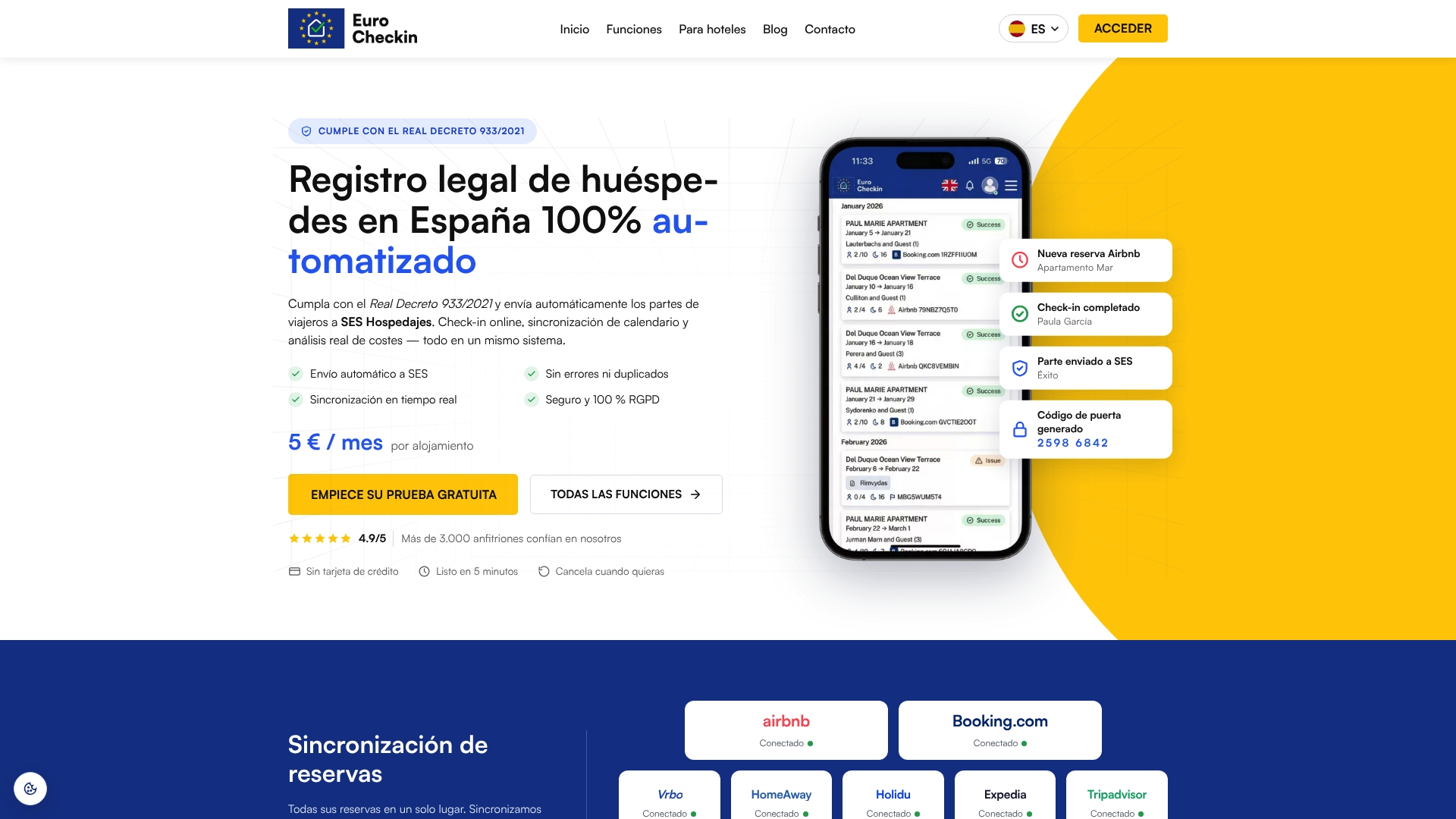
EuroCheckin automates guest registration in Spain and sends each guest’s data to SES Hospedajes in line with Real Decreto 933/2021 and GDPR. Guests complete a multilingual online check-in, with smart links for Airbnb, Booking and Vrbo, and you get instant alerts for every arrival. The digital guest register is fully online.
The published prices are simple:
- EuroCheckin for accommodations: €5 per month per accommodation, with a free trial.
- EuroCheckin for hotels: €3 per month per room.
- SES Hospedajes registration service: from €79 one-off per accommodation, if you prefer us to handle the initial registration.
If you manage vacation rentals on Airbnb, our guide on what you must register as an Airbnb host in Spain shows how the platform’s own requirements relate to SES. If you want the check-in page to carry your own brand, see custom branded check-in.
A simple monthly compliance routine
Even with automation, a short review keeps you safe:
- Check that every confirmed booking has a completed check-in.
- Look for reports that were rejected or are still pending.
- Confirm that cancellations and date changes were sent.
- Verify that your credentials are still valid, especially after a password change.
- Confirm that your retention period is respected and old records are handled properly.
Ten minutes a month is enough when the daily work is automatic.
FAQ
Do I need SES Hospedajes if I only rent one apartment?
Yes, in general. The Ministry of the Interior states that the platform applies to professional and non-professional providers. Non-professional providers have some exemptions regarding the computerized register and telematic communication, but they still have communication duties under Article 6 of the decree. Confirm your exact situation with a professional.
How long do I have to send guest data?
The Ministry of the Interior indicates that the data must be sent immediately and within 24 hours of making or cancelling a reservation, and at the start of the services. Do not leave it for arrival day. Automatic submission when the guest completes check-in avoids the issue.
How long must I keep the guest records?
Three years from the end date of the service, according to Real Decreto 933/2021. During that time the data must be protected and used only for the purposes the law provides.
What happens if I report late or make a mistake?
Late, false, erroneous or incomplete reports are minor infractions, with fines of €100 to €600. Not registering or not communicating at all is serious, with fines from €601 to €30,000. Correct errors as soon as you detect them.
Does the European Commission procedure mean I can stop reporting?
No. The procedure reported by HOTREC concerns whether the volume of data is proportionate. Until the rules change officially, the current obligations remain in force.
Sources
- Ministerio del Interior: Hospedajes y alquiler de vehículos
- Ministerio del Interior: Ostatuak eta ibilgailuen alokairua
- Real Decreto 933/2021 (BOE, consolidated text)
- HOTREC: Commission launches infringement procedure against Spain on traveller data collection