
A hotel data breach plan is a written procedure that says who does what, in what order and how fast when guest data is lost, stolen or exposed. In Spain, the plan must cover one hard deadline: if the breach is likely to put guests’ rights and freedoms at risk, you have 72 hours from the moment you become aware of it to notify the data protection authority, the AEPD. This guide shows you how to build the plan before an incident, what to do in the first hours, and how to tell guests. It applies to hotels, hostels, vacation rentals and property managers alike.
TL;DR
- Write the plan now and name a coordinator, a legal contact, a technical lead and a communications lead, each with a backup.
- Notify the AEPD electronically within 72 hours of becoming aware of a breach that is likely to put guests at risk.
- Tell affected guests without undue delay when the risk to them is high, in clear language and with the details the AEPD lists.
- You stay responsible even when your reservation software or another processor caused the breach.
- Collect less guest data, keep it in secure systems, and turn on two-factor authentication everywhere.
Table of Contents
- Why accommodation businesses need a plan now
- What counts as a data breach
- Build the plan before an incident
- The first hours: what staff do, in order
- Notifying the AEPD within 72 hours
- Telling guests
- After containment: recovery and preventing a repeat
- Hold less guest data in the first place
- Our perspective
- Put guest data in one secure flow
- Common mistakes to avoid
- FAQ
- Sources
Why accommodation businesses need a plan now
Breach notifications in Spain are rising fast. The AEPD received 3,949 notifications between January and July 2026, 42.8% more than the 2,765 recorded across all of 2025, and July 2026 alone reached 919.
Hotels are part of that picture. The AEPD’s May 2026 report says that breaches linked to hotel establishments and their processors, generally reservation-management software, have contributed significantly to the increase. Guest records are attractive because they combine identity details, contact information and travel dates.
A plan does not prevent every incident. It makes the first hours predictable, which is when most avoidable mistakes happen: deleting logs, waiting for a vendor to call back, or discovering that nobody knows who files the notification.

What counts as a data breach
The AEPD defines a personal data breach as a security incident that causes accidental or unlawful destruction, loss or alteration of personal data, or its unauthorized transmission or access. That is broader than a hack. Typical accommodation examples:
- A phishing email gives an attacker access to the mailbox where guest passport scans arrive.
- A reservation platform or channel tool you use is compromised and guest records leak.
- A laptop or phone with guest lists is lost or stolen.
- A staff member emails check-in data to the wrong guest.
- Ransomware locks the system that holds your guest register, so the data is no longer available.
- A former employee keeps access to the property management system.
Note that loss of availability counts too. If you cannot reach guest data because it was encrypted by ransomware, that is a breach, even if nobody copied anything.
Build the plan before an incident
Keep the plan short enough that someone can use it under stress. Four to six pages is plenty for a small operator.
Name the response team and a backup for each role
Good practice is to assign a response coordinator, a legal contact, a technical or forensic investigator and a communications lead, with a named backup for each. In a small business one person may hold two roles, but the backup must be a different person.
| Role | What they do | Example in a small operator |
|---|---|---|
| Coordinator | Runs the incident, keeps the timeline, decides escalation | Owner or general manager |
| Legal contact | Assesses risk, prepares the AEPD notification and guest notice | Your data protection adviser or lawyer, or your DPO if you have one |
| Technical lead | Isolates systems, preserves evidence, restores service | IT provider or the person who manages your software accounts |
| Communications lead | Writes guest messages, handles press and OTA contact | Guest relations or marketing manager |
Record every incident, even small ones
The plan should log incidents, including those that are not escalated to the response team. That record shows later how you assessed each event and why you did or did not notify. For each entry, note the date and time you became aware, what happened, which data and how many guests, the risk assessment and the decision.
Map your processors
The controller, which is your business, stays responsible. The AEPD guide says the controller may delegate breach management to processors, but delegating functions does not delegate responsibility. Before anything happens, list every system that touches guest data: property management system, channel manager, check-in tool, email, payment provider, smart lock software, cloud storage. For each one, write down the support contact, how the vendor will alert you to a breach, and what your contract says about notification time.
The AEPD also expects hotels to use only reservation-management services that can guarantee adequate security for guests’ personal data. Put that question in your vendor selection.
Prepare templates and contacts
Draft in advance, in Spanish and in the languages of your main guest markets:
- A holding message to guests that you can send within hours.
- A skeleton of the guest notice with the AEPD’s required content (see below).
- The phone numbers of your insurer, lawyer, IT provider and bank.
- Your internal log template.
Run a tabletop exercise once a year: pick a scenario, such as a stolen laptop, and walk the team through the plan. Annual exercises are a common recommendation and they reveal missing phone numbers fast.
The first hours: what staff do, in order
When someone suspects a breach, use the same sequence every time.
- Report internally at once. Any staff member who suspects an incident tells the coordinator immediately, and the coordinator starts the log. Write down the exact time of awareness. This starts the 72-hour clock.
- Contain the incident. Isolate affected systems without destroying evidence: disconnect a device from the network, revoke compromised credentials, sign out active sessions. Do not wipe or reinstall yet.
- Preserve evidence. Stop routine log deletion, keep emails and screenshots, and note who did what.
- Call the technical lead and your legal contact. Notify your insurer if you have a cyber policy, since many policies set their own notice periods.
- Assess the risk to guests. Which data was involved? Passport numbers, payment details and contact data carry different consequences than a guest name alone. How many people? Could the data be used for identity theft or fraud?
- Contact the processor. If a vendor’s system is involved, ask for the facts in writing: what happened, when, which of your records are affected.
- Decide on notifications. The legal contact decides whether the AEPD and guests must be told, and prepares the documents.
- Report possible crimes. The AEPD says the controller must always report possible crimes such as identity theft or fraud to the police or judicial authorities.
For cyber incidents, Spain’s national response team for the private sector is INCIBE-CERT, and its guidance describes the channels for reporting incidents. Add its contact route to your plan.
Notifying the AEPD within 72 hours
Under Article 33 of the GDPR, the controller must notify the supervisory authority when the breach is likely to constitute a risk to people’s rights and freedoms, within 72 hours from becoming aware of it. The notification is made electronically through the AEPD’s breach notification form on its electronic office.
Practical points:
- Count from the moment you are reasonably aware, not from the moment the investigation ends. Hours matter, including weekends.
- If you do not yet have every detail, file what you know and follow up. Do not wait for a perfect picture.
- Keep a copy of what you submitted and the confirmation.
- If you decide not to notify because the risk is unlikely, write the reasoning in your incident log.
Spanish accommodation businesses also have a separate duty: reporting traveler data to the authorities through SES Hospedajes. That is a different obligation from breach notification. Our guide to SES Hospedajes compliance explains it, and the Real Decreto 933/2021 overview covers the traveler register rules.
Telling guests
Under Article 34, you must communicate the breach to affected individuals without undue delay when it is likely to result in a high risk to their rights and freedoms. The AEPD asks for clear and simple language and at least these elements:
- Contact details of the data protection officer or another contact point.
- A general description of the incident and when it happened.
- The possible consequences of the breach.
- The data and personal information affected.
- A summary of the measures taken to control possible damage.
- Other useful information that helps guests protect their data or prevent harm.
Contact guests directly where you can: by phone, email, SMS or post. If direct contact would take a disproportionate effort, the AEPD allows an indirect public notice in a prominent place.
A message structure that works
- Open with what happened and when, in two sentences.
- State exactly which data was involved, and which was not.
- Explain what could follow, for example phishing emails that use their booking details.
- Say what you have done to contain it.
- Tell guests what to do: be careful with unexpected messages, contact their bank if payment data was involved.
- Give one named contact and a working email or phone number.
Avoid vague reassurance. Guests react better to precise facts than to a long apology.
After containment: recovery and preventing a repeat
The plan should end with a review, not with the notification. Within a few weeks, hold a debrief: what was the root cause, how long did each step take, which contact was missing, what changes?
Security measures the AEPD points to
The AEPD’s reports refer to several GDPR articles that apply directly to hotels:
- Article 32: controllers and processors must apply technical and organizational measures appropriate to the risk, guaranteeing confidentiality, integrity, availability and resilience.
- Article 25: secure design, segmentation and recovery procedures, with backups that are updated and isolated from the network.
- Article 24: review and update measures. The May 2026 report gives effective two-factor authentication as an example, to be used by processors and properly applied by controllers.
In practice: turn on two-factor authentication for your property management system, email, channel manager and any platform with guest data. Give each staff member their own login. Remove access the day someone leaves. Keep an offline or network-isolated backup and test a restore.
Plan for continuity, not only backups
The AEPD has written that having backups is no longer enough. Where availability of processing matters, organizations need an action plan and a business continuity plan. For a hotel, that means knowing how you will check in guests if the system is down for a day: a paper fallback, a second device, a contact at your software vendor. The same blog notes that resilience should also cover the discontinuity of products or applications, so know how you would export your data if a vendor disappeared.
Hold less guest data in the first place
Every stored passport scan is something you could lose. Collect what the law requires and what the stay needs, and keep it in one secure place instead of in inboxes, chat threads and spreadsheets. Our guest data checklist for Spain lists what to collect and what to leave out, and the check-in form questions guide helps you trim forms.
Two other leak points are easy to miss:
- Identity documents. Photos sent over WhatsApp or email stay on personal phones. A structured process is safer, as described in our digital identity capture guide.
- Shared calendars. Calendar feeds can carry guest details. See how to protect guest data in booking calendars.
Our perspective
Most breaches we see discussed in hospitality do not start with a sophisticated attack. They start with scattered data: IDs in email, guest lists in spreadsheets, copies on several phones. Every copy is another place a breach can happen and another place to check when you assess one.
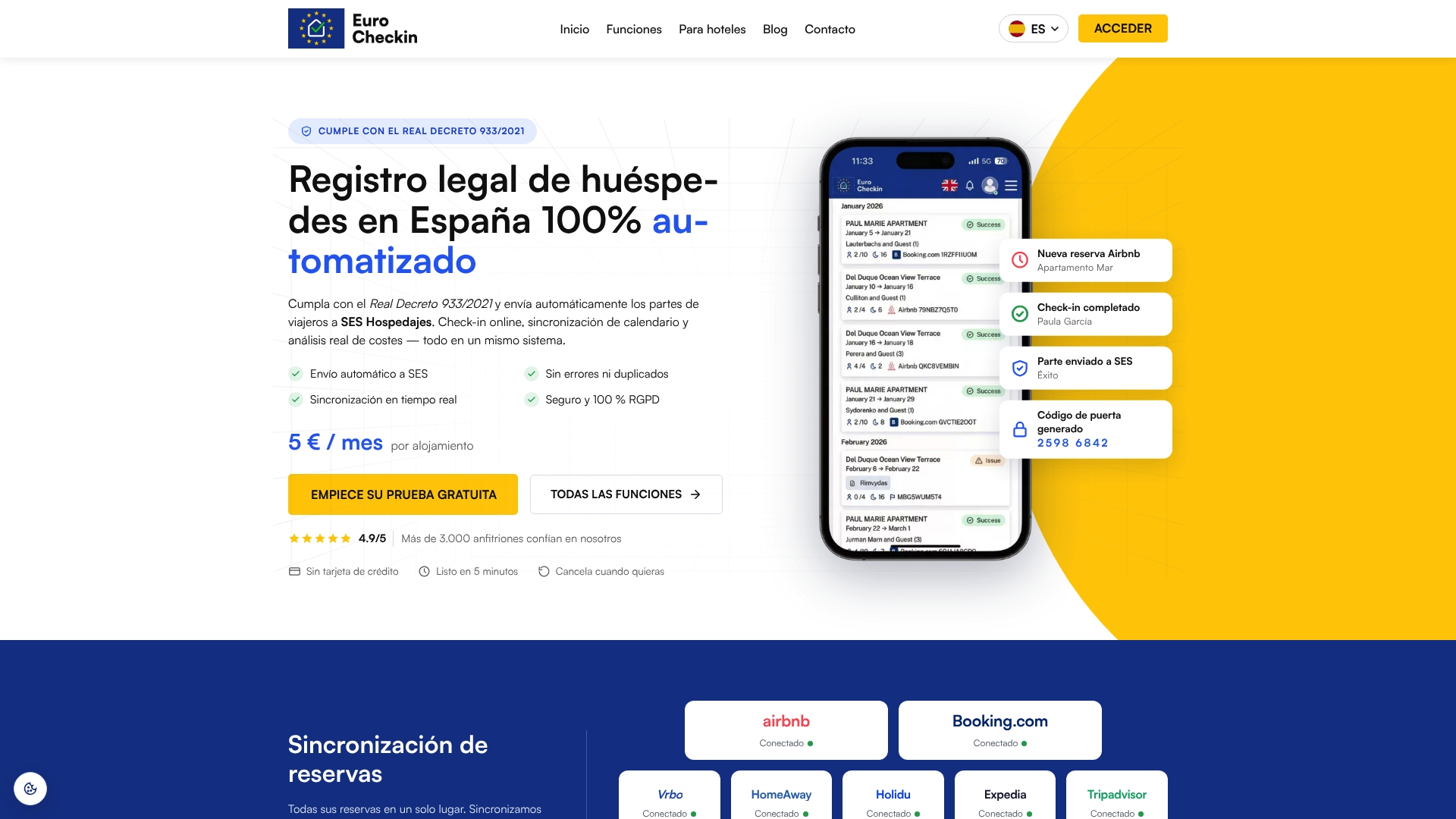
That is why we built EuroCheckin around one flow. Guests complete a multilingual online check-in, the data goes to a digital traveler register, and it is sent automatically to SES Hospedajes without manual work or duplicate records. The information is hosted on secure infrastructure inside the European Union. Fewer manual steps and fewer copies make a response plan simpler to run, because you know where the data is.
A plan is still your responsibility as controller, and it works best when your tools support it. We recommend that every host and hotel document who does what, choose vendors that can protect guest data, and run one tabletop exercise a year.
Sofía Herrera
Put guest data in one secure flow
If your guest data is spread across inboxes and chat apps, consolidating it is the most practical first step in your plan. EuroCheckin automates online check-in, the digital traveler register and the reporting to SES Hospedajes. Plans start at €5 per month per accommodation, and hotels pay €3 per month per room, with a free trial. See EuroCheckin for accommodations or the hotel plan.
If you would rather have the SES Hospedajes registration set up for you, we offer registration in SES Hospedajes from €79 one-off per accommodation.
Common mistakes to avoid
- Waiting for certainty. The 72 hours start when you become aware, so file with what you know and update later.
- Wiping the affected device. You destroy the evidence your investigator and lawyer need.
- Assuming the vendor handles it. Delegating breach management to a processor does not delegate your responsibility.
- No backup for each role. The coordinator is on holiday and nobody else knows the plan.
- Not logging small incidents. A misdirected email still belongs in the record.
- Skipping the debrief. Without it, the same gap is still there next season.
FAQ
Do small vacation rentals need a data breach plan?
Yes. The GDPR obligations apply to the controller of personal data whatever its size, and a host who collects guest IDs and contact details is a controller. A short plan with one coordinator, a backup, your vendor contacts and the AEPD form link is enough to start.
How long do I have to report a breach to the AEPD?
You have 72 hours from becoming aware of it, when the breach is likely to put people’s rights and freedoms at risk. The report is made electronically on the AEPD’s breach notification form. Details can be added afterwards if they are not yet known.
Do I have to tell guests about every breach?
No. Article 34 requires direct communication when the breach is likely to result in a high risk to guests’ rights and freedoms. You still need to log the decision and your reasoning, and you should ask your legal contact when the risk level is unclear.
Who is responsible if my reservation software is breached?
You remain responsible as controller, even if the processor manages the breach on your behalf. That is why your plan lists every vendor, how they will alert you and what their contract says about notification time.
What should I do first if a staff laptop with guest data is stolen?
Tell the coordinator immediately and record the time. Revoke the laptop’s access to email and your systems, report the theft to the police, and have your legal contact assess the risk, including whether the device was encrypted. Then decide on AEPD and guest notification.
Sources
- AEPD: personal data breach notification procedure
- AEPD: guide to notifying personal data breaches
- AEPD: breach report, May 2026
- AEPD: breach report, July 2026
- AEPD: notifying personal data breaches to the authority
- AEPD: communicating breaches to affected individuals
- AEPD blog: ransomware and risk management
- INCIBE-CERT: private-sector cyber incident management
- The Objective: breach notifications rise in 2026
- OAIC: preparing a data breach response plan
- Hotel data breach legal requirements guide