



Yes, a hotel, hostel or vacation rental in Spain can have guests sign contracts and house rules electronically, and the signature is legally valid. Spanish and EU law do not require a digital certificate from the guest for this. What you need is a clear signing process, proof of who signed what and when, and a record you keep. This guide explains the legal basis, the types of signature, the steps for signing before arrival and the checks to run when you choose a tool.
TL;DR
- An electronic signature cannot be denied legal effect or be rejected as evidence only because it is electronic, under eIDAS (Regulation 910/2014).
- A Spanish digital certificate is the tool for signing in the name of an identified holder, for example with public bodies. It is not a requirement for a guest who accepts your rental agreement.
- Under Real Decreto 933/2021, each guest over 14 must sign the entry form, and you must keep the register for three years.
- Before the guest signs, show the conditions clearly. After they sign, confirm receipt within 24 hours.
- Keep the signed document, the date and time, and the identity data together so you can show them if a contract is challenged.
Table of Contents
- Are electronic signatures valid for guest contracts in Spain?
- Electronic signature vs. digital certificate
- Types of signature and which fits a stay
- The entry form is a separate obligation
- How a guest signs before arrival, step by step
- What evidence to keep
- How to choose an e-signature tool for your property
- Our perspective
- Put it into practice with EuroCheckin
- Common mistakes with guest signatures
- FAQ
- Sources
Are electronic signatures valid for guest contracts in Spain?
They are. Spain applies Regulation (EU) 910/2014, known as eIDAS, together with Ley 6/2020 on electronic trust services. The official guidance explains that a signature cannot be refused legal effects or admissibility as evidence merely because it is electronic or does not meet the requirements of a qualified signature. A qualified electronic signature carries the same effect as a handwritten one.
Contract law points the same way. The Spanish LSSI guidance on electronic contracting states that contracts concluded electronically are valid and effective even if they are not on paper. It excludes family law and succession contracts, which do not apply to a stay or a rental agreement. It also says that any extra formal requirement, such as a notarial deed or a registry entry, still applies. A tourist stay or short rental agreement does not normally need these, but a long-term lease you plan to register is a different matter and worth checking with your advisor.

What happens if a signature is challenged
In a civil case, an electronic document with a simple or advanced signature is treated like any other private document. According to LegalToday, if its authenticity is disputed, the party who presents it can offer additional evidence, and the judge assesses it under the rules of sound discretion (sana crítica). The Ley de Enjuiciamiento Civil now refers expressly to eIDAS Article 25.

In practice, this means your evidence matters as much as the signature itself. A signed PDF with no record of when, how and by whom it was signed is weaker than one backed by a full trail.
Electronic signature vs. digital certificate
The two terms get mixed up, and the search results for this topic are mostly about the certificate. They are different things.
- Digital certificate: according to the Spanish Tax Agency, it is a document signed electronically by an authorized certification provider. It identifies the signer and ties them to verification keys and a validity period. The AEPD adds that identifying yourself with it has the same validity as showing your ID in person.
- Electronic signature: the official citizen guidance says you need a digital certificate or the electronic ID card (DNIe) to sign a document with that method. The certificate holds the cryptographic keys, and the signed document is the electronic signature, which must be kept.
What this means for you as a host or hotelier: you may need a certificate yourself to deal with administrations, for example to access tax formalities. Your guests do not need one to accept a rental agreement. Most of your guests are foreign visitors who have no Spanish certificate, and the guidance on certificates does not address guest-signing flows at all. Requiring one would only block bookings.
Types of signature and which fits a stay
eIDAS defines three levels. Understanding them helps you pick the right one for each document.
| Level | What it is | Typical use in accommodation |
|---|---|---|
| Simple electronic signature | Data in electronic form attached to or associated with a document to show acceptance | House rules, guest guide acknowledgment, low-value stays |
| Advanced electronic signature | Uniquely linked to the signer, identifies them, created under their sole control and linked to the data so later changes are detectable | Rental agreements where you want stronger proof of who signed |
| Qualified electronic signature | An advanced signature created with a qualified device and based on a qualified certificate | Documents where a handwritten-equivalent effect is required |
The requirements for the advanced and qualified levels come from eIDAS Article 26 and its definitions as summarized by the Spanish government. For a normal guest stay, a simple or advanced signature supported by identity data and a solid audit trail is the practical choice. A qualified signature is not needed for the document to be valid and admissible.
The entry form is a separate obligation
Do not confuse a rental contract with the traveler entry form that Spain requires. Under Real Decreto 933/2021, every person over 14 who uses lodging services must sign the entry form. For children under 14, the accompanying adult provides the data. The establishment is responsible for the accuracy of the data, which must match the documents or identity systems that guests show or provide.
The same decree sets two time rules:
- You must keep a computerized register of the prescribed data for three years after the service ends.
- You must transmit the data by telematic means immediately, and within 24 hours of the reservation, contract formalization or cancellation, and of the start of the service.
Signing the entry form online before arrival is one way to meet these rules without queues at the reception desk. For the full list of obligations, see our guide to Real Decreto 933/2021 for Spanish hosts and our overview of SES Hospedajes compliance.
How a guest signs before arrival, step by step
A clean online flow follows the same order every time.
- Send the check-in link when the booking is confirmed. The link should open on a phone, in the guest’s language, without an app download.
- Show the conditions first. The LSSI requires clear information before the contract starts: the conditions, the steps to follow, whether the document will be archived, the technical means to correct input errors, and the language of the contract. Put the house rules and the cancellation terms on the screen before the signature box.
- Capture the identity data. Collect the data the register requires and an image of the ID document. Our guides on digital identity capture and the guest data checklist for Spain list what to ask and what to leave out.
- Collect the signature. The guest signs on the screen. Every adult guest signs the entry form, as the decree requires for anyone over 14.
- Confirm receipt. The LSSI says you must confirm that you received the acceptance, for example with an acknowledgment email, within 24 hours.
- Store and report. Archive the signed documents and send the traveler data to SES Hospedajes within the legal deadline.
Steps 5 and 6 are the ones people forget. They are also the steps that protect you if a dispute comes up.
What evidence to keep
If a guest later denies they accepted the rules, your proof is your file. Keep these items together for each stay:
- The signed contract or house rules, in a format that cannot be edited.
- The date and time of signing, and the guest’s name as entered.
- The version of the text the guest saw, so you can show which rules applied.
- The acknowledgment email you sent after acceptance.
- The identity data collected for the register, kept for the three years the decree requires.
The reason is the court standard described above: if authenticity is challenged, you will need to support the document with more evidence, and the judge weighs it all.
How to choose an e-signature tool for your property
A specialist tool for accommodation saves work compared with a generic document-signing service, because the contract, the entry form and the police-registry reporting sit in the same flow. Check these points:
- Legal fit: does it work within eIDAS and Spanish law, and does it handle the entry form required by Real Decreto 933/2021?
- Audit trail: does it record date, time and the document version for every signature?
- Privacy: where is the data hosted, and does the provider comply with GDPR? Hosting inside the European Union keeps your data transfers simple.
- Guest experience: can a guest sign in their own language from a phone, with no account and no certificate?
- Connection to your channels: do links work for guests who book through Airbnb, Booking or Vrbo?
- Branding: can the check-in carry your name and look? See our page on custom branded check-in.
- Cost model: is the price per property or per room, and is there a trial?
Our perspective
We built EuroCheckin on a simple idea: a host in Spain should not have to choose between being compliant and being quick. A signature is only useful if it sits inside a process that also collects the traveler data and reports it on time.
That is why our digital contracts with electronic signature and house rules live in the same check-in as the entry data and the transmission to SES Hospedajes. The guest completes everything once, in their own language, and the data is hosted on secure infrastructure in the European Union.
Our approach is designed to remove the manual work and the duplicate records that cause most errors for hosts, from the first message to the arrival. A hotel with dozens of rooms and a single apartment owner face the same legal duties, so we priced the service per accommodation and per room.
Sofía Herrera
Put it into practice with EuroCheckin
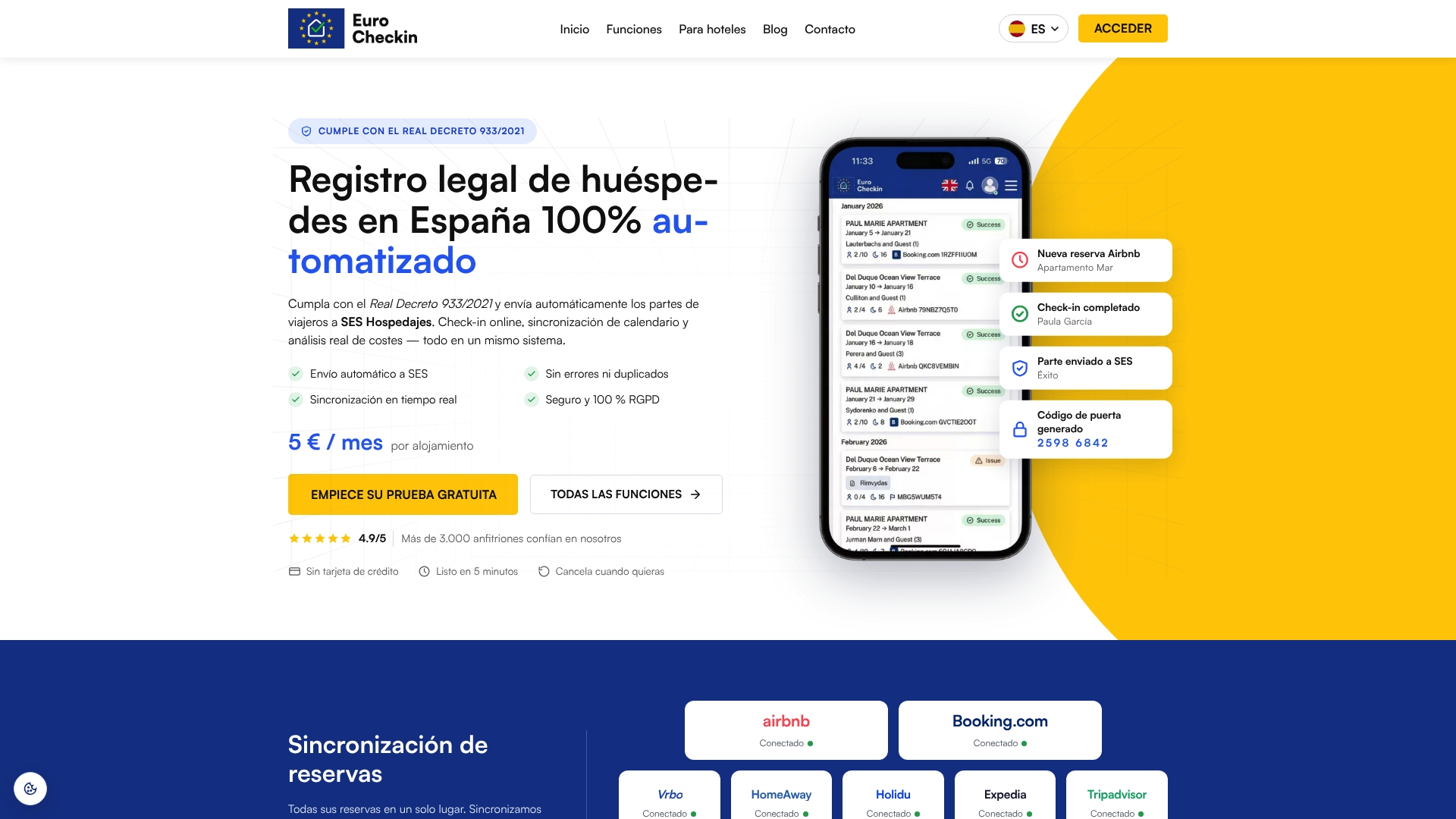
EuroCheckin brings the contract, the e-signature, the multilingual online check-in and the automatic report to SES Hospedajes into one platform. For apartments and houses, EuroCheckin para alojamientos costs €5 per month per accommodation, with a free trial. Hotels can use EuroCheckin para hoteles at €3 per month per room.
If you want help getting registered first, the registration service for SES Hospedajes starts from €79 one-off per accommodation.
Common mistakes with guest signatures
- Asking guests for a digital certificate. It excludes most international visitors and the law does not require it for a rental agreement.
- Signing without showing the conditions first. The LSSI requires clear information before the contract begins.
- Skipping the acknowledgment. Confirm receipt within 24 hours.
- Treating the contract as the entry form. They are two documents with two sets of rules.
- Not saving the version of the rules. You cannot prove what the guest accepted.
- Sending traveler data late. The 24-hour window runs from the reservation, formalization or cancellation, and from the start of the service.
FAQ
Does my guest need a digital certificate to sign a rental agreement in Spain?
No. The official guidance on digital certificates describes how a certificate or the DNIe is used to sign with that method, but eIDAS also protects signatures that do not meet the qualified level. A guest can accept your agreement with a simple or advanced electronic signature on their phone.
Is an e-signature enough in court?
It cannot be rejected as evidence solely because it is electronic. If someone challenges it, the judge evaluates it with any other proof you offer, so keep the audit trail, the acknowledgment and the identity data.
Do children have to sign the entry form?
Under Real Decreto 933/2021, every person over 14 signs the entry form. For anyone under 14, the accompanying adult provides the data.
How long must I keep guest records?
The decree requires a computerized register of the prescribed data for three years after the service ends.
Can the guest sign before arriving?
Yes. You can send the link when the booking is confirmed so the guest signs the contract and entry form remotely. Remember to send an acknowledgment within 24 hours and to report the data in time.
Sources
- Firma Electrónica, base legal for companies
- Firma Electrónica, base legal for citizens
- Firma Electrónica, the electronic signature
- LSSI, electronic contracting
- LegalToday, the value of the electronic signature as evidence
- Tax Agency, what a digital certificate is
- Tax Agency, ways to access formalities
- AEPD, what an electronic certificate is
- Real Decreto 933/2021, BOE