



Receipt capture for a rental in Spain means two jobs. You issue and file the receipts you give guests or tenants. You also capture the receipts and invoices you receive for cleaning, repairs, supplies and utilities. Both need the right content, a digital copy that stays legible and a filing habit tied to each property. This guide covers what a rent receipt must include, when you need an invoice instead, how to store records and how to cut the manual work.
TL;DR
- Spanish law does not set one mandatory format for a rent receipt, but for residential leases it must itemize each payment component and show the rent in force.
- A receipt only proves payment. An invoice is a tax document, and you need one when the recipient is a business, a legal person or a public authority, or when a private individual requests it to exercise a tax right.
- A PDF sent by email can serve as a digital receipt. Keep invoicing documents so the tax authority can access them without delay, in their original legible format.
- Guest data under RD 933/2021 is a separate obligation: 24-hour reporting and 3-year retention for professional operators.
- Capture every expense receipt per property from day one, so your numbers are ready at tax time.
Table of Contents
- Rent receipt, invoice and guest registration: three different documents
- What the law says about rent receipts
- What a good rent receipt includes
- When you need an invoice instead
- Capturing the receipts you receive
- Storing records digitally: formats and retention
- Don’t forget the other record: guest registration
- Our perspective
- Setting up a receipt flow that runs by itself
- Automate capture with EuroCheckin
- Common mistakes to avoid
- FAQ
- Sources
Rent receipt, invoice and guest registration: three different documents
Hosts often mix up three records that look similar but serve different purposes.
| Document | What it proves | Who needs it |
|---|---|---|
| Rent receipt | That a payment was made | The tenant or guest, and your own bookkeeping |
| Invoice | A taxable or VAT-exempt transaction, with tax data | Businesses, professionals, public bodies, or anyone who requests one for a tax right |
| Guest registration record | Who stayed and when | The authorities, through SES Hospedajes |
The first is about money received. The second is a tax document. The third is a police and registration duty. A guest registration is not a receipt, and a receipt does not replace a registration.
What the law says about rent receipts
For residential leases, Article 17.4 of the Ley de Arrendamientos Urbanos obliges the landlord to give the tenant a receipt for each payment, unless the parties agreed on a payment method that itself proves payment. The same article requires the receipt, or the document replacing it, to show separately the amount of each item in the total payment and the current rent in force.
In practice, this has three consequences:
- If rent is paid by bank transfer or direct debit, the bank record can act as the receipt.
- If you pass on community fees, IBI or utilities, list them on separate lines. A receipt that says only “850 € rent” when it includes other items does not itemize as the law asks.
- Do not hand over a receipt before the full agreed amount has arrived. A receipt can be read as proof of payment even when the payment was partial, as idealista’s guide to paying rent points out.
Short-stay guests are a different case. They stay under a tourist-rental arrangement, not a residential lease, so the same practical logic applies (proof of payment, itemized amounts) but your platform booking confirmation often already documents the payment. Decide per channel what the guest receives from you directly.
What a good rent receipt includes
No official template exists, but a complete receipt is built from the same fields. Use this checklist:
- Receipt number, ideally sequential, so you can control the series.
- Place and date of issue.
- Landlord’s and tenant’s full names and DNI or NIE.
- Full address of the property.
- The month or period the payment covers.
- Each item on its own line (rent, community fees, IBI, utilities) and the total in figures, ideally also in words.
- Payment date and method, with the transfer reference when relevant.
- The landlord’s signature.
The fields above follow what several Spanish template guides recommend, for example Plantillazo’s guide to writing a rent receipt in Spain. The legal minimum is the itemization in the LAU. The rest is good practice that protects both sides.
Worked example
A tenant pays €900 in total for March. Your receipt shows three lines: current rent, community fee and water. Each has its own amount, and the total is written in figures and words. It names the March period, the transfer date and the reference. It carries number 2026-03 in your series. If someone asks six months later what the €900 was made of, the document answers.
When you need an invoice instead
The practical dividing line is who pays and what you provide.
- Private individual, VAT-exempt lease: per the Tax Agency, an invoice is not required for property leases unless the transaction is with a business, a legal person or a public authority. An invoice is also required if a private individual requests one to exercise a tax-related right, or if another regulation demands it.
- Company, self-employed person or public body: issue an invoice.
- Hospitality-type services: a binding tax ruling on tourist accommodation, consultation V1397-23, says operators providing complementary services such as cleaning, restaurant or laundry must issue an invoice at 10% VAT, even if a platform collects the payment. Without those services, a VAT-exempt lease requires no invoice unless the recipient is a business or professional.
If your property offers services that go beyond a standard stay, talk to your tax adviser (gestor or asesor fiscal) about which VAT regime applies to you before you set up your document flow. The rule depends on the services you actually provide, not on the platform you use.
Do you need computerized invoicing (Verifactu)?
A binding ruling, V0205-26 of 4 February 2026, confirms that property landlords without employees are not obliged to use computerized invoicing systems. Reason: under Article 27.2 of the IRPF law, renting real estate counts as an economic activity only when at least one full-time employee organizes it. If you run a larger operation with staff, confirm your position with your adviser.
Capturing the receipts you receive
Rent receipts are what you give out. Your expense receipts are what you collect: the cleaning company’s invoice, a plumber’s bill, laundry, amenities, internet, community fees. Without a system they end up in email inboxes, photo galleries and paper piles, and the cost of each property gets blurred.
A simple routine works for most hosts:
- Capture at the moment you receive it. Photograph the paper receipt or save the PDF the same day.
- Tag it to one property. Every document belongs to one accommodation, so you can see costs per unit.
- Name files consistently. Date, property, supplier, amount. For example: 2026-03-14_Sol-Apartment_Cleaning_85.pdf.
- Check the data. Supplier tax ID, invoice number, date, base amount, VAT and total must be readable.
- Store it in one place. Not a mix of WhatsApp, email and a shoebox.
- Review monthly. Compare costs against income for each property.
The weak points are almost always step 2 and step 4. A photo with a cropped total or a missing tax ID forces you to chase the supplier later.
Storing records digitally: formats and retention
Electronic storage is allowed
The Agencia Tributaria states that invoicing documents must be kept so the tax administration can access them without delay. Electronic storage works provided the documents remain legible in their original format and the data and mechanisms that verify authenticity and integrity are preserved. A blurry photo in a chat thread does not meet that standard. A clean scan or the original PDF does.

The same guidance covers storage outside Spain: the obligation counts as fulfilled only if you use electronic means that guarantee online access, remote loading and use by the tax administration, and you must notify the tax agency in advance. If your cloud tool stores data abroad, check this point with your adviser.
Digital rent receipts
A PDF sent by email is valid proof of payment. Housely’s guide explains that the handwritten signature matters mainly on paper receipts, while in digital form the traceability of the sending and the identifying data carry the evidential weight. Keep the sent email together with the PDF so the delivery is documented.
How long to keep guest registration data
For guest data, Article 5 of RD 933/2021 requires lodging operators to keep a computerized record of user data and to conserve it for 3 years from the end of the contracted service. Non-professional operators are exempt from the documentary registration and conservation duties but remain subject to the communication obligations. Whether you count as professional depends on your situation, so confirm it with your adviser or the authority.
For tax and rental documents, ask your adviser for the retention period that applies to your case. A practical rule: keep every receipt and invoice for a given year until you are certain no review of that year can still open.

Don’t forget the other record: guest registration
Receipt capture and guest registration run side by side at every check-in, and the second has a hard deadline. Under Article 6 of RD 933/2021, operators must transmit the required data immediately and in any case within 24 hours of the reservation or contract (or its cancellation) and of the start of the contracted services. The Ministry of the Interior’s SES.HOSPEDAJES platform became operational in December 2024, and lodging businesses must use it.
If you want the detail, read our guides on what RD 933/2021 asks of hosts, SES Hospedajes compliance and the guest data checklist for Spain.
Our perspective
Most hosts we talk to do not lose money on one big mistake. They lose it in small gaps: a receipt photographed but never filed, a cleaning invoice that nobody tied to a property, a guest record entered twice.
We built EuroCheckin on a simple idea: every piece of paper in a rental belongs to one accommodation and should be captured once. Guest data goes to SES Hospedajes automatically, without duplicate entries. Expense invoices go through AI-based OCR, and the result is an expense analysis per accommodation. You see what each property costs without opening a spreadsheet.
Our advice is to treat capture as part of the guest cycle, not as year-end homework. When check-in, contracts, extras and expenses live in one platform, the paperwork follows the booking instead of chasing it.
Sofía Herrera
Setting up a receipt flow that runs by itself
Put the pieces together property by property.
- Define your documents. Decide which guests or tenants get a receipt, which get an invoice, and what the platforms already issue.
- Build one template. Use the checklist above. Save landlord data and property address once, then change only the period, date and amounts.
- Itemize from the start. Separate rent from fees and utilities in the template, so you never forget it.
- Capture expenses on arrival. Photograph or forward every supplier invoice the day it arrives.
- Connect the guest side. Digital contracts with e-signature, check-in forms and guest registration should be completed before arrival, so the stay starts with clean records.
- Close each month. Check that every payment has its document and every expense is assigned to a property.
If a payment is disputed, the strongest evidence is a bank transfer record plus a receipt that itemizes the amounts. If a landlord refuses to issue a receipt, tenants can pay only by transfer and keep the statements, as this guide on rent receipts explains, and the LAU recognizes the right to a receipt.
Automate capture with EuroCheckin
EuroCheckin brings guest registration and expense capture into one platform. It sends guest data to SES Hospedajes automatically in line with RD 933/2021 and GDPR, runs unlimited multilingual online check-in, and offers digital contracts with e-signature. Its AI invoice OCR gives you an expense analysis per accommodation. Data is hosted on secure infrastructure within the European Union.
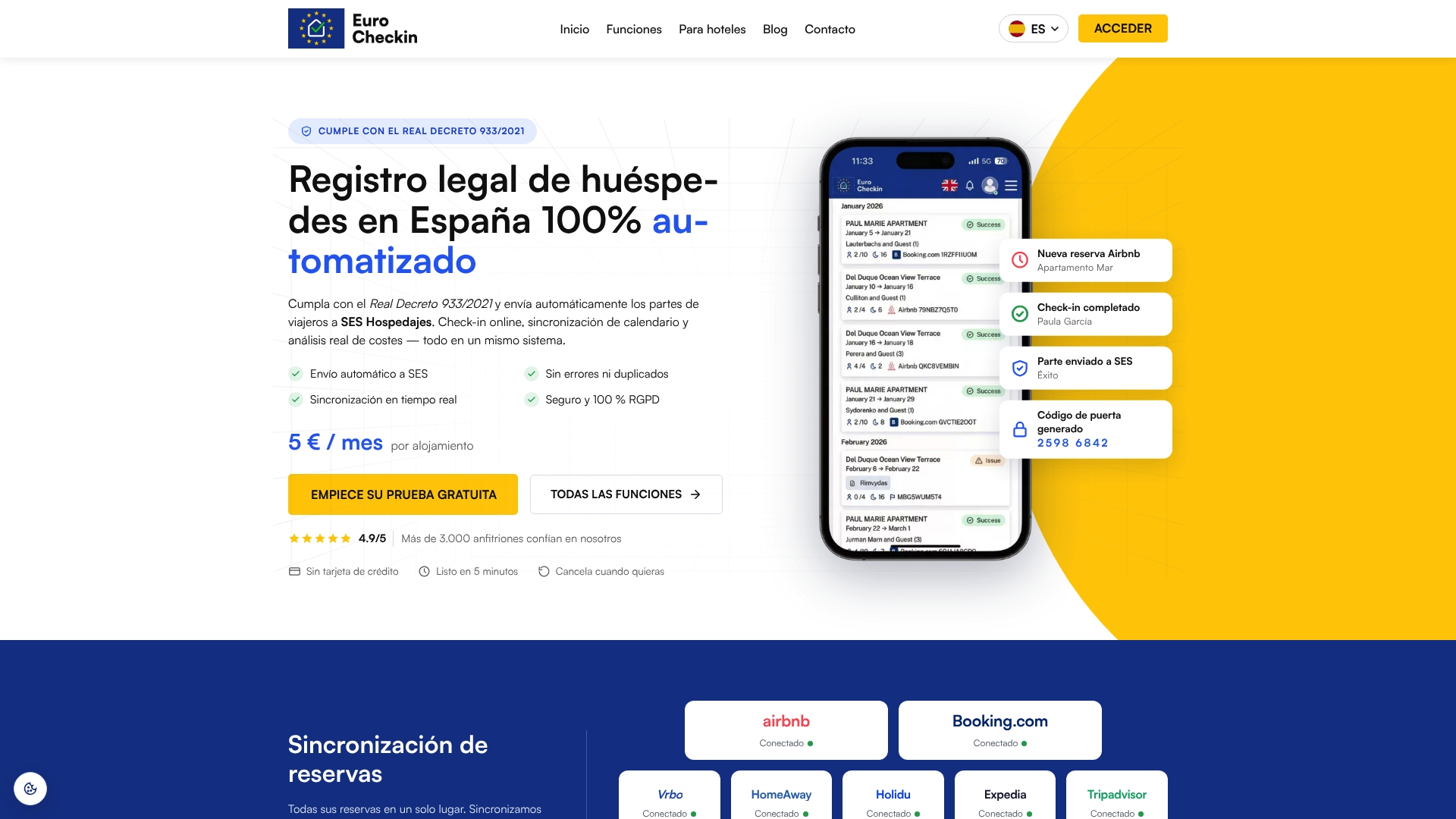
Pricing is €5 per month per accommodation on the plan for rental properties, with a free trial. Hotels pay €3 per month per room on the hotel plan. If you prefer us to handle the setup, our SES Hospedajes registration service starts from €79 one-off per accommodation.
Common mistakes to avoid
- Calling a receipt an invoice. A receipt proves payment. An invoice carries tax data. Use the one the situation demands.
- Lumping amounts together. Rent and passed-on costs belong on separate lines.
- Issuing a receipt for a partial payment. Wait until the full amount arrives.
- Keeping only photos in a chat. Store legible originals in one place.
- Skipping the property tag. Without it you cannot see the real cost of each unit.
- Treating guest registration as optional paperwork. The 24-hour deadline applies, and records must be kept for 3 years for professional operators.
- Forgetting to confirm with a professional. VAT treatment and non-professional status change with your services. Ask your gestor.
A short, more detailed read on which guest data to collect and which to skip helps you avoid the registration-side errors, and our check-in form guide shows the questions to ask before arrival.
FAQ
Is a bank transfer enough instead of a rent receipt?
Under Article 17.4 of the LAU, a receipt is not needed when the parties agreed on a payment method that proves the payment itself, such as a bank transfer or direct debit. The statement then serves as the proof. A receipt still helps when you need to separate rent from community fees or utilities.
Is a digital PDF receipt valid in Spain?
Yes. A PDF sent by email works as proof of payment when it carries the identifying data and the sending can be traced. Keep the PDF and the email together in your records.
Do I have to issue an invoice to a guest?
Not always. For a VAT-exempt lease to a private individual, the Tax Agency says an invoice is not required unless the recipient is a business, a legal person or a public authority, or the individual requests one to exercise a tax right. If you provide hospitality-type services, different VAT rules may apply, so confirm with your tax adviser.
How long should I keep guest registration data?
Professional lodging operators must conserve the computerized record of user data for 3 years from the end of the contracted service, under Article 5 of RD 933/2021. Non-professional operators are exempt from the conservation duty but still must communicate the data. Check with your adviser which category fits you.
Can I store receipts on a cloud service outside Spain?
The Agencia Tributaria accepts storage outside Spain only through electronic means that guarantee online access, remote loading and use by the tax administration, and you must notify the agency beforehand. Ask your adviser before you choose a storage tool.
Sources
- Artículo 17 de la Ley 29/1994 de Arrendamientos Urbanos
- El pago del alquiler: cómo, cuándo y dónde (idealista)
- How to write a rent receipt in Spain (Plantillazo)
- Tax Agency: VAT on property leases, invoicing FAQ
- Binding ruling V1397-23
- Binding ruling V0205-26
- Agencia Tributaria: Obligación de conservar las facturas
- Recibo de alquiler: qué debe incluir y cómo automatizarlo (Housely)
- Real Decreto 933/2021 (BOE, 27-10-2021)
- Ministerio del Interior: nuevo registro de hospedaje
- Modelo de recibo de alquiler (Herramientapp)