



A Vrbo check-in form, in operator terms, is a multilingual online guest-registration tool that collects the legal fields Spanish law requires, captures a signature, syncs with your Vrbo calendar, and submits guest data to SES.HOSPEDAJES. If you manage even one property on Vrbo, the recommended move is straightforward: adopt an SES-compatible automation platform, such as EuroCheckin, that validates documents, captures signatures, and logs every transmission for you.
TL;DR:
- Automated check-in forms are required for legal reporting, capturing all mandated fields, signatures, and supporting ID validation for each guest.
- Establishment registration with SES.HOSPEDAJES using a digital certificate or Cl@ve is mandatory before automating data submissions.
- Data collection relies on the performance of a contract basis, so unnecessary fields and optional marketing info should be kept separate and minimal.
- Testing the full registration and transmission process before guest arrival is crucial, focusing on successful form signing, data accuracy, and real-time notifications.
- Platforms like EuroCheckin streamline data flow from forms to SES.HOSPEDAJES, eliminating manual entry errors and ensuring compliance, with prices starting at $3 per month per room.
Table of Contents
- What Makes a Vrbo Check-In Form Different From a Guest App?
- What Does SES.HOSPEDAJES Actually Require From You?
- How Should You Handle GDPR on a Check-In Form?
- What Should Be on Your Setup Checklist Before Launch?
- How Do You Implement and Test the Full Check-In Flow?
- Why Automation Beats Manual Compliance Every Time
- Stop Re-Entering Guest Data by Hand
- Sources
- FAQ
What Makes a Vrbo Check-In Form Different From a Guest App?
Vrbo’s own guest interface tells travelers where to find the key and what time to arrive. It has nothing to do with your legal reporting duties. The check-in form you need as an operator is a separate, compliance-driven tool that sits between the booking and your obligation to report guest data to Spanish authorities.
That form typically includes several components working together:
- A multilingual form guests can complete in their own language before or at arrival.
- Identity-document validation that checks document type against document number.
- Digital signature capture for every traveler aged 14 or older.
- A field map that mirrors the official annexes exactly, so nothing gets left out.
- Smart check-in links sent automatically through Vrbo messaging, tied to calendar sync.
The flow looks like this: a guest books through Vrbo, a smart link goes out automatically, the guest fills in the form, your platform validates the entries, and the data either transmits to SES.HOSPEDAJES immediately or queues for review. Owners should also expect OCR scanning for ID documents, real-time arrival notifications, two-way calendar synchronization, and an audit trail that timestamps every submission. Skip any one of those pieces and you are back to manual data entry, which is exactly what the automated form exists to eliminate.
What Does SES.HOSPEDAJES Actually Require From You?
Spanish law is specific about what a check-in form must capture, and it does not leave much to interpretation. Real Decreto 933/2021 sets out the fields in Annex I, and your form needs to collect every one of them for every guest.
At minimum, that means:
- Document type and number, plus the support number where applicable.
- Full name, nationality, and date of birth.
- Habitual residence address, phone number, and email.
- Number of travelers on the reservation and their relationship where relevant.
- Dates and times of entry and exit, plus payment method details when required.
Every guest aged 14 or older must sign the part of entry, whether on paper or digitally, and operators must retain those records for a multi-year period specified by law, according to Real Decreto 933/2021.
Signatures do not have to be handwritten. Orden INT/321/2021 confirms that electronic signatures are acceptable, provided they are compatible with police electronic systems, which is precisely why compatibility testing matters before you go live.
Before any of this becomes automatic, you need to register your establishment with SES.HOSPEDAJES, using either a certificado digital or Cl@ve credential. Once registered, you can submit records manually through the web portal or, more practically for anyone managing multiple bookings, through the web-service/API route that supports automated transmission. Registration and credentialing are prerequisites, not optional extras. Without them, there is no automated submission path, no matter how well your form is designed.
How Should You Handle GDPR on a Check-In Form?
The lawful basis for most of this data collection is performance of a contract, not consent. EDPB guidance on Article 6(1)(b) makes clear that when data collection is objectively necessary to deliver the booking, you do not need a consent checkbox for it. Reserve consent for anything genuinely optional, like marketing emails or upsell offers.
Data minimization should shape the form itself:
- Collect only the fields the annexes actually require for legal reporting.
- Keep marketing or upsell fields visually and functionally separate from mandatory ones.
- Avoid asking for information “just in case” it might be useful later.
EDPB guidance also stresses documenting your processing activities and running a data protection impact assessment if you handle high volumes of bookings or connect multiple platforms. Apply the three-year retention rule consistently, restrict staff access to guest records on a need-to-know basis, and review who can export or view that data.
Pro Tip: Mark every required field with a clear visual cue and leave optional fields unchecked by default. A guest who sees an unexplained checkbox for marketing consent bundled with mandatory legal fields is more likely to abandon the form altogether.
What Should Be on Your Setup Checklist Before Launch?
Getting from zero to a working, compliant check-in flow follows a fairly predictable sequence. Work through it in order rather than jumping to the technology first.
- Register your establishment or entity in SES.HOSPEDAJES using a certificado digital or Cl@ve, then request web-service access if you plan to automate submissions.
- Map every required field from the official annexes to your form schema, and set up identity-document validation alongside digital-signature capture, or an accepted fallback for guests who cannot sign digitally.
- Add multilingual smart check-in links to your Vrbo booking confirmation messages, and turn on calendar synchronization so availability stays accurate across platforms.
- Configure transmission monitoring: delivery confirmations, error alerts, and a manual-review queue for anything SES.HOSPEDAJES rejects.
- Train staff on the administrative fallback workflow for when automation fails, and set clear access rights for who can view or edit guest records.
Pro Tip: Run a test booking through your entire flow before your first real guest arrives. Catching a broken smart link or a mismatched field mapping during a dry run costs you nothing; catching it after a guest has already checked in costs you a manual report and a compliance headache.
A guide to automating traveler registration in Spain walks through this sequence in more operational detail if you are setting up multiple properties at once.
How Do You Implement and Test the Full Check-In Flow?
Once the checklist items are in place, implementation moves through five distinct phases, and skipping the testing phase is the most common reason owners end up troubleshooting live, during an actual guest arrival.
- Register and credential. Complete your Ministry portal registration and decide whether you need the web-service route or manual upload will suffice for your volume.
- Build the form schema. Match every field to the official annexes, add validation logic for document numbers, and wire in the signature-capture tool.
- Integrate with Vrbo. Connect smart links or messaging templates, enable calendar sync, and test the full path from booking to form completion, including how cancellations and date changes get handled.
- Configure automated submission. Set up delivery confirmations and retry logic for failed transmissions, and build an admin view where staff can see and fix rejected records.
- Run acceptance testing. Submit test records, confirm SES.HOSPEDAJES receipt, review your audit logs, train staff on the dashboard, and write a rollback plan in case something breaks on go-live day.
Questions about what documents police require at check-in come up constantly during this testing phase, since document validation is where most rejected submissions originate. For a broader look at how hotels structure the arrival sequence itself, this hotel check-in workflow guide offers a useful operational comparison, even though its legal context differs from Spain’s.
Why Automation Beats Manual Compliance Every Time
Manual check-in registration fails in predictable ways: a transcription error on a passport number, a missed signature from a second traveler, a form that never reaches SES.HOSPEDAJES because nobody checked the confirmation. None of that stems from carelessness. It stems from asking a person to do, by hand, dozens of times a week, a job that a validation system does more reliably.

Automation does not remove your responsibility as the operator. You still need to monitor for missing fields and investigate rejected submissions. What automation changes is the failure rate and the visibility into failures. A platform like EuroCheckin builds around the exact checklist above: automated SES.HOSPEDAJES submission, multilingual check-in forms, smart Vrbo links tied to calendar sync, digital signature capture, compatibility with smart locks such as Nuki, TTLock, and Yale for self check-in, and an audit trail for every record sent.
If you are testing a platform, verify these specific things before trusting it with real guest data: does establishment registration complete cleanly, does a test submission actually reach SES.HOSPEDAJES, do arrival notifications fire in real time, and does the system alert you clearly when a submission fails. These checks indicate a platform’s reliability more than feature lists.
— Sofía Herrera
Stop Re-Entering Guest Data by Hand
Most property managers juggling Vrbo bookings are still copying passport numbers into a spreadsheet before pasting them into the SES.HOSPEDAJES portal by hand, one guest at a time. EuroCheckin removes that entire step: guest data collected through your multilingual check-in form flows automatically to SES.HOSPEDAJES, with no duplicate entry and no manual upload.
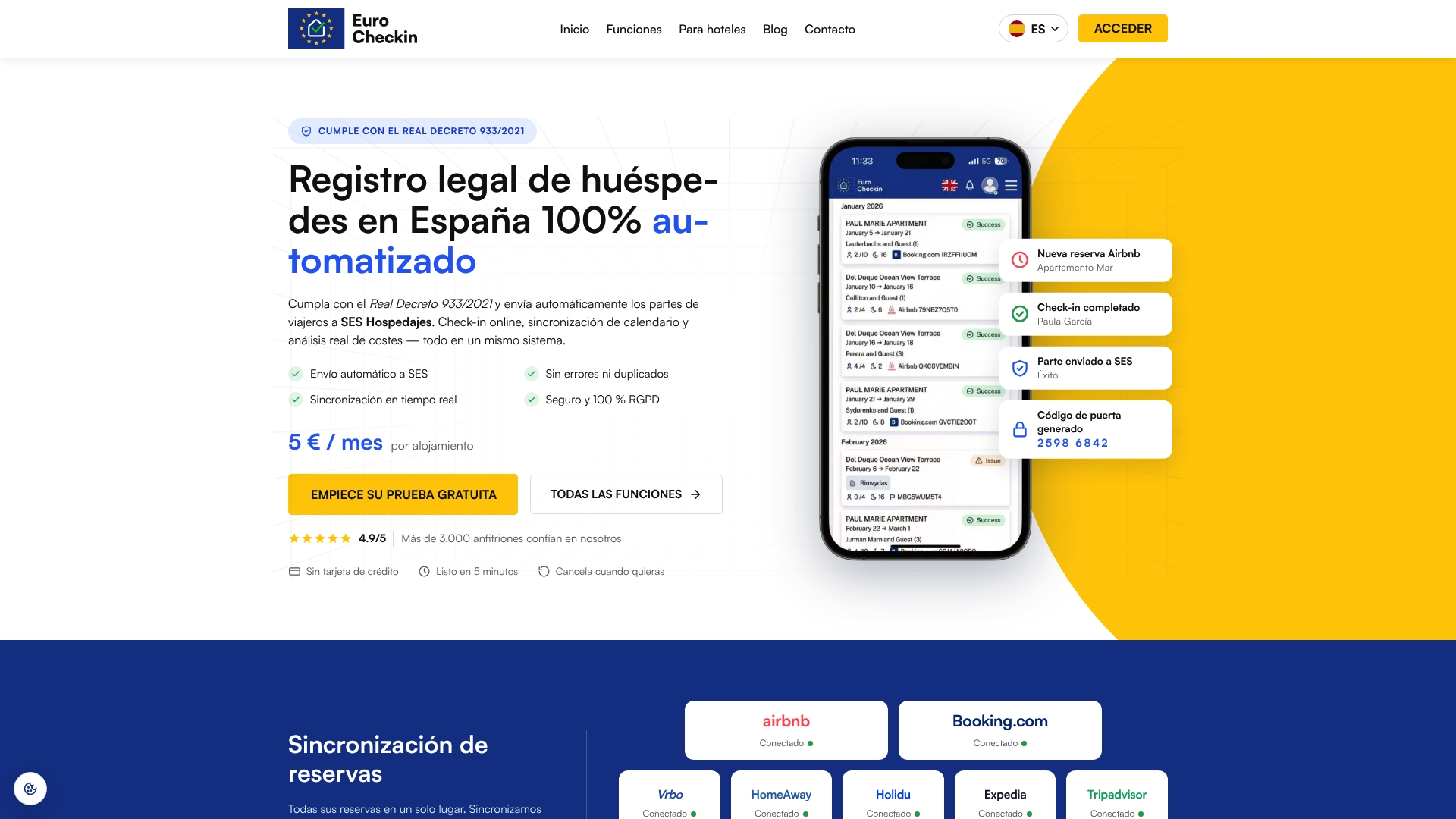
The platform’s check-in online setup for Spain includes smart links built specifically for Vrbo, along with calendar sync across more than a dozen platforms so you never risk a double booking. Pricing runs from $5 per month per property for individual listings, or $3 per month per room for hotels and larger operations, with a free trial to test the registration flow before committing. If you would rather have the SES.HOSPEDAJES setup handled for you entirely, the SES Hospedajes registration service starts at $79 as a one-time fee per property. Start a free trial and run one real booking through the system to see your first automated submission land.
Sources
For the legal text itself, read Real Decreto 933/2021 for the annex fields and retention rules, and Orden INT/321/2021 for digital-signature acceptance. The EDPB compliance guide covers data minimization in plain terms. A full walkthrough of registration obligations lives in this complete traveler registration guide.
- Real Decreto 933/2021 (BOE)
- SES.HOSPEDAJES / Ministry of the Interior
- EDPB guidelines on Article 6(1)(b)
FAQ
What Fields Must a Vrbo Check-In Form Collect?
The form must capture document type and number, full name, nationality, date of birth, habitual residence, contact details, and travel dates, following the annexes in Real Decreto 933/2021. Guests aged 14 and older must also sign the part of entry, either on paper or digitally.
Does a Vrbo Check-In Form Need a Digital Signature?
Yes, for every traveler aged 14 or older, though the signature can be electronic rather than handwritten. Orden INT/321/2021 confirms digital signatures are acceptable as long as they remain compatible with police electronic systems.
How Long Must I Keep Guest Registration Records?
Spanish law requires retaining guest registration records for three years, as set out in Real Decreto 933/2021. Automated platforms handle this retention period without requiring you to manage separate archives.
Can I Submit Guest Data to SES.HOSPEDAJES Automatically?
Yes, once your establishment is registered through SES.HOSPEDAJES with a certificado digital or Cl@ve, you can use the web-service route for automated submissions instead of manual uploads. A platform like EuroCheckin manages this connection and logs every transmission for you.
What Does EuroCheckin Cost for a Vrbo Property?
EuroCheckin for vacation rentals is priced from $5 per month per property, and the hotel-focused plan runs $3 per month per room. Both plans include a free trial period before any payment is required.