
A privacy policy for a rental in Spain is the notice that tells guests who you are, which data you collect, why, who receives it, how long you keep it and how they can exercise their rights. You must give it to guests before or at check-in, in clear language, and it must match what you actually do with the data, including the traveler registration you send to the authorities. This guide explains each block of the policy, step by step, with the legal references that support it.
TL;DR
- Your policy must name the data controller, the purposes, the legal basis, the recipients, any transfers outside the EEA, the retention periods and the guest’s rights.
- Traveler registration data is collected because the law requires it, so it does not need guest consent. Marketing does need consent.
- Do not ask for a copy of the ID card or passport. Collect only the required data through a form.
- Data goes to SES Hospedajes within 24 hours and the electronic register is kept for three years.
- Show the policy in layers: a short notice at check-in, with a link to the full text.
Table of Contents
- Why a rental needs its own privacy policy
- Who needs one: professional hosts and occasional owners
- The seven blocks your privacy policy must contain
- Legal basis: when you need consent and when you don’t
- Do not ask for a copy of the ID or passport
- Sharing data with SES Hospedajes and other recipients
- Delivering the notice: layers, timing and languages
- Retention and security in practice
- Handling guest requests
- Our perspective
- Automate the policy’s promises with EuroCheckin
- Checklist before you publish your policy
- FAQ
- Sources
Why a rental needs its own privacy policy
A generic template copied from a website does not work for a rental. Your processing is specific: guests send identity details through a check-in form, you pass them to a public registry, and you often use several tools (a calendar sync, a check-in platform, a smart lock, a payment service). The policy has to describe that real flow.
The Spanish Ministry of Consumer Affairs lists what any company processing personal data must tell the individual: who the controller is, the purpose, the legal basis, how long data will be kept, whether it is shared with third parties, whether there are international transfers and how to exercise the rights of access, rectification, erasure, opposition, limitation and portability. That list is the skeleton of your policy.
The Spanish data protection agency (AEPD) adds a style requirement. Information must be concise, transparent, intelligible and easily accessible, in clear and simple language, avoiding verbose formulas and generic references to legal texts. Write for a tired traveler reading on a phone, not for a lawyer.

Who needs one: professional hosts and occasional owners
If you take guests’ personal data, you are a data controller under the GDPR, even if you own a single apartment. Whether you are a professional or not changes the registration duties, not your privacy duties.
Royal Decree 933/2021 sets the traveler registration obligations. According to its consolidated text, non-professional providers are exempt from the record-keeping and retention duties. Even so, any data you do gather for your own purposes (contact details, arrival times, invoices) still needs a clear notice. For a full walkthrough of the decree, read our guide to Real Decreto 933/2021 explained for Spanish hosts.
The seven blocks your privacy policy must contain
Use these as headings in your policy. Keep each block to a few sentences.
1. Who is the data controller
Give your legal name or business name, tax ID, postal address and a contact email for privacy matters. If you manage properties for several owners, state clearly who decides the purposes of the processing and who acts on their behalf.
2. Which data you collect and why
List the categories by purpose, not in one long paragraph:
- Traveler registration: the identity and stay details the regulation requires.
- Managing the booking: contact details, arrival time, number of guests, language.
- Payments and invoices: billing details for what the guest pays.
- Communication: messages about the stay, check-in instructions, incidents.
- Optional marketing: newsletters or offers, only if the guest opts in.
The principle behind this list is minimization: collect what you need and nothing more. Our guest data checklist for Spain shows what to collect and what to leave out, and the check-in form questions guide helps you build a form that matches your policy.
3. Legal basis for each purpose
Do not write “consent” for everything. Each purpose has its own basis, explained in the next section.
4. Recipients
Name the categories of recipients: the Spanish authorities through SES Hospedajes, your check-in and calendar software, payment providers, your accountant, cleaning staff who receive arrival details, and any smart lock service that sends access codes. If a tool is hosted outside the European Economic Area, say so and state the safeguard used.
5. Retention periods
State a period for each purpose. For the traveler register, the decree sets three years from the end of the service. The Ministry of Interior confirms that the electronic register is kept for three years from the end of the contracted service. For other purposes, such as marketing contacts or messages, set your own period and write it down.
6. Guest rights
List the rights and how to use them. The AEPD’s citizen guide names access, rectification, opposition, erasure, limitation of processing, portability and the right not to be subject to individualized automated decisions. Give one email address for requests.
7. How to complain
Tell guests they can contact you first and, if they are not satisfied, the AEPD. The agency states that it generally cannot process rights complaints until the person has addressed the controller and the legal response period, one month as a general rule, has passed.
Legal basis: when you need consent and when you don’t
This is the point most templates get wrong.
| Purpose | Usual legal basis | Is consent needed? |
|---|---|---|
| Traveler registration sent to the authorities | Legal obligation | No |
| Managing the booking and the stay | Performance of the contract | No |
| Invoicing and accounting | Legal obligation / contract | No |
| Newsletters and promotions | Consent | Yes |
| Photos of guests for access control | Generally not justified | Not a valid shortcut |
The AEPD’s 2022 statement on tourist accommodation explains that data collected for traveler registration is legitimate under the legal obligation basis (Article 24 of Organic Law 4/2015). In the same case, collecting customer photographs for access control and billing was found to be unnecessary and disproportionate. Do not add extras to the registration just because the technology allows it.
When you do need consent, for example for marketing emails, the AEPD says it must be unambiguous and given by a clear affirmative action. Pre-ticked boxes and silence do not count, while ticking a box on a website does. The same page adds that consent must be free, informed and revocable, that you must be able to prove it at any time, and that the data protection part must be clearly separated from other declarations in a written text.
In practice: leave the marketing box unticked, keep a record of who agreed and when, and include an unsubscribe option in every message.
Do not ask for a copy of the ID or passport
In June 2025 the AEPD stated that requesting a copy of the DNI or passport in accommodation is not allowed. Its reasoning is that a full DNI contains data the regulation does not require, such as the photograph, expiry date, CAN and parents’ names, and that handing over a copy creates an unnecessary risk of identity impersonation.
The agency’s note on guest registration says a form with only the required data can be completed online or in person. For online collection, verification can rely on digital certificates, matching payment-method data or security codes sent to the guest’s phone or email. Any other method must be assessed by you for GDPR compatibility.
Your policy should reflect this. Say that you collect the data through a form, that you do not keep copies of identity documents, and what is verified and how. Our guide to digital identity capture for Spanish accommodation covers the options.
Two details to handle in the form:
- Every guest over fourteen signs the entry report. For children under fourteen, the accompanying adult provides the data, as the Ministry of Interior explains.
- The data must be collected before the service begins, as the AEPD note on RD 933/2021 states.
Sharing data with SES Hospedajes and other recipients
The policy must say that registration data is sent to the Spanish authorities. The deadline matters: Article 6.3 of the decree requires communication immediately and within a maximum of 24 hours from the reservation, contract formalization or cancellation, or the start of the contracted services. A professional association in Galicia notes that a communication at hour 25 would be a minor infringement.
For the registration process itself, see our SES Hospedajes compliance guide.
Other recipients need care too. Every provider that handles guest data on your behalf (check-in software, calendar tools, payment services, smart lock messaging, your accountant) should be covered by a data processing agreement under Article 28 of the GDPR. That agreement should define the purpose, type of data, duration, security measures, sub-processors, help with guests’ rights and the return or deletion of data at the end of the service. Calendars deserve attention because they can expose guest names and phone numbers; read our piece on booking calendar privacy before you share a calendar link.

Delivering the notice: layers, timing and languages
A long policy buried in a footer does not meet the duty to inform. A professional tourism cluster in Galicia explains that the information must be given in layers: basic information at check-in, then the full privacy policy. It must be visible at check-in, in person or online, and available on paper or digitally.
A practical setup:
- First layer (on the check-in form): two or three lines with the controller’s name, the purpose (traveler registration and managing the stay), the legal basis, the recipients (authorities), the rights and a link to the full policy.
- Second layer (the full policy): the seven blocks above, on a web page you can link from the booking confirmation, the check-in form and your digital guide.
- Guest languages: publish the policy in the languages of your main guest markets. A guest who cannot read the notice has not been properly informed.
If you use a QR code guest guide in the property, add a link to the privacy page there as well.
Retention and security in practice
Put a clear deletion routine behind the retention periods you declare.
- Traveler register: keep for three years from the end of the service, then delete. Non-professional providers are exempt from this duty under the decree, so only keep what your own purposes justify.
- Booking messages and contact details: choose a period and apply it consistently.
- Marketing contacts: keep until the guest withdraws consent.
- Identity documents: do not store copies.
For security, limit access to people who need it, use strong passwords and two-step verification, avoid sending guest data over personal messaging apps and prefer tools that host data inside the EU. If a breach happens, you will need to follow your own procedure, so write one down in advance.
Handling guest requests
A guest can ask for a copy of their data, ask you to correct it or ask you to delete it. Set this up before the first request arrives.
- Publish one email address for privacy requests.
- Check the identity of the person in a proportionate way, for example by matching the booking email.
- Reply within one month, the general legal period.
- Keep a log of requests and answers.
The AEPD’s controller guide states that exercising rights must be free of charge, except for manifestly unfounded or excessive requests, where you may charge an administrative fee or refuse to act. The same guide says portability applies only to automated processing based on consent or contract, and only to data the person provided; it does not cover data of third persons.
Note that some data you hold, such as the traveler register, you must keep for the legal period, so an erasure request may not apply to it until that period ends. Explain this in your reply.
Our perspective
We see the same mistake in many rentals: the privacy policy says one thing and the check-in process does another. A policy that promises minimal data, while the guest is asked to upload a passport photo, is a liability, not a protection.
That is why we design EuroCheckin around the form, not the document copy. Our platform is designed to collect the traveler data through a multilingual online check-in, send it to SES Hospedajes automatically and keep the digital register in infrastructure hosted inside the European Union. When the process is automated, the policy becomes simple to write and easy to keep true: one flow, one set of recipients, one retention rule.
Our advice to hosts is to write the policy last, after you have mapped your real data flow. Describe what you do, then make the tools do exactly that.
Sofía Herrera
Automate the policy’s promises with EuroCheckin
A policy only works if your daily process follows it. EuroCheckin is a platform for Spanish hosts, property managers and hotels that handles the online check-in, sends each guest’s data to SES Hospedajes and keeps a digital traveler register, without manual work or duplicate records. The plan for accommodations costs €5 per month per property, and for hotels €3 per month per room, with a free trial. If you prefer us to handle the registration setup, the SES Hospedajes registration service starts from €79 one-off per property.
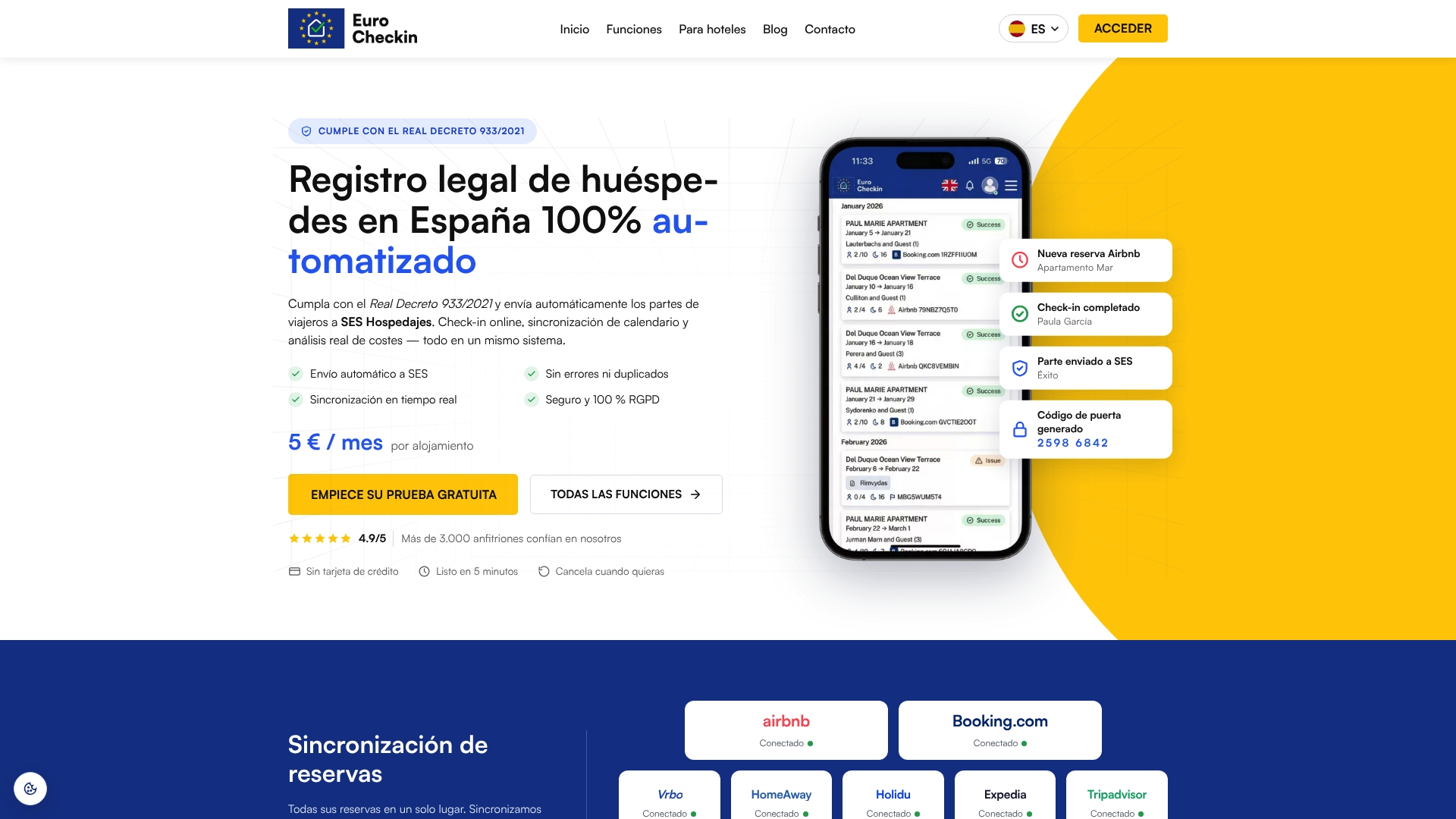
See the EuroCheckin plan for accommodations, the hotel version or the SES Hospedajes registration service.
Checklist before you publish your policy
- Controller name, tax ID, address and privacy email are included.
- Each purpose has its own legal basis.
- Marketing is optional, with an unticked box and an unsubscribe link.
- No copies of the DNI or passport are requested or stored.
- SES Hospedajes and every other recipient category are named.
- Transfers outside the EEA are stated, if any.
- Retention periods are given per purpose.
- Rights and the way to exercise them are explained, with a one-month reply commitment.
- A short first-layer notice appears on the check-in form, with a link to the full text.
- Processing agreements are signed with your providers.
FAQ
Do I need guest consent to register them with SES Hospedajes?
No. The data is collected to comply with a legal obligation, so consent is not the basis. You still must inform guests clearly about the purpose, the recipients and the retention period. Consent is only needed for optional uses such as marketing.
Can I ask guests to send a photo of their passport or ID?
The AEPD says requesting a copy of the DNI or passport in accommodation is not allowed, because it exceeds the data required. Use a form that collects only the data in the regulation, and verify it by a method compatible with the GDPR.
How long must I keep guest data?
Professional providers must keep the electronic traveler register for three years from the end of the service. Other data, such as marketing contacts, should be kept only as long as you have declared in your policy. Non-professional providers are exempt from the register retention duty.
When must guests receive the privacy policy?
Before or at the moment they provide their data, which in practice means at booking confirmation and on the check-in form. Use a short notice at check-in with a link to the full policy, available in digital or paper format.
Sources
- AEPD: how consent must be requested (FAQ-0211)
- AEPD: statement on traveler data in tourist accommodation (2022)
- AEPD: how to comply with the duty to inform (FAQ-0247)
- Ministry of Consumer Affairs: information a company must give
- Clúster Turismo de Galicia: traveler registration FAQ
- BOE: Real Decreto 933/2021, consolidated text
- AEPD: citizen guide
- AEPD: what the agency cannot help with (FAQ-0104)
- AEPD: GDPR guide for controllers
- AEPD: note on guest registration (2025)
- AEPD: press release on ID and passport copies (June 2025)
- Ministry of Interior: entry reports and register obligations