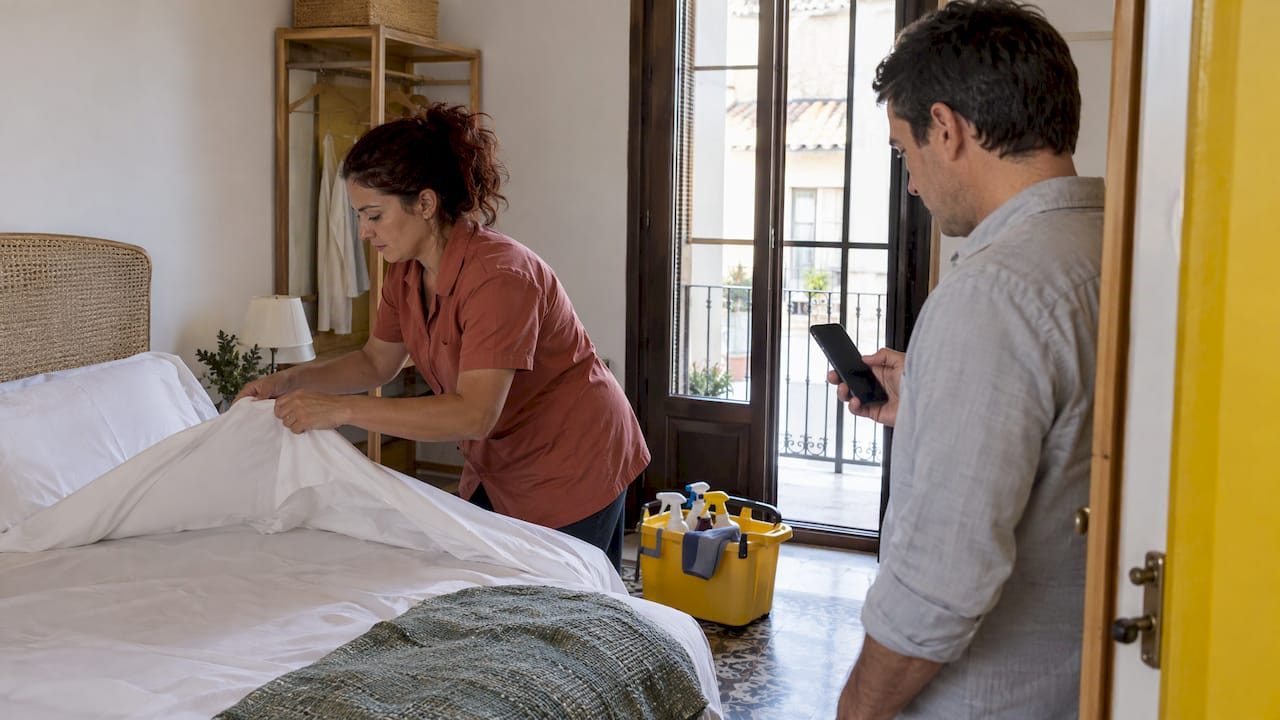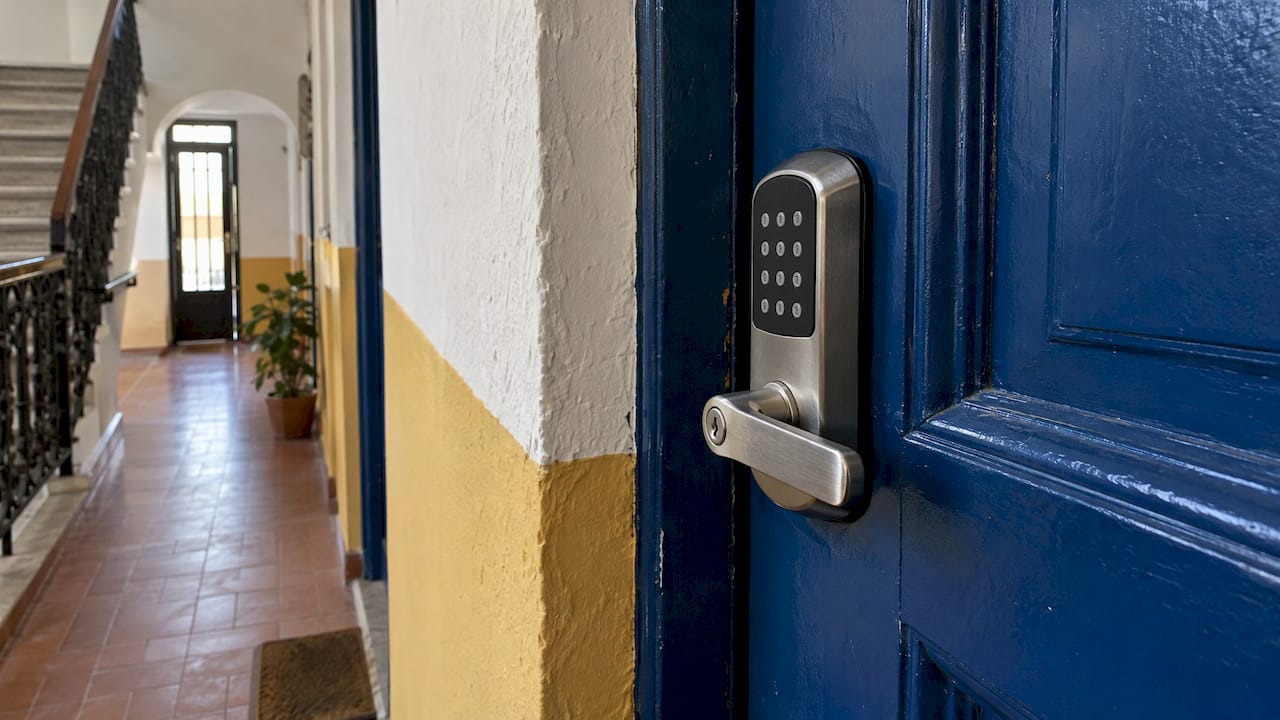
Secure self check-in in a Spanish tourist accommodation rests on four habits. Identify every guest before they arrive. Release the door code only after registration is complete. Collect and store guest data under the rules of both the Interior Ministry and the data protection authority. Keep a record that proves you did it. This guide shows how to set each one up, step by step, so guests can arrive at any hour without you handing over a key or compromising their data.
TL;DR
- Self check-in does not remove your legal duty to identify guests. In Spain, the data in each entry record must match the identity documents guests show or provide.
- Send the access code only after the guest has completed the online registration. Make the code valid only for the dates of the booking.
- Report guest data to SES Hospedajes within 24 hours, and keep the register for three years after the service ends.
- Collect the data the law requires and nothing more. The Spanish data protection authority has fined a hotel for collecting copies of ID documents without justification.
- Choose tools that protect credentials and data, because the data protection authority holds you responsible for the processors you pick.
Table of Contents
- What “secure” means for self check-in in Spain
- The secure sequence: register first, code second
- Identity verification without opening the door to the wrong person
- What data you must collect, report and keep
- Protecting guest data: two regimes, two authorities
- Main security risks and how to reduce them
- Records that show you are compliant
- Perspective: why we link the lock to the registration
- Put it into practice with EuroCheckin
- A short checklist before your next arrival
- FAQ
- Sources
What “secure” means for self check-in in Spain
Security here has two layers, and you need both. The first is physical: only the right person enters, only during the right dates. The second is legal and informational: you know who is in your property, you report it, and you protect what you collected.
The physical layer is usually solved with a code or a mobile-enabled lock that creates a credential valid only for the dates of each reservation, so no keys change hands. According to a guide from a Spanish access control company, you must also solve the street door of the building, respect community rules, and keep identifying guests as Spanish accommodation law requires.
The legal layer is where most hosts get caught out. Nobody greeting the guest at the door does not remove the duty to identify them. That is why the order of events matters more than the lock brand.
The secure sequence: register first, code second
The approach that works is simple: pair the lock with the online registration, and send the code only once the registration is complete. The same guide describes this as the usual approach. Here is how it looks in practice.
- Booking arrives. The reservation comes from Airbnb, Booking, Vrbo or a direct channel.
- Guest receives the check-in link. It should be in their language and work on a phone.
- Every adult completes the form and signs. Their identity document is captured digitally.
- You verify the data. The details must match the document.
- The code is generated for the stay dates. It is released only now.
- Data is reported to SES Hospedajes within the legal deadline.
- The code expires at check-out. No manual cleanup.
If you want to automate step 5, see our guide on how to automate smart lock codes for every booking. EuroCheckin integrates with Nuki, TTLock and Yale locks, so the code can follow the registration status instead of your memory.
What to do when a guest does not complete the form
Do not send the code as a courtesy. A missing registration is a missing legal record and an unidentified person in your property. Send reminders through the booking channel, explain that the form takes a few minutes, and release access only when it is done. The tone matters: present it as the step that unlocks the door, not as paperwork.

Identity verification without opening the door to the wrong person
The key rule is Article 4.3 of Royal Decree 933/2021. It makes accommodation providers responsible for the accuracy of the data in the entry records, so the data must match the documents or systems that prove identity, which users must show or provide. You can read the consolidated text on the BOE website.
In a self check-in, that translates into concrete practice:
- Capture the document type (ID card, passport, residence card) and its number and support number.
- Compare the name and document number typed by the guest with the document image or data.
- Treat a booking made under one name and a form completed under another as a reason to ask, not to ignore.
- Make sure every person who needs to be registered is registered, not only the person who booked.
On who signs: Article 4.2 requires entry records to be signed by everyone over fourteen who uses the accommodation. For children under fourteen, an accompanying adult provides their data, as the BOE text states. A single form completed by the lead booker is therefore not enough for a family or a group of friends.
For a deeper look at capturing documents digitally, read our guide to digital identity capture for Spanish accommodation.
What data you must collect, report and keep
Collecting the right data is itself a security measure. The less you hold, the less can leak. The legal baseline comes from the Royal Decree.
| Obligation | What the rule says | Source |
|---|---|---|
| Deadline to report | Immediately and in any case within 24 hours of the booking or contract (or its cancellation), and from the start of the contracted services | Article 6.3, BOE |
| Traveler data | Full name, sex, ID document and support number, nationality, date of birth, usual residence, phone numbers, email, number of travelers, and family relationship when a minor is involved | Annex I, BOE |
| Transaction data | Includes identification of the payment method | Annex I, BOE |
| Retention | Computer register data kept for three years after the contracted service ends | Article 5.3, BOE |
The Government’s reply in the Senate notes that the mandatory data points went from eleven to thirteen, adding the email address and the payment method identification, according to the Senate record. The decree replaces an older framework based on Decree 1513/1959 and Order INT/1922/2003.
The reporting channel is the SES Hospedajes application. The Interior Ministry activated the new register on Monday 2 December 2024. The Secretary of State for Security is responsible for custody and protection of the data. The register covers hotels, hostels, guesthouses, rural tourism establishments, tourist apartments, campsites and intermediary platforms, among others.
For the full list of fields and what to leave out, use our guest data checklist for Spain. For the reporting workflow itself, see SES Hospedajes compliance for Spanish hosts and our explainer on Royal Decree 933/2021.
Protecting guest data: two regimes, two authorities
Meeting the Interior Ministry’s requirements does not settle your data protection duties. As one Spanish data protection consultancy explains, these are separate regimes with separate authorities and separate penalties: public security under RD 933/2021, and privacy under the GDPR.
Do not collect what you do not need
The Spanish Data Protection Agency (AEPD) fined Posada de Llerena, S.L. €2,000 for infringing Article 5.1.c of the GDPR by collecting copies of customers’ identity documents without justification. It also ordered the practice to stop within three months, according to the AEPD resolution. The lesson for self check-in: capture the data the law lists, and think carefully about whether you need to store document images beyond what your process requires.

Teach guests safe habits
If any guest sends you an ID photocopy by message, the National Police advise sending it in black and white, pixelating the address, date of birth and signature, and writing the reason for sending across the image, as reported by Cadena SER. A secure form removes the need for guests to send documents through chat apps at all, which is a good reason to point everyone to the form instead.
Choose processors that can guarantee security
In its January 2023 breach report, the AEPD states that the data controller must select only processors that can guarantee an adequate level of security and compliance. It adds that hotels should use booking management services that offer adequate security for client data, as the AEPD report says. Ask where data is hosted and how access is controlled. EuroCheckin hosts information on secure infrastructure within the European Union.
Keep calendars and guest lists clean
Shared calendars and synced booking feeds can expose guest names and details to people who should not see them. Our guide on booking calendar privacy in Spain covers what to share and what to hide.
Main security risks and how to reduce them
The AEPD’s January 2023 report documented breach notifications involving compromised hotel credentials on booking management portals. Third parties accessed guests’ personal data and used it for fraud attempts. The agency reminded controllers and processors to apply suitable technical and organizational measures under Article 32 of the GDPR. Those credentials are the weak point, so most of your risk reduction starts there.
| Risk | What goes wrong | Practical measure |
|---|---|---|
| Code sent too early | Someone enters before being identified | Release the code only after registration is complete |
| Code reused | Former guests can still enter | Use codes valid only for the stay dates |
| Weak platform passwords | Third parties reach guest data | Use unique passwords and restrict who has access |
| Excess data stored | A leak exposes more than needed | Collect only the fields required and delete after the retention period |
| Unregistered companions | Persons in the property are not on record | Require each adult to complete and sign |
| Data shared by chat | ID photos remain in personal phones | Direct guests to the secure form |
A risk analysis helps too. A legal compliance firm recommends that accommodation providers assess possible contingencies of their data processing, considering the type of processing, the nature of the data and the number of people affected, and carry out an impact assessment if the risk is especially high, as Legal Global describes. For a small rental, that can start with a one-page list of who can access what.
Records that show you are compliant
Security that cannot be shown is hard to defend. Keep these items for each stay:
- The completed and signed entry record for each guest over fourteen.
- The confirmation that the data was sent to SES Hospedajes, with its date and time.
- The booking date, so you can show you reported within 24 hours.
- The time the access code was issued and when it expired.
- Your data protection documentation: who processes data, where it is hosted, who has access.
The stakes are real. According to Enfoke, failing to keep the register is a serious infringement under Organic Law 4/2015, with fines from €601 to €30,000, while simple irregularities in completing it are minor infringements with fines from €100 to €600. Check the current text of the law before relying on those ranges.
Perspective: why we link the lock to the registration
We built EuroCheckin around one idea: the door should answer to the registration, not the other way round. When a host sends a code first and chases the paperwork later, the legal duty and the physical access drift apart. We prefer to keep them in one flow.
In our platform, the online check-in is unlimited and multilingual, with smart links for Airbnb, Booking and Vrbo, and instant alerts so you can follow every arrival in real time. The guest data goes to SES Hospedajes automatically, without manual work and without duplicate records. The locks we integrate with, Nuki, TTLock and Yale, let the self check-in run autonomously once that data is in place.
We see security and convenience as the same project. A guest who completes a clear form in their own language arrives informed, and a host who does not copy documents between apps holds less data to protect. That is the standard we design for.
Sofía Herrera
Put it into practice with EuroCheckin
If you want this sequence running without manual steps, EuroCheckin for accommodations costs €5 per month per accommodation, and there is a free trial. Hotels can use EuroCheckin for hotels at €3 per month per room. The platform handles the online check-in, digital contracts with e-signature, the digital guest guide and the automatic report to SES Hospedajes.
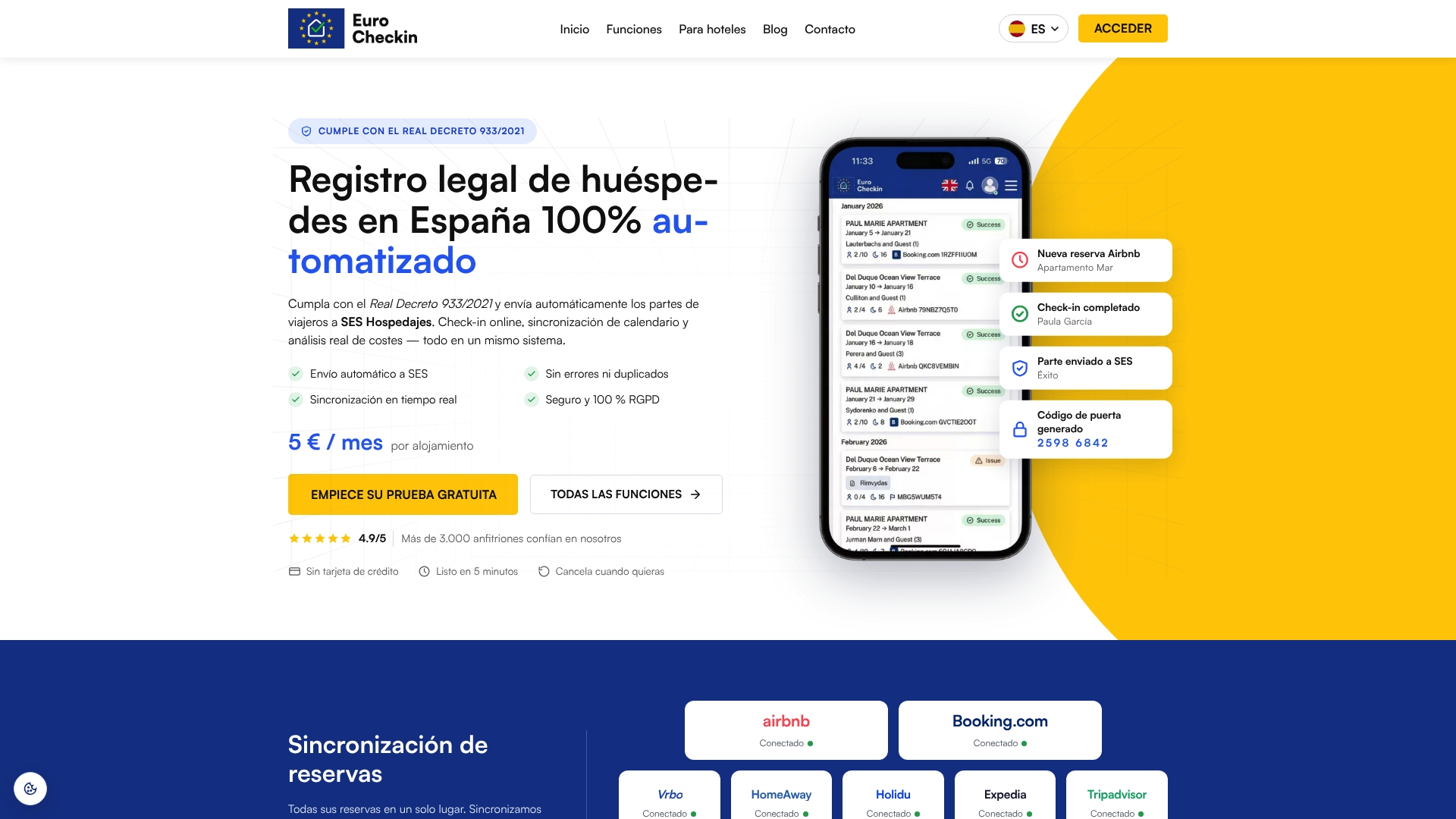
If you would rather have someone set up your SES Hospedajes registration, our SES Hospedajes registration service starts from €79 one-off per accommodation. You can also start with EuroCheckin directly. Prices are those published on our site.
A short checklist before your next arrival
- The check-in form asks for every legally required field and nothing extra. See our check-in form questions guide.
- Every adult guest completes and signs the form.
- You compare the data with the document.
- The code is released only after registration.
- The code is valid only for the stay.
- The report reaches SES Hospedajes within 24 hours.
- Access to your accounts uses unique passwords.
- You know how long you keep data, and who processes it.
FAQ
Is self check-in legal for tourist accommodation in Spain?
Yes, provided you still identify guests and report their data. The obligation under Royal Decree 933/2021 applies whether or not you meet the guest in person. Local tourism rules and community statutes may add conditions, so check those for your property.
When should I send the door code to the guest?
Send it once the guest has completed the online registration. That order keeps the physical access linked to a verified identity. Set the code to work only for the booked dates.
Can I ask guests to send a photo of their ID by email or chat?
It is better to avoid it. A secure form collects the data in one place and keeps documents out of personal inboxes. The AEPD has sanctioned the collection of ID copies without justification, so collect only what the process needs.
How long do I keep guest registration data?
Article 5.3 of Royal Decree 933/2021 sets three years from the end of the contracted service for the computer register data. Afterward, delete it unless another legal obligation applies.
Do I need to report the guest before they arrive?
The rule is to communicate the data immediately and within 24 hours of the booking or contract, and from the start of the services. Collecting the data through an online form before arrival makes that deadline manageable.
Sources
- Self check-in for holiday rentals in Spain
- Real Decreto 933/2021, consolidated text (BOE)
- Interior activates the new accommodation register (Ministerio del Interior)
- Government reply in the Senate on RD 933/2021
- AEPD resolution EXP202301658
- AEPD breach notification report, January 2023
- National Police advice on sending ID copies (Cadena SER)
- Data protection in tourist accommodation (Enfoke)
- Data protection for hotels (Legal Global)