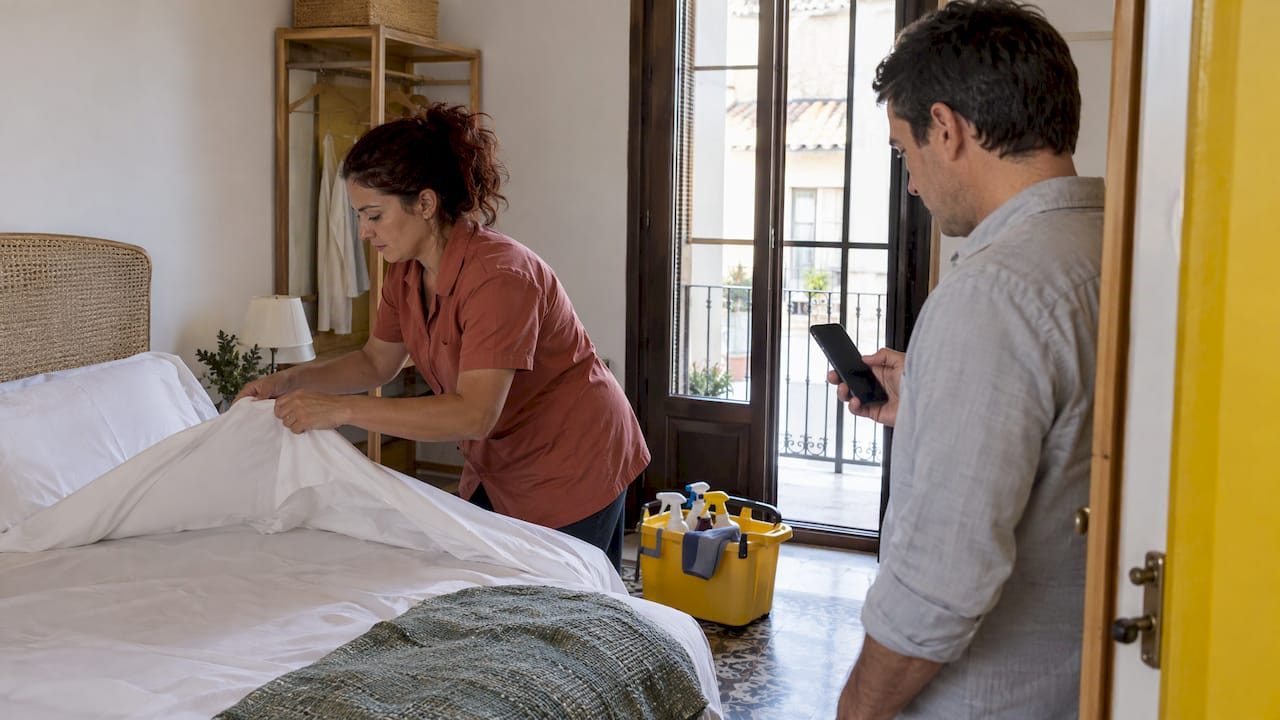



If you are looking for the “Guardia Civil lodging registry,” you are really looking for SES.HOSPEDAJES. This is the Interior Ministry platform that now receives guest and reservation data from every accommodation in Spain. According to the Ministry, the new register is hosted in the SES.HOSPEDAJES application, managed by the Secretaría de Estado de Seguridad. You register yourself and your property there, then send the data of each stay. You do not file separately with the Guardia Civil.
This guide explains what the registry is, who must use it, what you send, how to get access, what happens if you fail to report, and how to automate the work.
TL;DR
- The old Guardia Civil and police reporting routes have been replaced by one Interior Ministry platform, SES.HOSPEDAJES, under Real Decreto 933/2021.
- Professional and non-professional hosts, hotels, hostels, campsites and intermediaries are all covered, with different duties.
- You must register as an operator, register each accommodation, send traveler and reservation data, and keep a computerized register for three years if you are a professional.
- Fines run from €100 to €600 for minor errors and from €601 to €30,000 for serious omissions.
- Software can send the data for you, so you do not retype passports into a web form.
Table of Contents
- What the “Guardia Civil registry” is today
- Who must report guests
- What data you must collect and send
- Deadlines and record keeping
- How to register as an operator, step by step
- Penalties for not reporting
- Do not confuse it with the national rental registry
- A workable routine for hosts and managers
- Our perspective
- Automate the reporting with EuroCheckin
- FAQ
- Sources
What the “Guardia Civil registry” is today
For years, hosts sent traveler forms to the Guardia Civil or the National Police, or kept a paper book. That model is gone. The Interior Ministry describes SES.HOSPEDAJES as a secure application that simplifies processing and integration of information. It replaces the old company record books with electronic communication systems and allows external applications to connect and submit data automatically.
The Guardia Civil and the police still use the information for public security, but you do not choose between them. The platform receives the data once and the security forces access it. If a guide still tells you to fill in a Guardia Civil form or visit an old “Hospederías” page, treat it as outdated and go to the Ministry’s own Hospedajes y Alquiler de Vehículos page.
The legal basis is Real Decreto 933/2021 of 26 October. Its consolidated text on the BOE is the document that defines the obligations, and the communication duties became applicable in 2023. For a plain-language walk through the text, see our Real Decreto 933/2021 explained.
Who must report guests
The Interior Ministry states that all natural or legal persons who carry out accommodation activities in Spain, professionally or not, or who act as intermediaries are obliged under the decree. In practice that includes:
- Hotels, hostels, guest houses and rural tourism establishments.
- Tourist flats and apartments and similar tourist accommodation.
- Campsites and motorhome parking areas.
- Intermediaries and digital booking platforms.
This list comes from the Ministry’s press release of 2 December 2024. The same release says intermediaries and platforms only have to enter the data they collect for their own commercial management, which is mostly data they already communicated to the previous system.
Who is responsible when a platform is involved
If you advertise on a web platform, you do not hand the duty over to it. The Ministry explains that the liable party is the one that holds the direct and final contractual relationship with the client. Each party still transmits the information it holds. For a host or manager, that usually means you are the one who must send the traveler data, even if Airbnb or Booking sent you the booking.
We cover the host side in more detail in Airbnb host registration in Spain.
Professional and non-professional hosts
The duties differ. According to the Ministry’s page on entry forms, non-professional hosts are exempt from the documentary register and data retention duties and are only subject to the communication obligations. The BOE text also provides that communications are made electronically, but non-professional hosts can use non-telematic means through the procedure that is set. If you rent a property regularly, as most hosts and managers do, plan on the professional route.

What data you must collect and send
The Ministry says professional operators must provide the reservation and traveler data listed in annexes I and II of the decree and keep a computerized register with that data. In practice, you collect:
- Identity data of each traveler: name, surname, sex, date of birth, nationality, ID document type and number.
- Contact data and address.
- Reservation data: dates, number of travelers, relationship between them where minors travel, and payment details.
- Details of the accommodation itself.
What counts as a valid identity document and which fields are mandatory are covered in our guest data checklist for Spain and check-in form questions.
Minors and signatures
The Ministry’s page on entry forms states that forms must be signed by everyone over 14 who uses the service, while data on children under 14 is provided by the accompanying adult. The same page says the establishment is responsible for the data matching the identity documents, which guests must show.
That last point matters for online check-in. A guest typing a passport number from memory is a source of errors. Capturing the document image or reading it automatically reduces them. Our guide to digital identity capture explains how this works in a Spanish accommodation.
Deadlines and record keeping
There are three timing rules to separate.
| Obligation | Rule | Source |
|---|---|---|
| Register the accommodation | Within ten days of completing the administrative formalities for the activity, and in any case before it effectively starts | Interior Ministry |
| Send guest data | Electronically through the Ministry’s platform, within the deadline set by the decree (24 hours from the start of the stay) | BOE text |
| Keep the register | Three years from the end of the contracted service | BOE text |
The three-year retention applies to the computerized register with the annex data, including minors under 14 where applicable. Store it securely and be able to produce it if an authority asks.
How to register as an operator, step by step
The procedure sits on the Interior Ministry’s electronic office. Here is the sequence.
- Get your credentials ready. The Ministry says you must register through its electronic procedure using a digital certificate or being registered in Cl@ve.
- Prepare to sign. To sign the registration you use Cl@ve-Firma or Autofirm@ if you have a local certificate, according to the same page.
- Register yourself as an operator. Enter your personal or company data exactly as it appears on your documents.
- Register each accommodation. Professional operators must register themselves and their accommodations before starting the activity, as the Ministry guidance states.
- Obtain the connection data. If you use software to send the data, you will need the accommodation code (the código de arrendador) and the web service user and password generated for that connection. Copy them exactly as shown.
- Connect your software and send a test reservation. Check that the platform returns an acknowledgment.
Our SES Hospedajes compliance guide goes through these credentials in more detail.
Common errors
- Copying the web service password with an extra space or a changed character.
- Registering the operator but forgetting to register the accommodation.
- Using an expired digital certificate when signing.
- Sending data for a guest whose document number does not match the ID.
- Sending the data late because the guest filled in the form after arrival.
Penalties for not reporting
The Ministry’s 2026 FAQ for platform users sets two levels:
| Infringement | Examples | Fine |
|---|---|---|
| Minor | False data, errors in guest data, partial omissions, communicating outside the deadline | €100 to €600 |
| Serious | Not being entered in the register as a provider, or not communicating guest data to the authorities | €601 to €30,000 |
The practical lesson is that late or inaccurate submissions already count. A process that checks data at the moment of check-in and sends it automatically protects you from the minor tier as well as the serious one.
Do not confuse it with the national rental registry
Many pages ranking for this topic mix guest reporting with the short-term rental registration number. They are different obligations. Guest reporting goes to the Interior Ministry. The rental registry came from Real Decreto 1312/2024, in force since 2 January 2025, which created the Ventanilla Única Digital de Arrendamientos. The current BOE text notes that the Registro Único and the registration-number provisions have since been annulled.
What does that mean for you? The change affects your tourist license and listing requirements, but not your guest reporting. Your traveler data duty under Real Decreto 933/2021 stays as it was. Check your regional and municipal tourism rules for the license itself, since they vary by autonomous community.

A workable routine for hosts and managers
A manual process works for one flat and breaks with five. A routine that holds up looks like this:
- Send every guest an online check-in link as soon as the booking arrives.
- Collect the data and document for every adult and the data of minors through the accompanying adult.
- Collect signatures from guests over 14.
- Submit the data to SES.HOSPEDAJES before arrival, not after.
- Keep the register for three years in a secure place.
- Review failed submissions every day.
The same flow can also hold your house rules and contract. Our guidebook for Spain rentals shows what to include so guests arrive informed.
If you are a hotel, the data flow is the same but the volume is higher, and a data incident is a real risk. See our hotel data breach plan.
Our perspective
We built EuroCheckin around one idea: reporting guests should be a by-product of check-in, not a second job.
Most compliance problems we see are not about hosts ignoring the law. They are about data typed twice, credentials copied wrongly, or a guest who completes the form after arriving. When the guest completes an online check-in before the stay, the identity data, the signature and the submission to SES Hospedajes happen in one flow, with no duplicate records.
That is why our platform sends each guest’s data to SES Hospedajes automatically, in line with Real Decreto 933/2021 and GDPR, and keeps the digital traveler register on infrastructure inside the European Union. Check-in is unlimited and multilingual, with smart links for Airbnb, Booking and Vrbo, so a guest from any country can complete it in their own language.
Once compliance runs by itself, the same guest data lets you do more: digital contracts with e-signature, a guest guide, calendar sync across more than 12 platforms, and smart lock integration with Nuki, TTLock and Yale for self check-in. Our aim is that you spend your time on guests, not on forms.
Sofía Herrera
Automate the reporting with EuroCheckin
If you manage one apartment or a whole portfolio, EuroCheckin sends the traveler data for you and keeps your digital register ready. The plan for accommodations costs €5 per month per accommodation, and hotels pay €3 per month per room. You can start with a free trial on the EuroCheckin page for accommodations, or see the hotel plan.
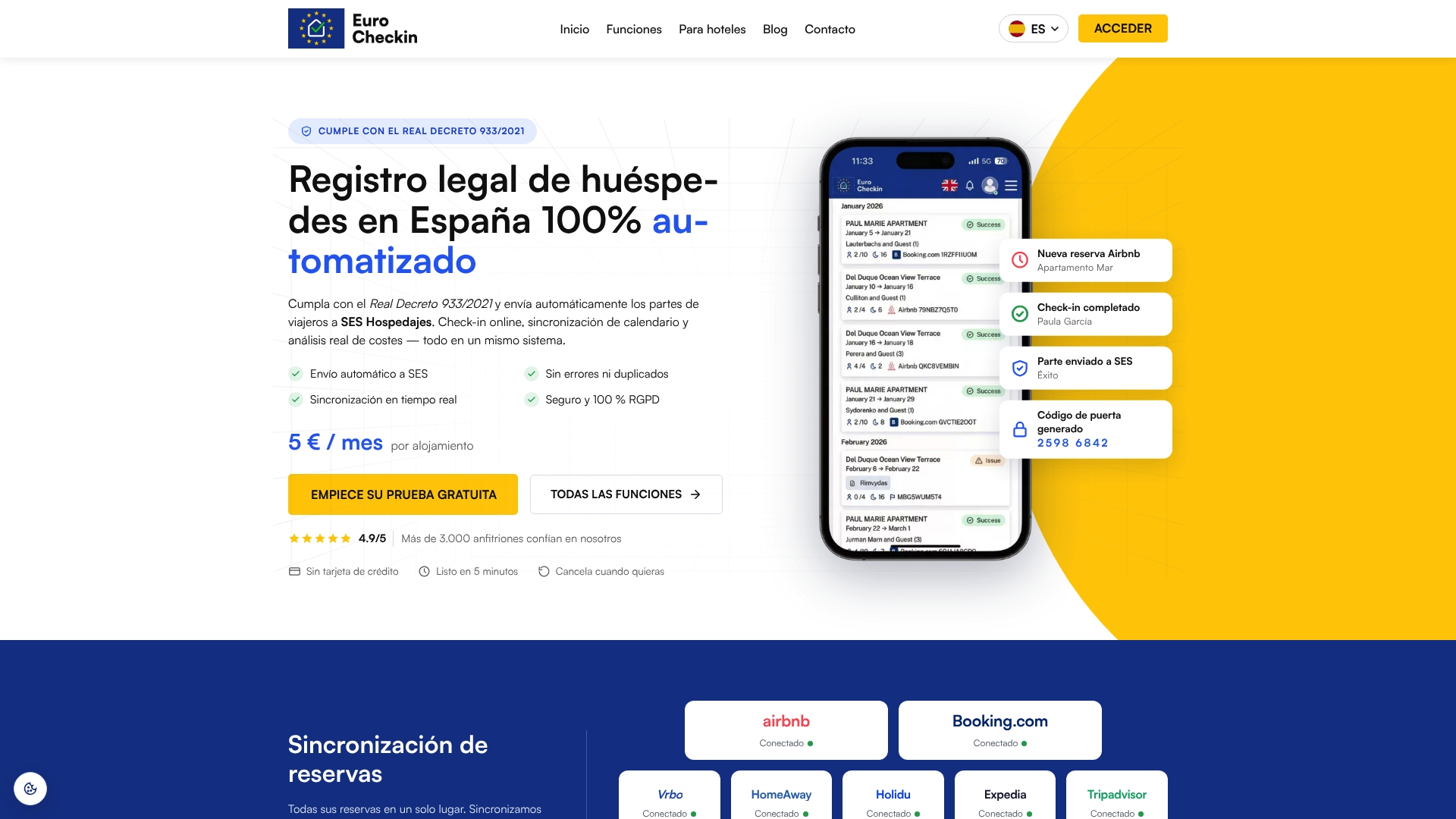
If you would rather not handle the registration steps yourself, our SES Hospedajes registration service is available from €79 one-off per accommodation.
FAQ
Do I still have to report guests to the Guardia Civil directly?
No. Guest and reservation data go to the Interior Ministry’s SES.HOSPEDAJES platform, which replaced the old record books and separate reporting routes. You register as an operator, register each accommodation and send the data there. The security forces access it from the platform.
Does the rule apply to a single Airbnb apartment?
Yes. The Interior Ministry says the obligation covers anyone who carries out accommodation activity, professionally or not. Non-professional hosts have lighter duties, because they are exempt from the documentary register and retention, but they still have to communicate guest data.
How long do I keep guest data?
Professional operators must keep the computerized register for three years from the end of the contracted service, according to the BOE text of Real Decreto 933/2021. Store it securely and delete it once the period ends, in line with data protection rules.
What happens if I send the data with a mistake?
Errors in guest data, partial omissions, false data or late communication are minor infringements, with fines from €100 to €600 according to the Interior Ministry’s FAQ. Checking the document against the data at check-in is the simplest prevention.
Does the annulled national rental registry change my guest reporting?
No. The registration number for rentals and the guest reporting duty are separate. Guest reporting remains governed by Real Decreto 933/2021 and the SES.HOSPEDAJES platform.
Sources
- Interior Ministry: new lodging and vehicle rental register
- La Moncloa: Interior activates the new register (Spanish)
- La Moncloa: Home Affairs activates the new registration
- Interior Ministry: Hospedajes y Alquiler de Vehículos
- Interior Ministry: Hospedajes y Alquiler de Vehículos (main page)
- Interior Ministry: entry forms and documentary register
- BOE: Real Decreto 933/2021 consolidated text
- Interior Ministry electronic office: procedures
- Interior Ministry FAQ for platform users (2026)
- BOE: Real Decreto 1312/2024