

A good guest guidebook for a Spanish rental answers the questions guests ask before they ask them: how to get in, how to connect to Wi-Fi, which rules apply, who to call in an emergency and where to eat nearby. In Spain it also has a second job. It is the natural place to explain the traveler registration that every guest must complete before arrival. This guide shows what to put in, in what order, and how to keep it accurate.
TL;DR
- Put arrival, Wi-Fi, house rules, appliance help and emergency contacts on the first screens. Local tips come after.
- Explain the guest registration step in the guidebook. Spanish law requires traveler data to be communicated within 24 hours of the reservation or start of service.
- Do not ask guests to send photos of their IDs by message. The data protection authority (AEPD) asks operators to minimize data.
- Make it digital, multilingual and easy to update before each season.
- Check your region’s rules. Licensing and operating conditions differ between autonomous communities and municipalities.
Table of Contents
- What a guest guidebook is for in a Spanish rental
- The essentials every guidebook needs
- Legal details to include in a Spain guidebook
- Explaining guest registration (Real Decreto 933/2021)
- Which questions to answer before guests ask
- Make it digital, multilingual and easy to reach
- Keep the guidebook accurate all year
- Add services your guests actually want
- Our perspective
- Put it all in one place with EuroCheckin
- A simple template to start your guidebook
- Common mistakes to avoid
- FAQ
- Sources
What a guest guidebook is for in a Spanish rental
A guidebook is the single place where a guest finds everything about your property and the stay. Done well, it replaces dozens of repetitive messages and calls, and it sets expectations about the rules before they become a problem.
In Spain, hosts have an extra reason to take it seriously. Guests arrive from many countries and speak many languages. They also have to go through a legal registration step that most of them have never seen at home. The guidebook is where you explain that step calmly, in their language, before they stand at the door with a suitcase.
Think of it as three layers:
- Getting in and settling in. What the guest needs in the first 30 minutes.
- Living in the property. Rules, appliances, waste, quiet hours, checkout.
- The destination. What to do, eat and see, and how to get around.
Keep that order. Guests read the first layer carefully, the second when something is unclear, and the third when they plan the day.
The essentials every guidebook needs
Arrival and check-in
Start with the facts a guest needs when they land or park outside:
- Full address with a map pin and a short note on parking or the nearest public transport stop.
- Check-in and check-out times.
- How access works: key box, keypad code, smart lock or a person who meets them.
- What to do if they arrive late or the door does not open, with a phone number that is answered.
If you use smart locks, say exactly when the code becomes active and how it is delivered. Our guide on automating smart lock codes for every booking explains how to send a unique code per stay so you never reuse or retype one.
Wi-Fi and everyday equipment
Give the network name and password in a format that can be copied, not only read. Then cover the items that cause the most questions:
- Air conditioning and heating: how to switch between modes, and what the remote’s symbols mean.
- Hot water: where the switch is, how long it takes to heat.
- Oven, induction hob, washing machine, dishwasher.
- TV and streaming accounts.
- Where spare linen, towels and cleaning supplies are.
A 20-second photo or video of each appliance is more useful than a paragraph of text. Guests who can see which button to press do not need to write to you.
House rules
Write rules as plain statements with a short reason. “Quiet hours are 10 p.m. to 8 a.m. because the building is residential” gets better compliance than a bare prohibition. Typical items for Spain:
- Quiet hours and terrace use.
- Maximum number of guests and visitors.
- Smoking policy.
- Recycling: which bins, where they are, what goes in each.
- Checkout routine: keys, windows, air conditioning off, trash.
If you use digital contracts with house rules and e-signature, mention in the guidebook that guests will receive them before arrival, so there are no surprises.
Emergency and practical contacts
List the emergency number, the nearest hospital or health center, a 24-hour pharmacy and your own contact. Add the address written in Spanish, so a guest can read it aloud to a taxi driver or emergency operator.
Local recommendations
Keep this section short and personal. Five restaurants you would actually send a friend to beat fifty from a listing site. Include the closest supermarket and its hours, how to get to the beach, old town or train station, and one or two things that are not in every travel guide.
Legal details to include in a Spain guidebook
This is where a Spanish guidebook differs from a generic welcome book. We recommend including the following. They are our recommendations for a clear, professional guide, not a replacement for the rules of your region.
- Property identification. The accommodation name, address and your tourist license or registration number, as your region requires it. Guests and inspectors both find it reassuring.
- Contact for complaints. Tell guests how to reach you first, and where official complaint channels are available under your region’s rules.
- A short explanation of traveler registration. See the next section.
Regional rules differ. Tourist rental regulation is set by each autonomous community, and municipalities can add their own limits on top. Check the tourism department of your region and your town hall for the current requirements before you publish anything about licenses. If you are also reviewing your obligations as a host, our overview of what to register as an Airbnb host in Spain is a good next step.
Explaining guest registration (Real Decreto 933/2021)
Since the rules under Real Decreto 933/2021, anyone who provides accommodation in Spain has duties to communicate traveler data. The official text in the BOE covers natural and legal persons offering accommodation, professionally or not, as well as intermediaries. The key points for your guidebook:
- Timing. Traveler data must be communicated immediately and within 24 hours of the reservation, contract or start of the service, according to the same decree.
- Who is included. The registration covers guests over 14. For younger travelers, the accompanying adult provides the information.
- Retention. Professional providers must keep the data for three years after the service ends. Non-professional providers are exempt from that retention duty.
- Penalties. The Ministry of the Interior states that failing to register or communicate guest data can bring fines of €601 to €30,000, while errors, omissions or late reports can bring fines of €100 to €600.
- System. Data goes to SES.Hospedajes, the Ministry’s platform, which was updated in December 2024 to cover new business models enabled by digital technology.
For the guidebook, you do not need to quote the decree. Write two or three sentences a guest can understand:
Spanish law requires every accommodation to register its guests. Please complete the online check-in form before you arrive. It takes about five minutes, and you will need your passport or ID.
For a deeper explanation of the rule and your duties, read Real Decreto 933/2021 explained and SES Hospedajes compliance for Spanish hosts.
What not to ask guests to do
Privacy rules apply to the registration step too. In its note on the hospitality registry, the AEPD says operators must apply data minimization and should not request copies of guest IDs. For in-person collection, the agency says identity can be checked visually against the document.
The risk is real. The AEPD fined a guesthouse €2,000 for excessively collecting copies of guests’ identity documents. So your guidebook should never say “send us a photo of your passport by WhatsApp”. Point guests to a secure form instead, and tell them what you collect and why. Our guides on the guest data checklist for Spain and digital identity capture go through what to collect and what to leave out.

Which questions to answer before guests ask
Most messages hosts receive fall into the same dozen groups. Use them as a checklist when you write.
| Guest question | Where to answer it in the guidebook |
|---|---|
| How do I get in? | Arrival section, first screen |
| What is the Wi-Fi password? | Wi-Fi section, copyable text |
| Do I need to register or send my ID? | Registration explanation, with the link to the form |
| How does the air conditioning work? | Appliance section, with photo or video |
| Where do I put the trash? | House rules, recycling |
| Can I check in early or leave late? | Check-in and check-out times, plus your policy |
| Who do I call in an emergency? | Contacts section |
| Where do I eat nearby? | Local recommendations |
If your form asks guests for details, keep it short. We cover the exact fields in check-in form questions for guests in Spain.
Make it digital, multilingual and easy to reach
A PDF in a folder is better than nothing, but a digital guide wins for three reasons.
- Language. Guests in Spain come from everywhere. A guide that switches to the guest’s language removes most misunderstandings.
- Updates. When a restaurant closes or a door code policy changes, you edit once and every guest sees it.
- Access. A link sent with the booking confirmation, or a QR code inside the property, puts the guide on the phone in seconds.
A QR code at the entrance and one in the kitchen covers most situations. We explain the setup in how to set up a QR code guest guide for a Spanish rental.
Send it at the right moments
Timing matters as much as content. A workable sequence:
- At booking: a message with the check-in form link and the legal reminder.
- Three to five days before arrival: the guide link, so guests can plan the trip from the airport.
- On the day: access instructions and the code, once registration is complete.
- The day before checkout: a short checkout reminder and a review request.
The last step is worth planning. If your guests feel the stay was organized, they are more likely to leave a good review. See why busy managers should prioritize Booking.com reviews.
Keep the guidebook accurate all year
An outdated guide is worse than a short one. A wrong door code or a closed restaurant creates the very messages you wanted to avoid. Build a routine:
- Before each season, reread the whole guide as if you were a guest. Update opening hours, seasonal tips, events and transport changes.
- After every change in the property (new appliance, new router, changed bin location), update the matching page the same day.
- After every complaint or repeated question, add the answer. Your inbox is the best editor you have.
- Once a year, check the legal sections against your region’s current tourism rules and the Ministry of the Interior’s page on hospitality registration.
Assign one person, even if it is you, as the owner of the guide, and write the date of the last review in your own notes.
Add services your guests actually want
The guidebook is also a quiet sales channel. If you offer extras such as early check-in, airport transfers, a welcome basket or late checkout, mention them where they help the guest, not in a banner at the top. Guests who read the arrival section are the ones planning their first day, so that is where a transfer offer fits.
For ideas on what sells and when, see our guides on selling guest add-ons at your Spanish rental and what to upsell to guests in Spain.
Our perspective
Most hosts we talk to treat the guidebook, the registration form and the access instructions as three separate jobs. Guests do not. To them it is one arrival experience, and the legal step is the part most likely to cause friction if it is explained badly.
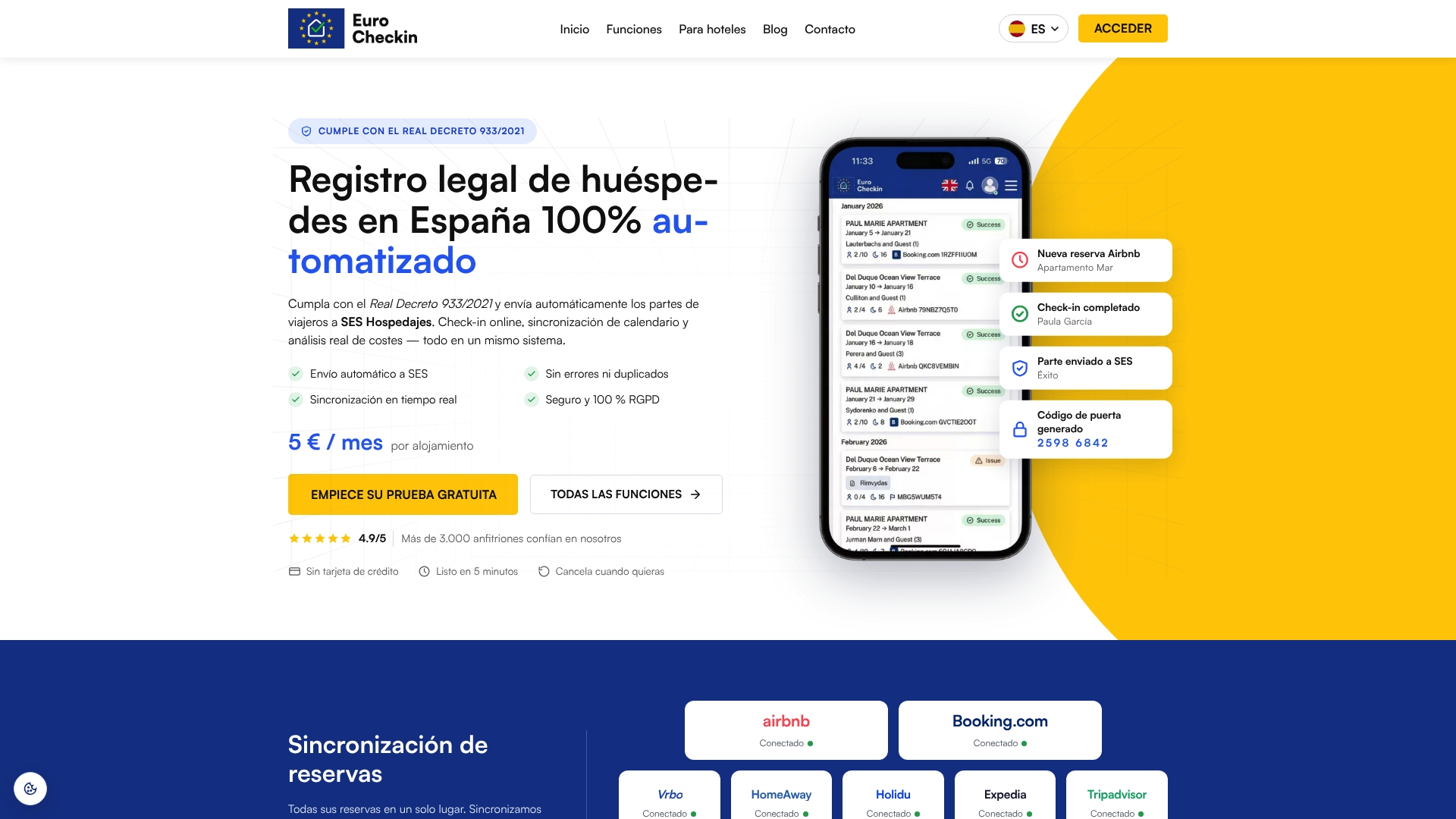
We believe the guidebook should lead the guest into registration, not hide it. A clear message in the guest’s language, a short form that works on a phone, and an automatic communication to SES Hospedajes mean the legal step is done before the guest reaches the door. That is why we built check-in, the guest guide, digital contracts and smart lock integrations into one platform, so the code a guest receives and the data you report come from the same record.
Our advice is simple: write the guide once, keep it short at the top, and let software handle the repetitive parts, such as collecting data, sending it and delivering the right access at the right time. Your time is better spent on the property and on the guests.
Sofía Herrera
Put it all in one place with EuroCheckin
If you manage one apartment or a portfolio, EuroCheckin brings the guest guide, multilingual online check-in, digital contracts and automatic reporting to SES Hospedajes into one platform. The plan for accommodations costs €5 per month per accommodation, hotels pay €3 per month per room, and you can start with a free trial. If you prefer help with the initial setup, the SES Hospedajes registration service is available from €79 one-off per accommodation.
See the plan for accommodations, the hotel plan or the SES Hospedajes registration service.
A simple template to start your guidebook
Use this outline and fill in each point for your property. It works as a one-page version or as the structure of a digital guide.
- Welcome. Two lines in the guest’s language, with your name.
- Before you arrive. Online check-in link, why registration is required, how long it takes.
- Arrival. Address, map, parking, access method, check-in time, late arrival plan.
- Inside the property. Wi-Fi, climate control, hot water, kitchen, laundry, TV.
- House rules. Quiet hours, guest limit, smoking, recycling, terrace.
- Contacts. Your number, emergency number, hospital, pharmacy.
- The neighborhood. Supermarket, five places to eat, transport, beach or main sights.
- Departure. Checkout time, checklist, key return.
- Extras. Services you offer and how to book them.
Write each point in short sentences. Use bold for the one thing a guest must not miss, such as the code activation time or the registration form.
Common mistakes to avoid
- Burying the registration step. If guests discover it at the door, you lose time and goodwill.
- Asking for ID photos by chat. It runs against the AEPD’s data minimization guidance and leaves sensitive data in message threads.
- Writing only in one language. Offer at least Spanish and English, and add the languages of your main guest markets.
- Leaving old information in place. Door codes, prices and opening hours go stale quickly.
- Copying another host’s legal text. Rules differ by region and municipality, so use the wording your own region requires.
- Making it too long. Put the essentials first and let the rest be searchable.
FAQ
Is a guest guidebook mandatory for rentals in Spain?
No national rule requires a guidebook as such, but your region may set information duties for tourist accommodation. Check your autonomous community’s tourism rules and your municipality. Even where it is not required, a guide is the easiest way to deliver rules, contacts and registration instructions consistently.
Do I need to explain guest registration in the guidebook?
Yes, we recommend it. Spanish law requires traveler data to be communicated within 24 hours of the reservation or start of the service, so guests need to know early that they must complete a form. A short note in the guide, with a link to the form, prevents delays at check-in.
Should I ask guests to send a copy of their passport?
No. The AEPD asks operators to minimize the data they collect and not to request copies of guest IDs. Use a secure online check-in form that collects the required fields, and check the document visually if you meet guests in person.
How often should I update the guidebook?
Review it at least before each season and whenever something changes in the property, such as a new appliance or door code. Add answers to any question guests ask twice. Once a year, check the legal sections against your region’s current rules.
Can a digital guide replace a printed one?
In most cases, yes. A digital guide can be translated, updated in minutes and opened from a QR code. Many hosts keep a one-page printed summary with the Wi-Fi password and emergency numbers by the entrance as a backup.
Sources
- Real Decreto 933/2021, BOE núm. 257 (2021)
- Ministerio del Interior: Hospedajes y alquiler de vehículos
- Ministerio del Interior: nuevo registro de hospedaje y alquiler de vehículos
- AEPD: nota sobre el registro de hospedajes
- AEPD: resolución del expediente EXP202301658