Check-in fraud is stopped in three places: before the guest arrives, at the moment identity data is collected, and around the links, codes and accounts that open the door. In Spain, the third layer sits on top of a legal duty: you must collect the traveler data that Real Decreto 933/2021 prescribes and answer for its accuracy. A routine that automates the registration and keeps every guest’s data in one place makes each of those checks easier to run. This guide gives you the warning signs, the verification rules and a short routine you can adopt this week.
TL;DR
- Most fraud shows itself between booking and arrival, so review risky reservations in that window, not at the door.
- In Spain you are responsible for the accuracy of the registration data, but you should not ask for a full copy of the ID or passport.
- Unattended self check-in needs a way to authenticate the data submitted, not just a stored photo.
- Protect check-in links, smart lock codes and staff accounts with individual access and activity logs.
- Write a short procedure, record neutral facts for every incident and review it regularly.
Table of Contents
- What check-in fraud looks like in self check-in
- Spot suspicious bookings before the guest arrives
- Verify identity without breaking Spanish data rules
- Secure links, codes and accounts
- What to do when you suspect fraud
- Build a routine you can repeat
- Where EuroCheckin fits
- Our view on fraud and self check-in
- FAQ
- Sources
What check-in fraud looks like in self check-in
“Check-in fraud” covers several different problems that meet at the same moment: the guest’s arrival. Naming them separately helps, because each one is stopped by a different check.
Fake reservations. Booking.com for Partners describes fraudulent bookings as reservations made with no intention to stay or to pay. Some are used to collect marketing rewards, and some are a way to deliver phishing messages to the property.
Stolen payment details. A booking paid with a card that belongs to someone else usually surfaces weeks later as a chargeback, after the guest has already stayed.
Identity misuse. Someone checks in with another person’s data, or the person who registered is not the person sleeping in the unit. In Spain this matters twice: it is a security problem and a registration accuracy problem.
Impersonation of your property. Attackers write to your guests pretending to be you, and push them to “confirm” a booking or pay again through a fake link. Spain’s cybersecurity institute, INCIBE, has published a warning about hotels being impersonated over WhatsApp and other channels. The attackers exploit urgency before any physical arrival takes place.
Misuse of access. A forwarded check-in link, a code that stays active after checkout or a shared staff login lets people in who were never booked.

Self check-in does not create these risks. It moves the moment of verification from a reception desk to a form and a lock, so the verification has to be designed instead of improvised.
Spot suspicious bookings before the guest arrives
The gap between booking and check-in is your best defense. Booking.com notes that this time lets you flag suspicious reservations before any service is delivered. Use it.
Booking.com’s list of warning signs for partners includes:
- invalid card details
- last-minute bookings
- overlapping reservations
- several bookings in rapid succession
- an unusually high number of rooms
- unusually long stays
- sudden changes to a booking
- links supplied by the guest
- requests to move the conversation off the platform
Payments specialist Stripe adds a second set of signals in its travel fraud guide: a mismatch between billing address and IP location, several rooms under one name, and newly created accounts attached to high-value reservations. It recommends real-time risk scoring, travel-specific rules and a manual review queue, with decisions made before the guest’s arrival window.
For a host with three apartments, a risk score engine is overkill. A simple rule is enough: any reservation with two or more of the signals above goes into a manual review before the check-in link is sent. For a hotel with many rooms, the same logic applies to group bookings and long stays.
Watch the channel, not just the booking
The single most useful signal is a request to leave the booking platform. A guest who asks you to continue by WhatsApp, to pay by bank transfer or to click a link they send you is asking you to remove the protections the platform gives you. Keep the conversation inside the platform until the reservation is verified.
The reverse also holds. Tell your own guests, in your confirmation message, which channel you will use and that you will never ask for card details by chat. INCIBE advises guests to verify hotel messages through independently obtained official contact details, check the domain of any link and distrust urgent requests for credentials or payment data. If your messages are consistent, an impersonator stands out.
Handle the card on the reservation
Booking.com advises partners, where policy permits, to pre-authorize the card linked to the reservation, to report invalid cards through the Extranet, to require the card that was charged to be presented on arrival and to keep reservation statuses up to date. In a self check-in setting there is no desk to present a card at, so the pre-authorization and the status hygiene carry more weight.
Verify identity without breaking Spanish data rules
This is where Spanish hosts most often go wrong, in both directions: they collect too little to know who is in the property, or too much and create a privacy problem.
What the law asks you to collect
The Spanish data protection agency (AEPD) explains in its note on the accommodation register that RD 933/2021 requires you to collect the prescribed traveler data before the service begins. The form can be completed online or in person. The same note says operators should collect only the data the decree requires.
For the exact list, see our guest data checklist for Spain and our explanation of Real Decreto 933/2021. For the questions on the form itself, see check-in form questions for guests in Spain.
No full copy of the ID or passport
The AEPD states that operators should not request a complete copy of a national ID or passport. Doing so goes against GDPR data minimization and creates an unnecessary risk of identity theft. The guidance compiled by the Clúster Turismo de Galicia says the same in practical terms: you may require the document to be shown, but you may not make a copy.
That shapes your fraud routine. You cannot stockpile document photos as your safety net, and you should not want to, because every stored image is also a data breach waiting to happen. If you need a plan for that scenario, our hotel data breach plan walks through it for Spain.
You answer for accuracy, so authenticate
The Spanish Senate material on the subject records that under article 4.3 of RD 933/2021 the establishment is responsible for the accuracy of the registration data and must make sure it matches the documents or systems that evidence the user’s identity. The same material says the decree does not require document scanning, and that you may choose your own collection and checking method as long as you meet your transparency and information duties.
The AEPD adds a distinction that matters for self check-in. In person, you visually compare the data supplied with the document the guest shows you. For unattended online collection, you should use an authentication method, such as a certificate, a match with payment data or a security code, and assess whether it is compatible with GDPR. The AEPD’s reasoning also means a document image alone does not reliably prove that the person using the accommodation is the document holder. Authenticate the data submitted, rather than treating a stored picture as proof.
The Galician guidance puts it plainly: remote collection requires a system that verifies the accuracy of the data. Our guide to digital identity capture for Spanish accommodation covers this in more detail.
Tell guests what you do with their data
The same Galician guidance says privacy information under GDPR articles 13 and 14 and Spain’s LOPDGDD should be given in layers. A short, visible notice appears during check-in, whether online or in person, and the full detail sits in the privacy policy. A clear notice also builds guest trust, and guests who trust the form complete it faster.
Report within the deadline
The Galician guidance also states that traveler and transaction data under Annex I of RD 933/2021 must be communicated immediately and no later than 24 hours from the reservation, cancellation or start of the contracted service, depending on the event. Fraud prevention and registration meet here: a booking you cancel for suspected fraud is also an event you may need to handle correctly in the register. Our SES Hospedajes compliance guide explains the reporting side.
Secure links, codes and accounts
A guest who passes every check can still be followed by someone who did not. Access control is the last layer.
Check-in links. Treat a check-in link as a credential. Send it only to the contact details on the reservation, and only after any review is complete. If a guest says the link was shared with a friend, issue a new one.
Door codes. A code that is valid only for the length of the stay removes the risk of old codes opening the door. Our guide on how to automate smart lock codes for every booking explains the approach.
Staff and manager accounts. The US National Institute of Standards and Technology’s reference design for securing property management systems uses role-based access control, limits access to users with a business need and audits system activity. It also recommends least-privilege permissions, authenticated users and activity logging. For a small operator, that translates to one login per person, no shared passwords, and permissions that match the job. A cleaner needs the cleaning schedule, not the guest list.
Physical and operational habits. UKHospitality’s guest security checklist recommends defined self-check-kiosk procedures, identity verification, controlled replacement-card processes, regular review of unusual access requests, accurate occupancy records and a log of replacement-key activity. It also advises individual, role-appropriate staff access, discreet handling of room numbers, never confirming whether a named person is staying, restricted operational documents and regular audits of master keys and security equipment. The guidance is written for the UK, but each of these habits applies equally to a Spanish hostel or apartment building.
What to do when you suspect fraud
A clear sequence keeps you calm and keeps your records clean.
- Pause. Hold any non-standard change, such as a date change, an upgrade or a new payment method, until you have checked it.
- Compare the facts. Check the name, the card, the country, the booking channel, the timing and the guest’s messages against the signals listed earlier.
- Verify through a known channel. Contact the guest using the phone number or email on the original reservation, or through the booking platform, never through contact details supplied later in the conversation.
- Escalate. If you cannot confirm the identity, the decision to cancel belongs to the owner or manager, not to whoever is answering messages.
- Cancel and refund if needed. If identity cannot be verified, cancel the reservation, refund the card on file and note the reason. If the booking came through a platform, report it there; Booking.com provides a reporting route in its partner help pages.
- At the door. If someone arrives and the check fails, decline access, and contact the police if the situation warrants it.
- Preserve evidence. INCIBE recommends keeping screenshots, sender numbers, fraudulent links and proof of payment, and reporting the incident to Spain’s law-enforcement authorities.
- Write it down. Record neutral facts: dates, times, what was seen and who handled it. Leave out opinions about the guest.
Build a routine you can repeat
A one-off policy decays. UKHospitality treats guest security as a discipline of continuous improvement: review incidents, near misses, unusual access requests and replacement-key patterns on a schedule. A short procedure that anyone on your team can follow does the same job.
| Stage | Check | Record |
|---|---|---|
| Booking received | Warning signs, channel, card status | Reviewed yes or no |
| Before arrival | Verify via original contact details, send check-in link | Date of contact |
| Check-in form | Prescribed data only, authenticated, privacy notice shown | Completed form |
| Access | Code or key active only for the stay | Code validity dates |
| Registration | Data sent within the legal deadline | Submission confirmation |
| Monthly review | Incidents, near misses, odd access requests | Short review note |
A month of entries in this table tells you which channel produces your problem bookings and which check catches them. That is the evidence you need to adjust the rules.
Where EuroCheckin fits
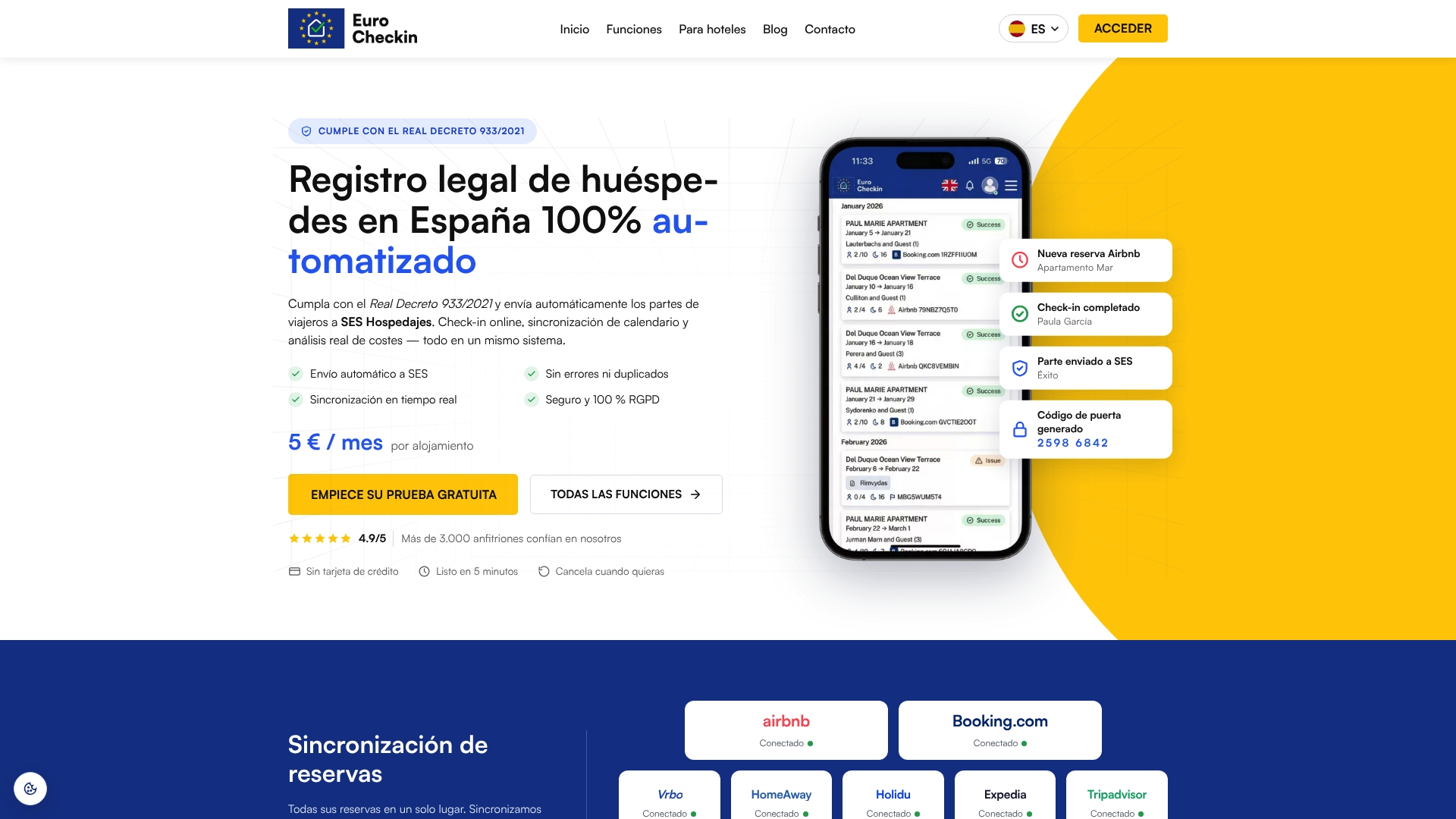
The routine above has a lot of repeated manual steps: collecting data, translating forms, registering travelers, watching arrivals and managing codes. EuroCheckin is a digital platform that automates the traveler registration for Spanish properties. It sends each guest’s data to SES Hospedajes automatically, in line with Real Decreto 933/2021 and the GDPR, without manual work or duplicate records. Its traveler register is fully digital, and the information is hosted on secure infrastructure within the European Union.
The online check-in is unlimited and multilingual, with smart links for Airbnb, Booking and Vrbo, and instant notices let you follow each arrival in real time. Digital contracts with e-signature and house rules, and integration with TTLock, Nuki and Yale smart locks, support a fully autonomous self check-in. Pricing starts at €5 per month per accommodation for apartments and holiday rentals, and €3 per month per room for hotels, with a free trial. If you would rather hand over the SES Hospedajes registration itself, the registration service starts from a €79 one-off fee per accommodation.
Our view on fraud and self check-in
The most common mistake we see in the market is treating fraud prevention and legal registration as two separate jobs. They are the same job. Spanish law already asks you to collect specific data, to be responsible for its accuracy and to report it within a short deadline. A host who has a clean, complete and timely record of every guest has already done most of what fraud prevention requires.
That is why our platform is designed around one flow: a multilingual check-in form, automatic submission to SES Hospedajes, a digital register that is hosted within the EU, and instant notices when a guest completes the process. Fewer manual steps means fewer places for a mistake, a duplicate or a forgotten registration.
Self check-in also works best when the key, the contract and the guest information live in the same place. With smart lock integration for TTLock, Nuki and Yale, digital contracts with e-signature and a digital guest guide, you control the arrival from your phone, in any language your guest speaks.
Our advice: write your short procedure, keep your records neutral and let automation handle the repetitive parts, so your attention goes to the bookings that actually look strange.
Sofía Herrera
FAQ
Is self check-in more exposed to fraud than a reception desk?
Not by nature, but it needs its checks designed in. At a desk, a person compares the guest with the document. In self check-in, you replace that step with authentication of the submitted data, a verified reservation and an access code tied to the stay dates.
Can I ask guests to upload a photo of their passport or ID?
The AEPD says operators should not request a complete copy of the ID or passport, because it conflicts with data minimization and increases identity-theft risk. Collect the data that RD 933/2021 prescribes and authenticate it. Our guide to digital identity capture explains the options.
What should I do if a guest asks to switch to WhatsApp or pay outside the platform?
Decline politely and keep the conversation on the booking platform. Booking.com lists requests to move communications off-platform among its warning signs. If the guest insists, treat the booking as suspicious and verify it through the contact details on the original reservation.
How long do I have to report guest data to the authorities?
According to the Galician tourism cluster’s 2025 guidance, the data under Annex I of RD 933/2021 must be communicated immediately and no later than 24 hours from the reservation, cancellation or start of the contracted service, depending on the event. Check the current rules on the official SES Hospedajes pages.
Who do I report a fraud attempt to?
Report it to the booking platform if the reservation came through one, and to Spain’s law-enforcement authorities, as INCIBE recommends. Keep screenshots, sender numbers, links and payment evidence for the report.
Sources
- Understanding, detecting, and reporting fake reservations, Booking.com for Partners
- Travel Fraud Prevention: A Guide, Stripe
- Suplantan a hoteles a través de WhatsApp y otros medios, INCIBE
- Nota de la Agencia Española de Protección de Datos sobre el registro de hospedajes
- Spanish Senate document 57.895 on RD 933/2021
- Preguntas frecuentes: Registro de viajeros, Clúster Turismo de Galicia
- Securing Property Management Systems, NIST SP 1800-27
- Guest Security: Hospitality Industry Principles and Good Practice, UKHospitality