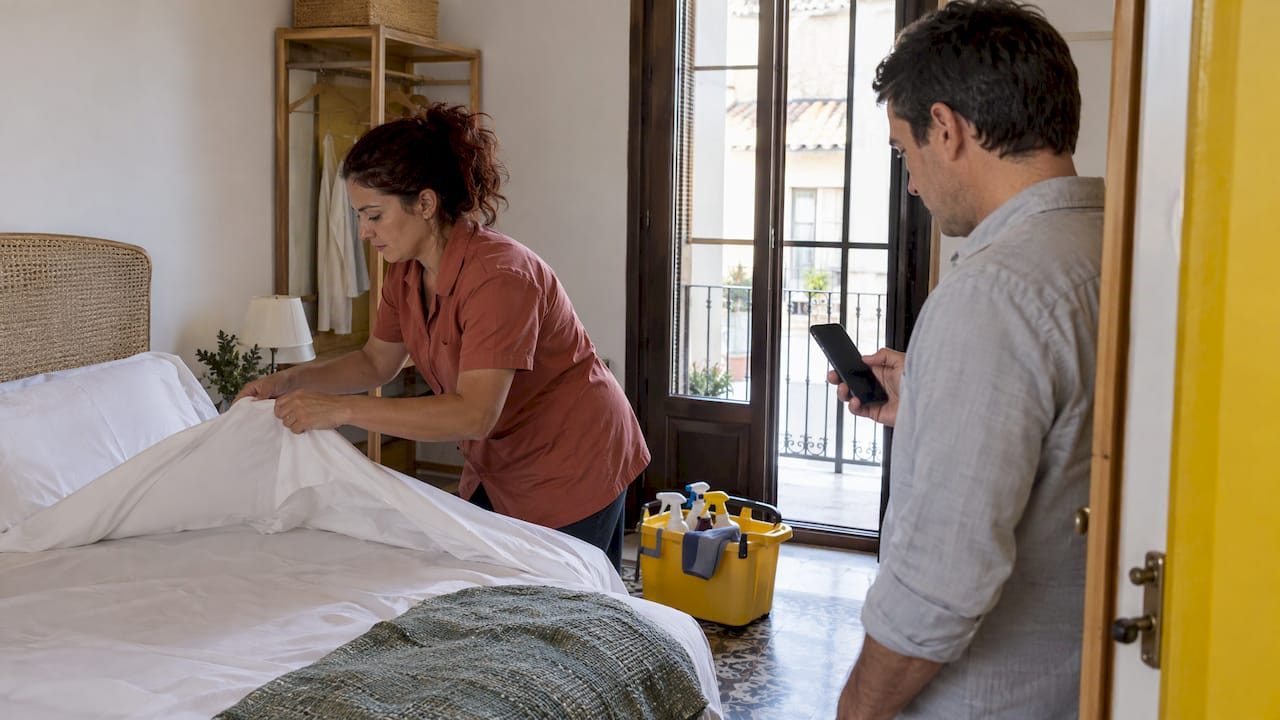


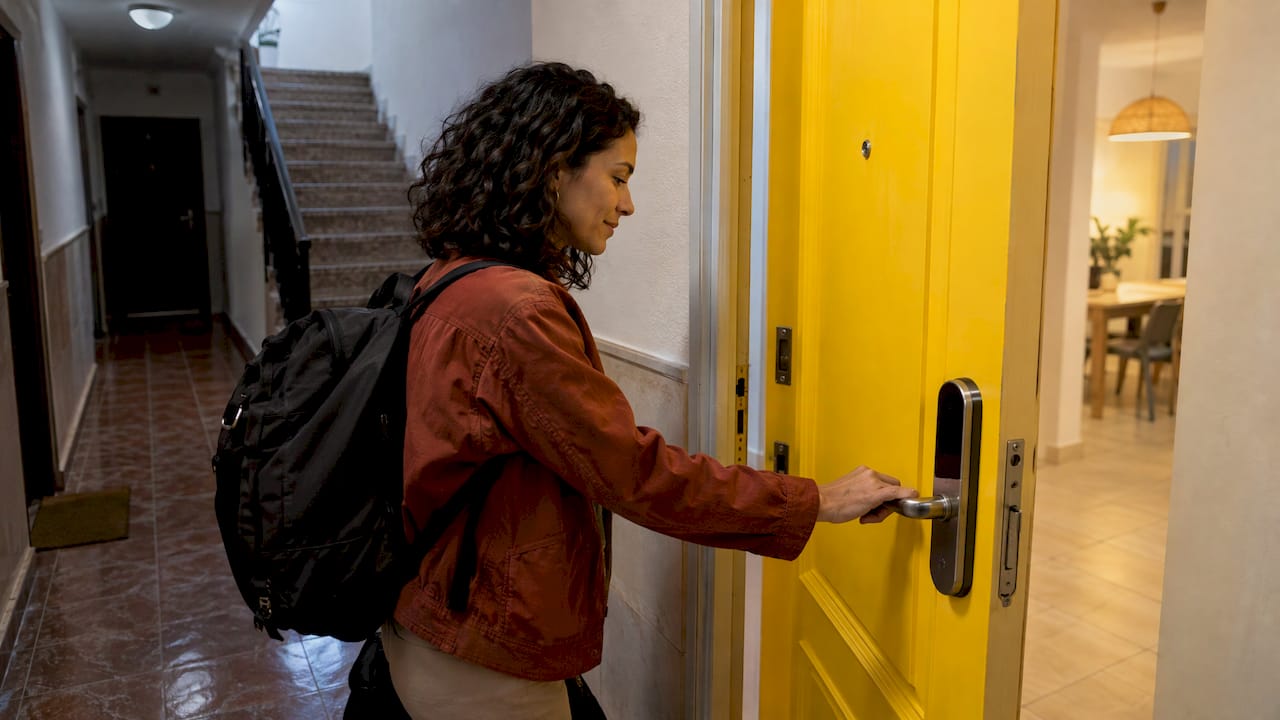
Late check-in automation means the guest completes the legal registration online before arriving, the data goes to the authorities without you typing it, and the guest enters on their own at 23:30 without you waiting at the door. In Spain this works when three things are connected: an online check-in form, automatic reporting to SES Hospedajes, and a smart lock or other self-entry method. We built EuroCheckin to connect those three pieces for owners, managers, hotels and hostels, with online check-in that is unlimited and multilingual.
This guide shows the process step by step, what Spanish rules apply to a late arrival, what to send the guest and when, and what to do when something goes wrong at midnight.
TL;DR
- Spanish consumer guidance says a room can generally be occupied from 14:00 and that guests arriving late, especially after 18:00 in apartments, should tell the property their approximate arrival time.
- Registration cannot wait for the guest to show up: collect identity data online before arrival so the late arrival is only an entry, not an administrative task.
- Traveler data must reach the authorities within 24 hours of the start of service, so a late arrival does not move your deadline.
- Pair online check-in with a smart lock (Nuki, TTLock or Yale) and a clear fallback plan for failed access.
- Test the full flow with a dummy booking before it meets a real guest.
Table of Contents
- What the rules say about arriving after the stated time
- The legal part that does not wait: registration
- How an automated late check-in works, step by step
- What to send the guest, and when
- Late arrival fees and policies
- When access fails: a plan for the night
- Security without losing the guest’s time
- How to test the flow before a real guest does
- Why automating late check-in pays off
- Perspective
- Put it in place with EuroCheckin
- FAQ
- Sources
What the rules say about arriving after the stated time
Spain has no national rule that forbids a guest from arriving late. The practical guidance comes from consumer authorities. The Spanish Ministry of Consumer Affairs, through the European Consumer Centre, recommends contacting the property with an approximate arrival time, especially when arriving later than 18:00 at apartments, and notes that as a general rule the room can be occupied from 14:00. The national tourism portal gives the same general advice about arriving after 14:00 and informing the property of late arrival.
What this means for you:
- Your published check-in window is a service promise, not a legal barrier. You decide how late you accept arrivals and whether you charge for it.
- The guest is advised to warn you. Your process should make that warning easy and automatic: a field in the check-in form asking for the estimated arrival time.
- Your legal duties do not change with the hour. The guest still has to be registered.
The legal part that does not wait: registration
A late arrival is where manual registration hurts most. A guest lands at 22:00, reaches the apartment at midnight, is tired, and nobody is there to scan a passport. Automation solves this by moving the registration earlier.
The basics for Spain:
- Royal Decree 933/2021 updated the documentary registration of travelers, and the new system lives in SES Hospedajes. According to the Ministry of the Interior, since 2 December 2024 hotel companies, intermediary platforms and travel agencies must report their customers’ data to the registry. The same page describes the registry as covering hotels and similar lodging, tourist apartments, campsites and motorhome areas.
- The Galicia Tourism Cluster explains that the communication must be made immediately and in any case within 24 hours of the booking or cancellation, or from the start of the service.
- The data you report includes traveler identity details, contact details, number of travelers, relationship when minors are present, and transaction data such as entry and exit times and payment.
- The same professional source says the traveler register book must be kept for three years from the digital record.
- Penalties are real: reporting media list minor fines from €100 to €600 and serious ones from €601 to €30,000, depending on the infraction.
For a deeper walk through the obligations, see our guides on Real Decreto 933/2021 and SES Hospedajes compliance.
How an automated late check-in works, step by step

The sequence below is the same for a single apartment and for a 40-room hostel. What changes is the volume.
1. The booking arrives and the guest gets the check-in link
The process starts when a reservation comes from Airbnb, Booking, Vrbo or a direct channel. The guest needs a link to the online check-in form, sent as soon as the booking is confirmed, not on the day of arrival. Sending it early gives the guest days to complete it from a laptop, not minutes on a phone in a taxi.
With EuroCheckin, the check-in form is multilingual and we provide smart links for Airbnb, Booking and Vrbo, so guests from different countries complete it in their own language.
Common mistake: sending the link only on arrival day. Late arrivals are exactly the guests most likely to skip or rush it.
2. The form asks for the arrival time and the identity data
A good form does two jobs. It captures the legal data and it captures the operational data you need for a late arrival: approximate arrival time, flight or train number if relevant, and a phone number that works abroad.
Keep the form to what you need. Our guides on which guest data to collect, the right form questions and digital identity capture cover the fields and the ID step in detail.
Common mistake: asking for more than the regulation requires. That adds friction and increases your data protection exposure.
3. Give privacy information in layers and avoid copying documents
The Galicia Tourism Cluster says GDPR information should be given in layers: basic information at check-in, completed by the full privacy policy. It also says the establishment should not make copies of the document when verifying identity. Build the form accordingly: a short notice with the form, a link to the full policy, and no stored photocopies beyond what the process requires. If you need a template for the policy, read what a rental privacy policy should include.
4. The data goes to SES Hospedajes automatically
Once the guest submits the form, the traveler data has to reach the registry. Doing this by hand at 01:00 is where errors and missed deadlines appear. EuroCheckin sends each guest’s data to SES Hospedajes automatically, in line with Royal Decree 933/2021 and GDPR, with no manual work and no duplicate records. The digital traveler register book is also kept for you.
Because the 24-hour window runs from the start of service, an early, pre-arrival submission puts you well inside the deadline even if the guest walks in after midnight.

5. You get an alert and see the guest’s status
Instant notifications let you follow each arrival in real time: form completed, form pending, guest still outstanding. For a late arrival this is the control point. If at 20:00 the form is still empty, you know to send a reminder while the guest is still reachable.
6. The guest receives access instructions
After the form is complete, the guest needs the way in. EuroCheckin integrates with TTLock, Nuki and Yale smart locks for fully autonomous self check-in, and includes a digital guest guide with the house rules, parking, Wi-Fi and directions at night. If you want to see how codes are tied to each booking, read how to automate smart lock codes.
Contracts and house rules can be signed electronically in the same flow, so the guest accepts them before arriving, not at the door.
7. The guest enters and you confirm
The last step is the entry itself. The check-in is complete when the data is registered and the guest is inside. You see this without being there.
What to send the guest, and when
A late arrival goes well when the guest knows exactly what to do. This timeline works for most properties:
| When | Message | Purpose |
|---|---|---|
| Booking confirmed | Check-in link and request for estimated arrival time | Start registration early |
| 3 to 5 days before | Reminder if the form is incomplete | Avoid last-minute data entry |
| 24 hours before | Arrival details, late arrival policy and any fee | Remove surprises |
| Day of arrival | Access instructions and digital guest guide | Make entry self-explanatory |
| 1 hour before arrival | Ask the guest to confirm they are on their way | Spot delays early |
| After arrival | Short welcome and support contact | Reassure and prevent calls later |
Write messages in the guest’s language, keep each to one action, and put the support phone number at the top of the access message, not at the bottom.
Late arrival fees and policies
Some operators charge for late arrivals when someone has to wait up. With self check-in, the cost of a late arrival drops sharply because nobody has to be present. Decide one of three policies and state it in the booking confirmation and the check-in form:
- Free late arrival with self check-in. Simplest, and a selling point for guests with night flights.
- A cut-off hour. Self check-in works until a set time, after which the guest must call.
- A fee for assisted arrivals only. Guests who need a person pay; guests who use the lock do not.
You can also create extra services in EuroCheckin and sell them to guests, who pay in seconds with Apple Pay or Google Pay. A late arrival or a luggage-storage option can be one of those services, added in about two minutes without an IT team. Whatever you choose, tell the guest before arrival, in line with the Consumer Ministry’s advice that arrival time be communicated.
When access fails: a plan for the night
Automation reduces problems but does not remove them. Prepare for the four most common ones.
The guest has not completed the form
Send a reminder with the link and ask them to complete it from their phone. Because the form is online and multilingual, this takes a few minutes. Do not share the lock code until the registration is complete if that is your policy; make that rule clear in advance.
The lock does not respond
Batteries are the usual cause. Check battery levels regularly and replace them before they reach critical levels; our guide to smart lock battery issues explains causes, fixes and prevention. Keep a physical key backup in a secure place and give the guest a number to call.
The guest arrives much later than planned
Ask for a confirmation one hour before arrival. If the delay moves arrival past your cut-off, offer an option: a later code window or an assisted arrival at the stated fee.
The guest cannot follow the instructions
Short, visual instructions in the digital guest guide solve most cases. Include a photo of the door, the lock and the building entrance, and describe the route from the street at night.
Write a one-page escalation sheet for whoever answers the phone: who to call, in what order, and what to authorize. It should cover only operational facts, with no personal data on it.
Security without losing the guest’s time
Self check-in should be easy for guests and hard for strangers. A few principles apply to any property:
- Link access to a completed registration and a specific stay.
- Keep codes valid only for the stay dates.
- Do not send identity documents by email or messaging apps; use the form.
- Host data on infrastructure within the European Union. EuroCheckin stores information on secure infrastructure inside the EU.
For a longer treatment, see our guide to self check-in security for tourist rentals. If you want to understand what happens to guest data after submission, how the Guardia Civil lodging registry works explains the reporting side.
How to test the flow before a real guest does
Run a dry test before you rely on automation for night arrivals:
- Create a test booking with your own name and a check-in time at 23:00.
- Complete the form on a phone, in a different language from your own.
- Confirm that you receive the alert and that the data appears in the register.
- Open the guest guide on mobile data, not your home Wi-Fi.
- Try the lock code from outside, in the dark, with the app closed.
- Let the code expire and confirm it stops working.
- Simulate the failure: wrong code, empty form, dead battery, and check that your escalation sheet works.
Repeat after any change to the lock, the booking channels or the form. It takes under an hour and prevents the call at 01:30.
Why automating late check-in pays off
The cost of manual late check-in is not only your time. It is the risk of a missed report with fines starting at €100, the guest standing outside, the bad review for a poor arrival, and the staff or owner tied to the phone at night. Automation moves all of that earlier in the timeline, to a moment when you and the guest are both awake and reachable.
Calendar synchronization across Airbnb, Booking, Vrbo and more than 12 other platforms also keeps your availability current, which helps avoid overbookings that turn a late arrival into a much worse problem. Our calendar sync audit checklist helps you verify it.
Perspective
Late arrivals are the best test of whether a check-in process really works. In the daytime, a manual process hides its weaknesses: someone is there, someone can scan a passport, someone can fix a lock. At midnight, only the system is there.
That is why we treat registration, communication and access as one flow. The guest completes the form in their own language days before travel. The data reaches SES Hospedajes without anyone retyping it. The smart lock, whether Nuki, TTLock or Yale, opens for the right person on the right dates. And you see it all in real time, from wherever you are.
Our advice to hosts is to start with the registration, because that is where the legal risk sits, then add the lock and the guest guide. Once those are in place, a 23:30 arrival is no longer an event. It is simply another check-in.
Sofía Herrera
Put it in place with EuroCheckin
If you manage one or many properties, EuroCheckin covers online check-in, automatic reporting to SES Hospedajes, smart lock integration and the digital guest guide in one platform. The plan for accommodations costs €5 per month per accommodation, hotels pay €3 per month per room, and there is a free trial. You can start on the EuroCheckin page for accommodations or see the hotel plan.
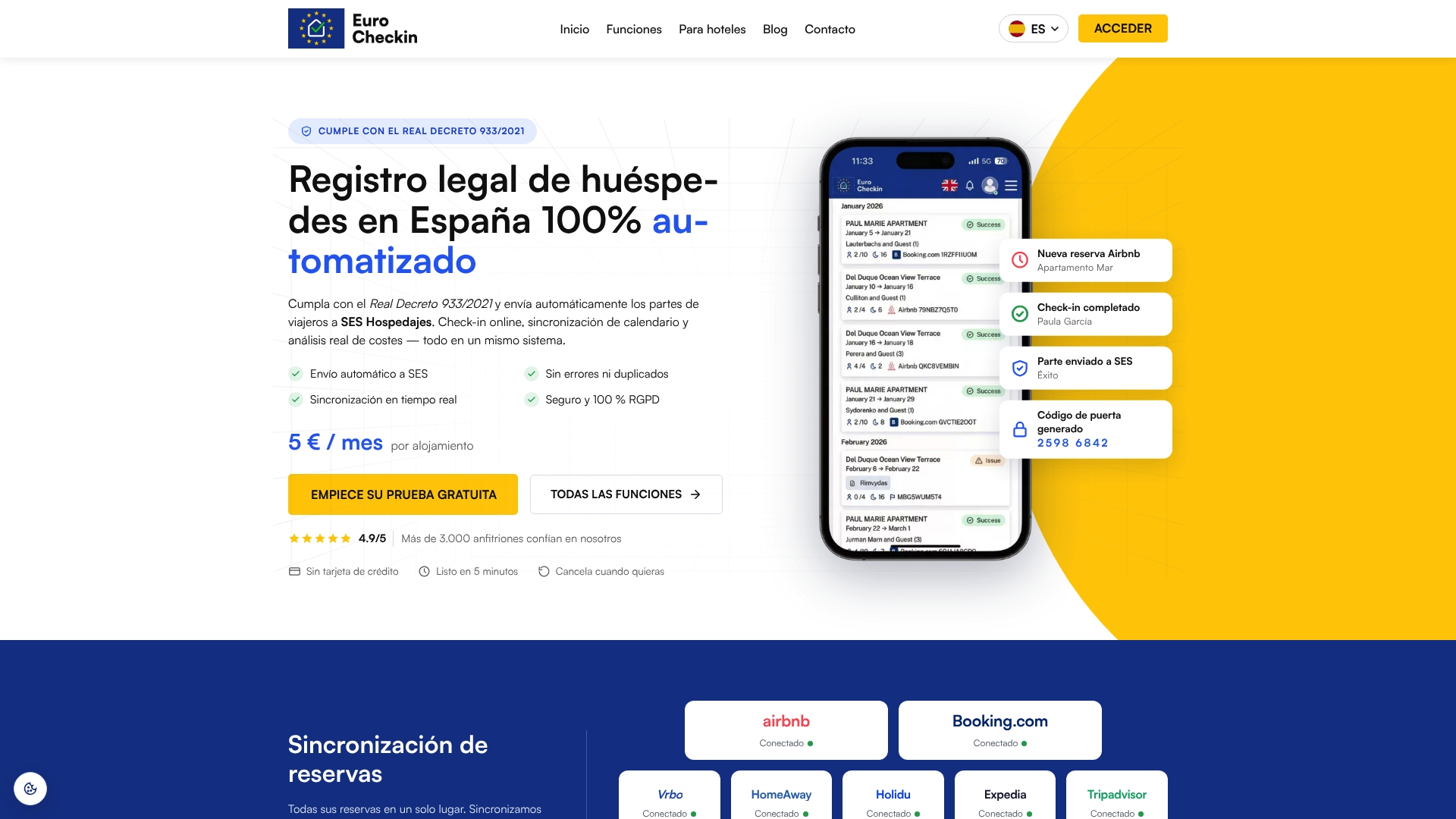
If you have not yet registered your property in SES Hospedajes, we also offer a registration service from €79 one-off per accommodation.
FAQ
Can a guest check in after the stated check-in time in Spain?
Yes. Spanish consumer guidance says the room can generally be occupied from 14:00 and recommends that guests tell the property their approximate arrival time, especially after 18:00 for apartments. The property sets its own latest arrival hour and any fee, so state it clearly in the booking confirmation.
Does the registration deadline change if the guest arrives at night?
No. The communication to the authorities must be made immediately and within 24 hours of the start of service. Collecting the data online before arrival, and sending it automatically, keeps you inside the deadline whatever time the guest enters.
What is automatic online check-in?
It is a process in which the guest completes a digital form with identity and stay data before arriving. With EuroCheckin, that data is sent automatically to SES Hospedajes, and the guest receives access instructions and the digital guest guide without you being present.
What if the guest cannot get in?
Check whether the form was completed, then whether the lock has power, and give the guest a clear number to call. Keep a backup key and a short escalation sheet so whoever answers the phone knows the next step.
Sources
- Recommendations after booking, European Consumer Centre Spain
- Tips for booking accommodation in Spain, Spain.info
- Interior activates the new lodging registry, Ministry of the Interior
- Traveler registry FAQ, Clúster Turismo de Galicia
- Hotels must provide up to 42 data points, Cadena SER